Gan-Ochir Doojav: New Keynesian benchmark puts a policy rate consistent with Mongolia’s inflation expectations at about 15–16%
Former Bank of Mongolia chief economist Gan-Ochir Doojav links the Nobel-winning work of Robert Hall and Michael Woodford to Mongolia’s monetary policy, citing his own estimate of a 2–3% natural real interest rate.
This story was prepared automatically by software.
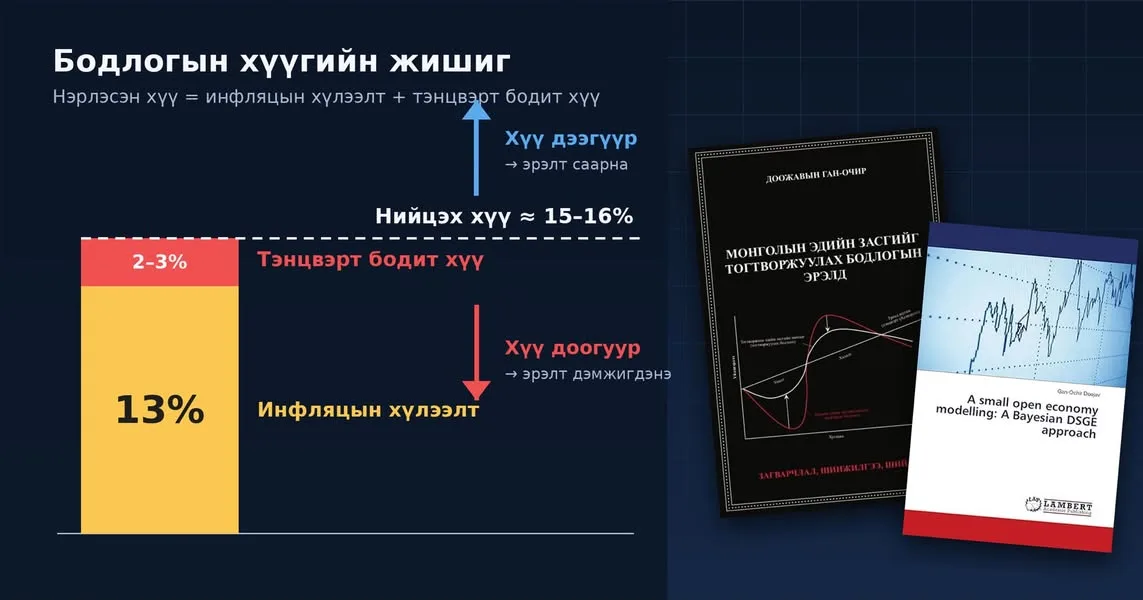
Dr Gan-Ochir Doojav, an economist who has served as the Bank of Mongolia’s chief economist and head of its Research and Statistics Department, published a long Facebook post on October 18 about the 2026 Nobel memorial prize in economics. In the essay, titled “Keeping the economy stable: New Keynesian theory and the central bank’s challenge”, he explains the laureates’ work and, drawing on his own research, sets out a “benchmark” for Mongolia’s policy rate.
Source: Gan-Ochir Doojav’s Facebook post https://www.facebook.com/ganochir.doojav.7/posts/pfbid02nbHWq6NXffBviwBMwzWFwoBW6MUnSPqydMSeSsJcAnCcHEW3sY7mPaHacHqNVgd3l
What the prize was awarded for
On October 12 the Royal Swedish Academy of Sciences awarded the 2026 Sveriges Riksbank Prize in Economic Sciences jointly to Robert E. Hall of Stanford University and Michael Woodford of Columbia University “for microeconomic foundations of macroeconomic stabilisation” (NobelPrize.org). The committee noted that the New Keynesian models that grew out of their work are now used by central banks and finance ministries around the world. The prize of 12 million Swedish kronor is shared equally.
Mr Gan-Ochir opens with The Economist’s article “A Nobel prize for how to keep economies on even keel” (The Economist, October 12) and poses the central question: should a central bank steer the money supply, influence aggregate demand, or shape household and business decisions through the policy rate? These are not merely theoretical questions, he writes, but policy choices with direct consequences for inflation, growth, employment and financial stability.
Understanding the macroeconomy through household and business decisions
As the author explains, the hallmark of New Keynesian theory is its “microfoundations”: it explains macroeconomic outcomes such as inflation and growth through the decisions, expectations and behaviour of households and firms. This approach underpins dynamic stochastic general equilibrium (DSGE) models, which treat prices and wages as sticky and so capture the effects of monetary policy. Many central banks now use such models for forecasting and for weighing policy options.
The field is closely tied to his own work. He earned a PhD at the Australian National University with a thesis titled “A Small Open Economy Modelling: A Bayesian DSGE Approach”, based on Australian data, and later a Doctor of Science degree from the Mongolian Academy of Sciences for research on stabilisation policy and modelling for Mongolia’s economy. He writes that he is glad to see the prize go to scholars who made major contributions to microfounded macroeconomics.
Consumption depends on expectations
Summarising one of Mr Hall’s key ideas, the author notes that people’s spending depends not only on today’s income but on what they expect to earn in the future. A temporary rise in income need not lift consumption by the same amount, while a growing risk of lower future income can lead households to cut spending and save more. Shifts in household expectations therefore move total consumption and aggregate demand.
The natural rate and a benchmark for Mongolia
Mr Woodford developed the ideas of the Swedish economist Knut Wicksell within modern macroeconomics. A central insight is that a central bank should judge its policy stance against the natural rate of interest. In the author’s explanation, the natural rate depends on productivity, saving and returns on investment, changes over time and cannot be observed directly, so it must be estimated with models. When the real policy rate sits below it, credit, spending and demand are stimulated and inflation pressure builds; when it sits above it, demand is restrained. What matters, he argues, is not the nominal rate alone but the real rate, adjusted for inflation expectations, compared with the natural rate.
The most striking part of the post applies this to Mongolia. “My research estimated Mongolia’s natural real interest rate at around 2–3%. If inflation expectations are around 13% and the natural real rate stays at 2–3%, the consistent nominal policy rate would be about 15–16%,” he writes. In his view, this is a benchmark for assessing the monetary policy stance: as long as those conditions hold, a policy rate below that level indicates relatively loose policy that supports demand. He sets out this research in more detail in his book on the search for stabilisation policy for Mongolia’s economy.
From theory to real-world policy
Central banking, the author stresses, is not simply a matter of setting rates according to a model. Supply shocks such as pandemics, wars and swings in energy and commodity prices can raise inflation while slowing output and employment. Tightening too hard risks deepening a downturn; easing too much risks entrenching inflation. In a mining-dependent economy like Mongolia’s, where external prices, export earnings, foreign-currency flows, budget spending and credit growth interact, “taking account of the coordination between fiscal and monetary policy is especially important,” he writes. If fiscal spending is boosting demand while monetary policy must restrain it, the conflict raises the cost of bringing inflation down.
“The value of theory lies not in making policy decisions automatically, but in understanding the consequences of choices and making well-grounded decisions,” he concludes. Effective policy, he argues, depends on weighing theory, quantitative analysis, real-world conditions, fiscal-monetary coordination and political economy together.
The current picture
The Bank of Mongolia’s Monetary Policy Committee met on September 16–17 and kept the policy rate at 12.5% (Bank of Mongolia). At the time, annual inflation stood at 12.5% nationwide in August, with core inflation at 6.8%. Governor S. Narantsogt said inflation pressure had not eased enough to justify a cut, but that further tightening would put heavy strain on economic activity and household consumption, noting that real household consumption contracted by 4.9% in the second quarter (Bank of Mongolia, in Mongolian). The committee also warned that this year’s budget amendment and an expansionary 2027 budget could significantly disrupt the inflation outlook.
According to the National Statistics Office, annual inflation rose to 12.9% in September, above the policy rate (Bloomberg TV Mongolia, October 8, in Mongolian). The central bank projects inflation will ease gradually from the second quarter of 2027 and approach the upper end of its target range by the end of next year, while the Mongolian Bankers Association has warned that budget expansion and higher fuel prices could push inflation as high as 18%.
Editor’s note
- Why it matters. Linking Nobel-winning theory to concrete estimates for Mongolia, in accessible language, is a rare and useful contribution from a specialist who has published widely in this field.
- How to read the numbers. The 2–3% natural rate and the 15–16% “consistent” policy rate are the author’s research estimates, not the Bank of Mongolia’s official position. As he notes himself, the natural rate cannot be observed directly, and inflation expectations can be measured in different ways, so such estimates are uncertain.
- Against today’s rate. Set against the current 12.5% policy rate, his benchmark would suggest policy is on the loose side by his definition. But the central bank has explained that it held rates with weak household consumption and subdued non-mining activity in mind, so this is a debate about policy choices rather than proof of an error.
- The common thread. Both the author and the Monetary Policy Committee identify fiscal expansion as a key inflation risk. Fiscal-monetary coordination deserves close public attention as the 2027 budget is debated.
Sources: Gan-Ochir Doojav’s Facebook post (October 18, 2026); NobelPrize.org; The Economist; Bank of Mongolia; Bloomberg TV Mongolia; author profiles at the Bank of Mongolia and Think Mongol.
Related articles