Ranked: The World’s 30 Busiest Shipping Ports
Global trade relies on massive, modern ports for the import and export of goods. Asia is home to the biggest and busiest.
This story was prepared automatically by software.
Where Are the World’s Busiest Shipping Ports?
Key Takeaways
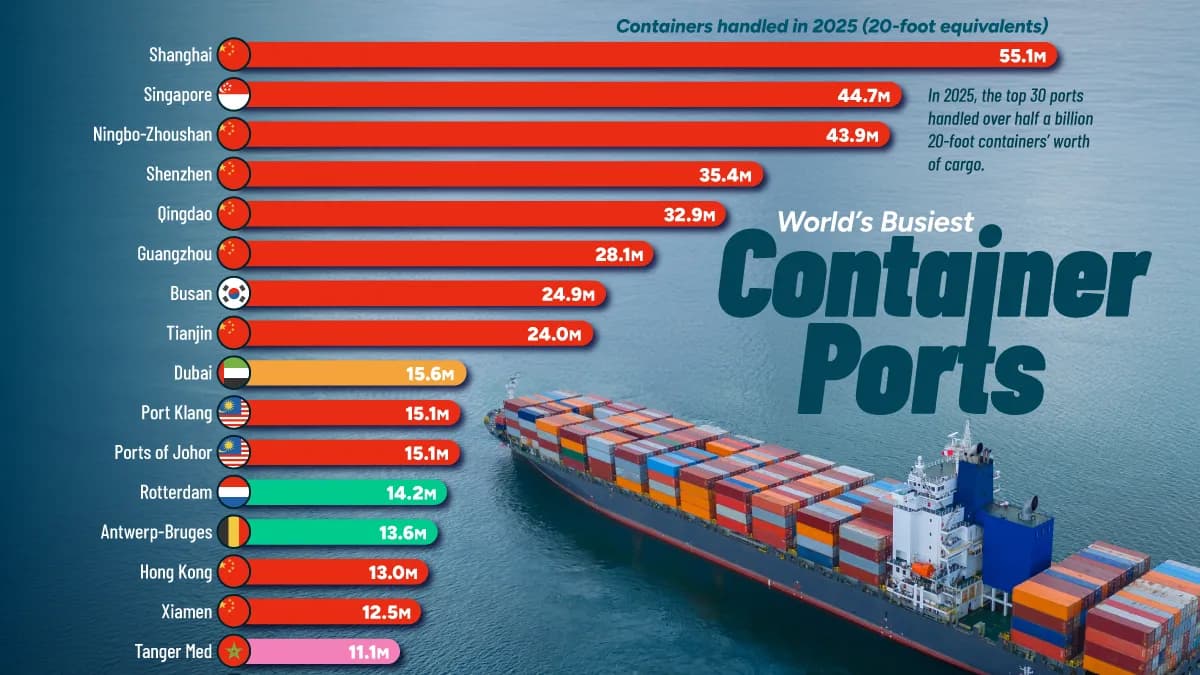
Shanghai is the world’s busiest container port, handling 55.1 million TEUs in 2025.
Six of the world’s eight busiest container ports are in China.
Los Angeles, the busiest U.S. container port, ranks 18th globally.
Asia sits at the center of global container shipping, with major ports connecting the region’s manufacturing hubs to markets around the world. The scale of traffic through these terminals offers a window into the geography of global trade.
This graphic ranks the world’s 30 busiest container ports using Lloyd’s List’s 2026 ranking, based on traffic handled in 2025.
Volumes are measured in twenty-foot equivalent units (TEUs), a standard shipping measure. A 20-foot container counts as one TEU, while a 40-foot container counts as two. Totals include both loaded and empty containers.
China Dominates the Container Trade
Shanghai retained its position as the world’s busiest container port for the 16th consecutive year in 2025. It handled over 10 million more TEUs than second-place Singapore and more than five times the volume of Los Angeles, America’s busiest container port.
Chinese ports, including Hong Kong (13 million TEUs), accounted for approximately half the combined traffic at the 30 ports shown. More broadly, all eight of the world’s busiest container ports are in East or Southeast Asia.
The table below shows the world’s 30 busiest container ports by throughput in 2025.
RankPort2025 throughput (TEUs)
1 Shanghai55,062,500
2 Singapore44,660,000
3 Ningbo-Zhoushan43,872,000
4 Shenzhen35,408,400
5 Qingdao32,893,000
6 Guangzhou28,050,900
7 Busan24,881,000
8 Tianjin24,032,900
9 Dubai15,552,000
10 Port Klang15,138,772
11 Port of Johor15,110,050
12 Rotterdam14,245,000
13 Antwerp-Bruges13,630,000
14 Hong Kong12,995,000
15 Xiamen12,507,700
16 Tanger Med11,106,164
17 Laem Chabang10,542,417
18 Los Angeles10,239,318
19 Suzhou10,215,000
20 Beibu Gulf10,063,000
21 Long Beach9,881,595
22 Ho Chi Minh City8,922,818
23 New York/New Jersey8,897,500
24 Kaohsiung8,885,854
25 Mundra8,377,663
26 Hai Phong8,323,043
27 Hamburg8,323,017
28 Tanjung Priok8,300,000
29 Colombo8,291,178
30 Jawaharlal Nehru7,944,257
Shanghai draws cargo from far beyond its city limits. Inland waterways and railways connect the port with industrial clusters along the Yangtze River, helping manufacturers across central and eastern China reach overseas markets.
Manufacturing is spreading across more Asian economies, while trade links between China and Southeast Asia continue to deepen. These connections help keep Chinese ports central to regional supply chains as companies diversify their production locations.
Singapore Connects the World’s Shipping Routes
Unlike China’s major ports, which serve vast domestic manufacturing regions, Singapore’s shipping industry is built largely around connecting international trade routes. Linked to more than 600 ports worldwide, it functions like a connecting airport for cargo, transferring containers between ships before they continue to their destinations. This process, known as transshipment, helps explain how a small city-state became the world’s second-busiest container port.
Deep-water berths and automated electric yard cranes help its newest terminals accommodate the world’s largest container vessels. These facilities allow shipping lines to transfer large volumes of cargo through a single stop on their routes.
Singapore is expanding that capacity through Tuas Port, which will consolidate its container operations in one location. When completed in the 2040s, the development is planned to handle 65 million TEUs annually, strengthening the city-state’s position in global shipping networks.
Southern California: America’s Pacific Gateway
Despite being America’s busiest container port, Los Angeles ranks behind major shipping hubs in Asia, Europe, and Africa. Together with neighboring Long Beach, it forms the San Pedro Bay port complex, which handled approximately a third of America’s containerized international seaborne trade in 2025.
Furniture, auto parts, and electronics were among Los Angeles’ leading imports. The port’s busiest trade routes connected it with East and Southeast Asia, illustrating how Asian manufacturing reaches American homes, stores, and businesses.
That reach extends well beyond California. The 20-mile Alameda Corridor connects both ports to the transcontinental rail network, providing an onward route for containers headed inland. Goods unloaded on the Pacific coast can continue their journey toward customers thousands of miles away.
Learn More on the Voronoi App
To explore the companies operating the ships that call at these ports, check out The World’s Largest Container Shipping Companies on Voronoi.
Related articles