7 medical robots changing modern healthcare from surgery to hospital logistics
Robotic systems have moved well beyond rigid industrial cages and into operating rooms, bronchoscopy suites,...
Robotic systems have moved well beyond rigid industrial cages and into operating rooms, bronchoscopy suites, and hospital corridors. Enabled by force-sensing actuators, fiber-optic shape sensors, structured-light computer vision, and edge AI compute, modern clinical machines assist surgeons with sub-millimeter precision while relieving overburdened nurses of routine logistics. Below are seven medical robots actively reshaping hospital care.
1. Intuitive da Vinci 5
Intuitive Surgical’s da Vinci 5 brings tactile sensation back to minimally invasive robotic surgery. Previous multiport teleoperated systems forced surgeons to rely almost entirely on visual cues to judge tissue tension, increasing the risk of crushing delicate structures.
Built with miniature force-sensing tips and actuators, the da Vinci 5 measures push and pull forces at the instrument tip in real time and transmits that resistance back to the surgeon’s hand controls.
In January 2026, the U.S. Food and Drug Administration (FDA) cleared the platform for complex cardiac procedures, including mitral valve repair and internal mammary artery mobilization, following earlier software clearances for live in-console force gauges and procedural video replay.
2. Johnson & Johnson OTTAVA
Space constraints have long kept large multi-arm surgical robots out of smaller community operating rooms. Johnson & Johnson’s OTTAVA tackles that footprint bottleneck by integrating four robotic arms directly beneath a standard surgical table rather than mounting them on bulky external carts. When not needed, the arms stow cleanly under the table, allowing surgical teams to switch smoothly between open, laparoscopic, and robotic workflows without re-docking heavy equipment.
After receiving FDA De Novo authorization in July 2026 for upper abdominal general surgery, including gastric bypass, gastrectomy, and hiatal hernia repair, J&J began a controlled U.S. clinical rollout across operating rooms as compact as 243 square feet.
3. Medtronic Hugo RAS
Medtronic’s Hugo Robotic-Assisted Surgery (RAS) system takes a modular approach to minimally invasive procedures. Instead of a single monolithic patient cart, Hugo mounts its wristed instruments on independent wheeled arm carts that can be rolled in or out depending on patient anatomy, paired with an open-console 3D high-definition display that keeps the lead surgeon visually connected to the bedside team.
Following U.S. clearance for urologic procedures such as prostatectomy and nephrectomy in December 2025, Medtronic secured expanded FDA 510(k) clearance in November 2026 for general surgery procedures, broadening multi-specialty hospital utilization of shared robotic hardware.
4. Intuitive Ion Endoluminal System
Reaching suspicious nodules deep inside the peripheral lung without puncturing the chest wall requires extreme flexibility and real-time positional awareness. Intuitive’s Ion Endoluminal System uses an ultra-thin, 3.5-millimeter articulating catheter embedded with an optical fiber that measures mechanical strain along its entire length hundreds of times per second.
That fiber-optic shape-sensing architecture lets physicians steer biopsy tools through tight, branching airways without relying solely on external electromagnetic tracking.
With more than 900 systems deployed globally and FDA-cleared AI navigation updates that integrate real-time cone-beam CT and tomosynthesis imaging, Ion corrects for lung motion during breathing to accurately sample early-stage nodules.
5. CMR Surgical Versius Plus
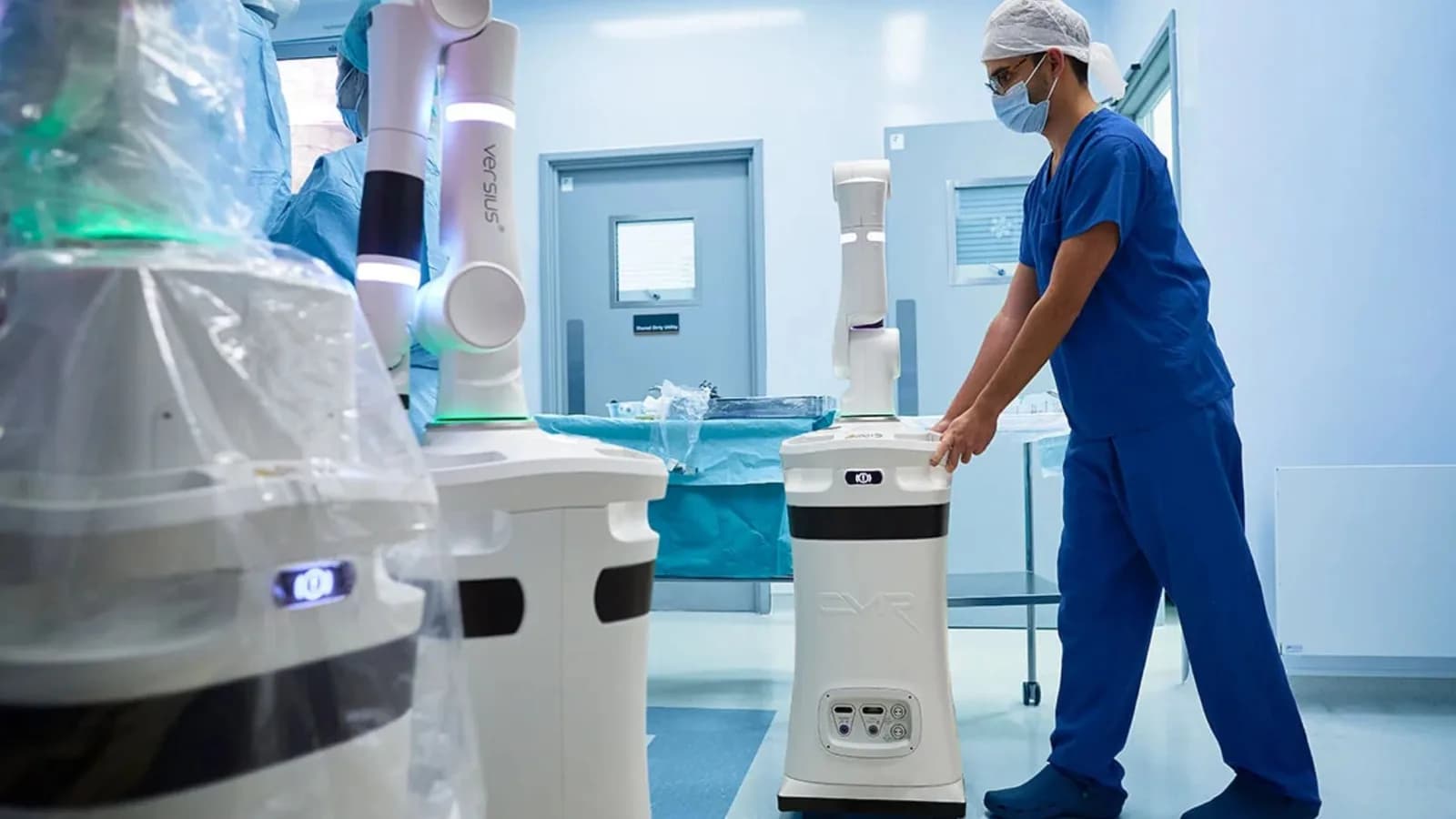
Designed to make keyhole robotics portable across hospital departments, CMR Surgical’s Versius Plus pairs compact, biomimetic bedside arms—modeled on the joints of a human arm with an open surgeon console and stereoscopic near-infrared fluorescence imaging.
The dual-spectrum camera overlays real-time blood perfusion and anatomical landmarks onto visible-light 3D video during tissue dissection. Having treated more than 45,000 patients worldwide, the second-generation platform won FDA 510(k) clearance for cholecystectomy in December 2025 and expanded its U.S. label in October 2026 to cover benign gynecological procedures, giving outpatient surgical centers a lightweight alternative to fixed-room systems.
6. Zeta TMS Robotic System
Non-invasive brain stimulation for treatment-resistant depression depends on aiming magnetic pulses at exact cortical targets, yet traditional setups require rigid head clamps or manual coil adjustments whenever a patient shifts. Developed by Boston-based Zeta Surgical, the Zeta TMS Robotic System pairs a structured-light 3D infrared camera with an active electromechanical positioning arm.
Its computer-vision software tracks native facial contours in real time to adjust the magnetic coil dynamically with sub-millimeter precision, eliminating the need for head frames. Cleared by the FDA in July 2026 and deployed in clinical settings alongside a DARPA-backed single-day neuromodulation study, the platform automates repeatable brain targeting.
7. Diligent Robotics Moxi 2.0
Not every hospital robot holds a scalpel. Nurses spend up to 30 percent of their shifts walking corridors to fetch lab samples, medications, and personal protective equipment. Created by Diligent Robotics, which joined Serve Robotics in 2026, Moxi is an autonomous mobile manipulator equipped with LiDAR navigation, a compliant robotic arm, and a digital face designed for crowded clinical hallways.
Rolling out in August 2026 with upgraded NVIDIA Thor edge-AI compute and a robotic world model, Moxi 2.0 autonomously calls elevators, opens badge-locked doors, and delivers pharmacy and laboratory supplies around the clock.
As tactile feedback, real-time imaging fusion, and physical AI mature, these systems are expanding minimally invasive care into smaller operating rooms while returning valuable hours to bedside staff.
Get the latest news delivered to your inbox.
Related articles