All of the World’s Farmland in One Chart
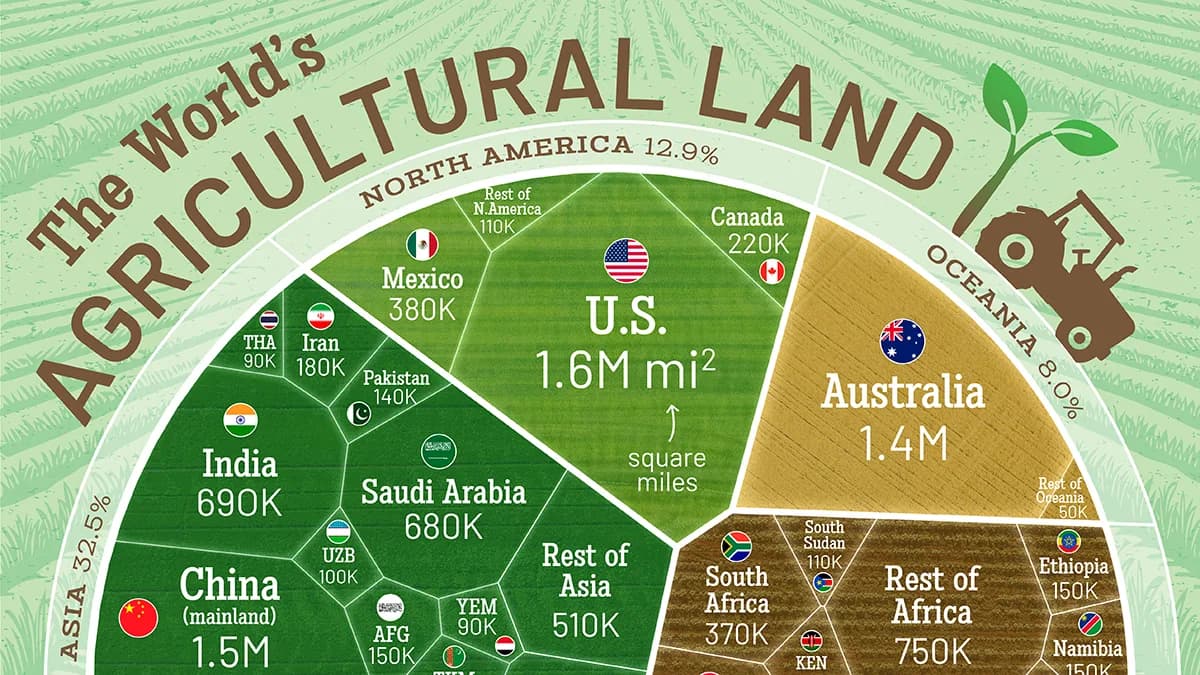
The U.S., China, and Australia hold a quarter of global agricultural land, including vast areas used for livestock grazing.
Which Countries Have the Most Farmland?
Key Takeaways
The U.S., China, and Australia together account for roughly a quarter of the world’s agricultural land.
Saudi Arabia has nearly as much agricultural land as India, despite having just a fraction of its cropland.
The world has more than 18 million square miles (46 million km²) of agricultural land, spanning everything from fertile crop belts to vast, arid rangelands.
This graphic visualizes the world’s agricultural land by country using 2024 data from the Food and Agriculture Organization of the United Nations (FAO).
The figures include both cropland and permanent meadows and pastures used for hay or grazing. The 50 countries with the largest agricultural footprints are shown individually, while the remaining countries are grouped by region.
Three Countries Hold a Quarter of the World’s Agricultural Land
The United States leads the world with 1.63 million square miles of agricultural land, followed by mainland China (1.51 million) and Australia (1.40 million).
Brazil is a distant fourth, with less than 1 million square miles.
The table below ranks the 50 countries with the most agricultural land in 2024, measured in millions of square miles and as a share of the global total. The remaining countries are grouped by region:
RankCountry / RegionAgricultural Land
Area
(Million sq. mi)Global Share (%)
1 U.S.1.639.0
2 China1.518.4
3 Australia1.407.8
4 Brazil0.925.1
5 Russia0.834.6
6 Kazakhstan0.834.6
7 India0.693.8
8 Saudi Arabia0.683.7
9 Argentina0.482.7
10 Sudan0.442.4
11 Mongolia0.412.3
12 Mexico0.382.1
13 South Africa0.372.1
14 Nigeria0.271.5
15 Canada0.221.2
16 Indonesia0.211.2
17 Chad0.191.1
18 Iran0.181.0
19 Niger0.181.0
20 Angola0.171.0
21 Somalia0.170.9
22 Mozambique0.170.9
23 Mali0.160.9
24 Algeria0.160.9
25 Ukraine0.160.9
26 Madagascar0.160.9
27 Colombia0.160.9
28 Tanzania0.150.9
29 Mauritania0.150.8
30 Turkmenistan0.150.8
31 Bolivia0.150.8
32 Namibia0.150.8
33 Türkiye0.150.8
34 Ethiopia0.150.8
35 Afghanistan0.150.8
36 DR Congo0.140.8
37 Pakistan0.140.8
38 Morocco0.120.6
39 Kenya0.110.6
40 France0.110.6
41 South Sudan0.110.6
42 Côte d'Ivoire0.100.6
43 Botswana0.100.6
44 Uzbekistan0.100.6
45 Spain0.100.5
46 Peru0.090.5
47 Zambia0.090.5
48 Yemen0.090.5
49 Thailand0.090.5
50 Venezuela0.080.5
--Rest of Africa0.754.1
--Rest of North America0.110.6
--Rest of South America0.211.2
--Rest of Asia0.512.8
--Rest of Europe0.563.1
--Rest of Oceania0.050.3
-- World total18.11100.0
Includes cropland and permanent meadows and pastures. Figures rounded.
Even among the largest agricultural nations, grazing land drives much of the total. Permanent meadows and pastures account for roughly 63% of U.S. agricultural land and two-thirds of mainland China’s, reflecting vast western rangelands and interior steppes alongside their major crop belts.
Why Saudi Arabia Has Almost as Much Farmland as India
India and Saudi Arabia rank seventh and eighth, respectively, in total agricultural land, but they use that land very differently.
Roughly 94% of India’s agricultural land is cropland, compared with less than 3% in Saudi Arabia, where permanent meadows and pastures dominate.
In fact, India has more cropland than either the United States or mainland China, despite ranking well behind both in total agricultural land.
Asia and Africa Hold Nearly 60% of the World’s Farmland
Asia accounts for 32.5% of global agricultural land, followed by Africa at 25.3%. North America (12.9%) and South America (11.6%) come next, followed by Europe (9.7%) and Oceania (8.0%).
Asia’s agricultural footprint is particularly large relative to its size. The region contains about 24% of the world’s land area, but nearly half of its own land is used for agriculture, the highest proportion of any region.
The table below compares each region’s share of global land and agricultural land in 2024, alongside the proportion of its own land used for crops or grazing:
RegionShare of
Global Land Area (%)Share of
Global Agricultural Land (%)Share of
Land Used for Agriculture (%)
Asia23.932.549.0
Africa23.025.339.6
North America16.212.928.8
South America13.411.631.0
Europe17.09.720.6
Oceania6.58.044.2
Europe, including Russia, accounts for roughly 17% of global land area but less than 10% of agricultural land.
In Oceania, around 44% of the region’s land is agricultural, more than double Europe’s 21%. Australia’s vast grazing areas help explain how a largely arid continent can have such a substantial agricultural footprint.
Learn More on the Voronoi App
If you enjoyed today’s post, check out the World’s Largest Agricultural Economies on Voronoi.
Source: https://www.visualcapitalist.com/all-of-the-worlds-farmland-by-country-in-one-chart/
Get the latest news delivered to your inbox.
Related articles