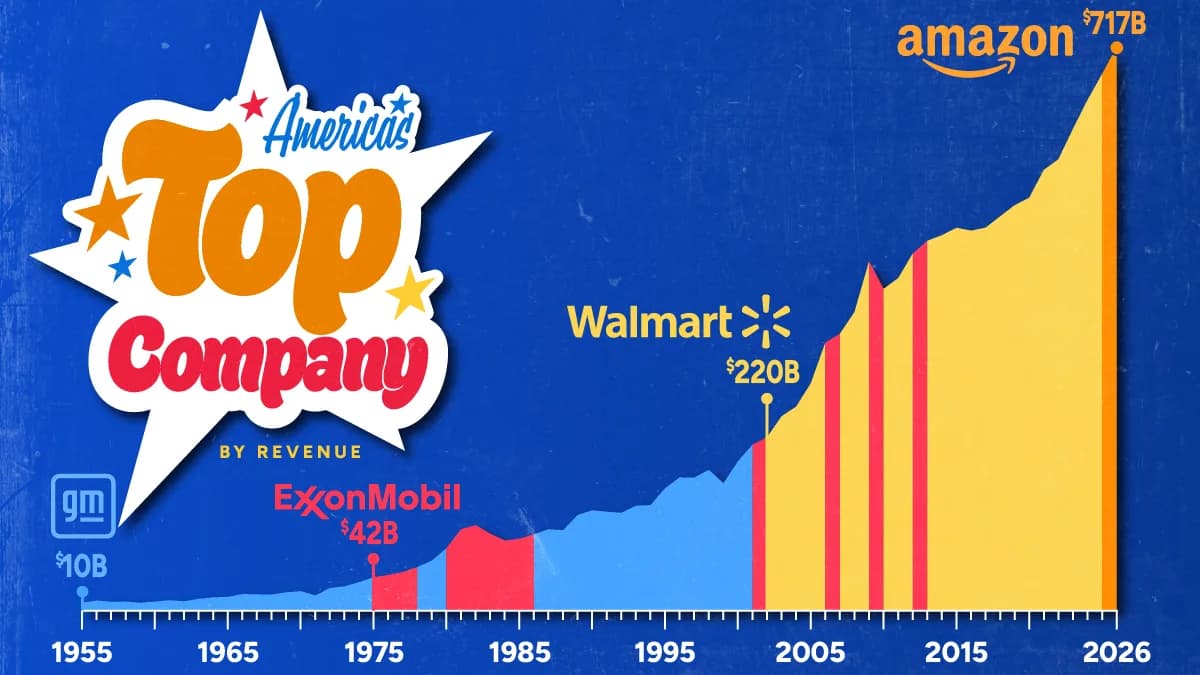
America’s Largest Company by Revenue, Every Year Since 1955
In 2026, Amazon has displaced Walmart from its decade-long position as the world's top company by revenue.
How America’s Largest Company Has Changed Over 70 Years
Key Takeaways
Amazon’s $716.9 billion in annual revenue ended Walmart’s 13-year reign at the top of the Fortune 500 in 2026.
Only four companies have topped the ranking since 1955: General Motors, ExxonMobil, Walmart, and Amazon.
Amazon overtook Walmart by just $3.7 billion in revenue, with less than 1% separating the two retail giants.
From Detroit’s assembly lines to the rise of online shopping and cloud computing, America’s largest companies tell the story of how the U.S. economy has evolved over seven decades.
This visualization tracks America’s largest company by annual revenue each year from 1955 to 2026, drawing on annual and historical rankings from Fortune and LLC Attorney.
The years refer to ranking editions, generally reflecting the preceding fiscal year, and revenues are in nominal dollars. Before 1995, eligibility was limited to industrial companies.
The Golden Age of Automaking and Oil
General Motors led the inaugural Fortune 500 in 1955 with $9.8 billion in revenue and held first place for 20 consecutive editions. The automaker has topped more than half of all Fortune 500 rankings, finishing first 37 times through 2026.
Headquartered in Detroit, GM was the world’s largest automaker for 77 years before losing the title to Japanese competitor Toyota in 2008. The company is best known for its Buick, Cadillac, Chevrolet, and GMC brands.
The table below lists the top U.S. company by annual revenue for every ranking edition from 1955 to 2026.
Fortune 500 YearCompanyRevenue (USD billions)
1955General Motors9.8
1956General Motors12.4
1957General Motors10.8
1958General Motors11.0
1959General Motors9.5
1960General Motors11.2
1961General Motors12.7
1962General Motors11.4
1963General Motors14.6
1964General Motors16.5
1965General Motors17.0
1966General Motors20.7
1967General Motors20.2
1968General Motors20.0
1969General Motors22.8
1970General Motors24.3
1971General Motors18.8
1972General Motors28.3
1973General Motors30.4
1974General Motors35.8
1975Exxon42.1
1976Exxon44.9
1977Exxon48.6
1978General Motors55.0
1979General Motors63.2
1980Exxon79.1
1981Exxon103.1
1982Exxon108.1
1983Exxon97.2
1984Exxon88.6
1985Exxon90.9
1986General Motors96.4
1987General Motors102.8
1988General Motors101.8
1989General Motors121.1
1990General Motors127.0
1991General Motors125.1
1992General Motors123.8
1993General Motors132.8
1994General Motors133.6
1995General Motors155.0
1996General Motors168.8
1997General Motors168.4
1998General Motors178.2
1999General Motors161.3
2000General Motors189.1
2001Exxon Mobil210.4
2002Walmart219.8
2003Walmart246.5
2004Walmart258.7
2005Walmart288.2
2006Exxon Mobil339.9
2007Walmart351.1
2008Walmart378.8
2009Exxon Mobil442.9
2010Walmart408.2
2011Walmart421.8
2012Exxon Mobil452.9
2013Walmart469.2
2014Walmart476.3
2015Walmart485.7
2016Walmart482.1
2017Walmart485.9
2018Walmart500.3
2019Walmart514.4
2020Walmart524.0
2021Walmart559.2
2022Walmart572.8
2023Walmart611.3
2024Walmart648.1
2025Walmart681.0
2026Amazon716.9
Exxon’s breakthrough followed the 1973–74 oil shock, when crude oil prices nearly quadrupled. That surge helps explain how an oil producer overtook an auto giant: higher commodity prices could lift revenue even without a comparable increase in sales volumes.
The transition was far from permanent. GM reclaimed first place in 1978 and again in 1986, beginning a final 15-year stretch at the top. Exxon, which became ExxonMobil following a merger in 1999, periodically returned to No. 1, interrupting the dominance of automaking and retail.
Walmart’s Rise to the Top
Walmart first reached No. 1 in 2002, with nearly $220 billion in annual revenue. The Arkansas-based retailer’s rise followed decades of expansion, including the introduction of supercenters in 1988, which combined groceries and general merchandise under one roof.
That format allowed customers to purchase everyday necessities alongside clothing, electronics, and household goods. After trading the top spot with ExxonMobil, Walmart secured an uninterrupted run at No. 1 from 2013 through 2025.
Walmart lost its crown despite growing annual revenue by nearly 5% to $713.2 billion in the fiscal year ending in January 2026. The retailer remains the world’s second-largest company by annual revenue.
Amazon and the Rise of the Digital Economy
Amazon’s annual revenue grew roughly 12% in 2025, propelling it to the top of the Fortune 500 for the first time. The company that began as an online bookstore now generates revenue from a wide range of businesses, including online retail, seller services, advertising, cloud computing, and subscriptions.
Cloud computing provides a particularly revealing contrast. Amazon Web Services (AWS) generated $128.7 billion in revenue and $45.6 billion in operating income in 2025. That represented approximately 18% of Amazon’s revenue but 57% of its operating income.
More broadly, services accounted for about 59% of Amazon’s total revenue, including fees paid by marketplace sellers, advertising, subscriptions, and AWS.
Seven decades after GM first took the lead, America’s revenue champion earns much of its money helping other businesses sell, advertise, and operate online.
Learn More on the Voronoi App
To zoom in on Amazon’s competition, check out Top 10 Consumer Goods & Services Companies Globally By Revenue (2024) on Voronoi.
Source: https://www.visualcapitalist.com/americas-largest-company-by-revenue-every-year-since-1955/
Get the latest news delivered to your inbox.
Related articles