Ranked: Inflation Forecasts for G20 Countries in 2026
Explore 2026 G20 inflation forecasts and why Argentina and Türkiye face soaring prices while China has the lowest inflation.
How Inflation Is Expected to Vary Across the G20 in 2026
Key Takeaways:
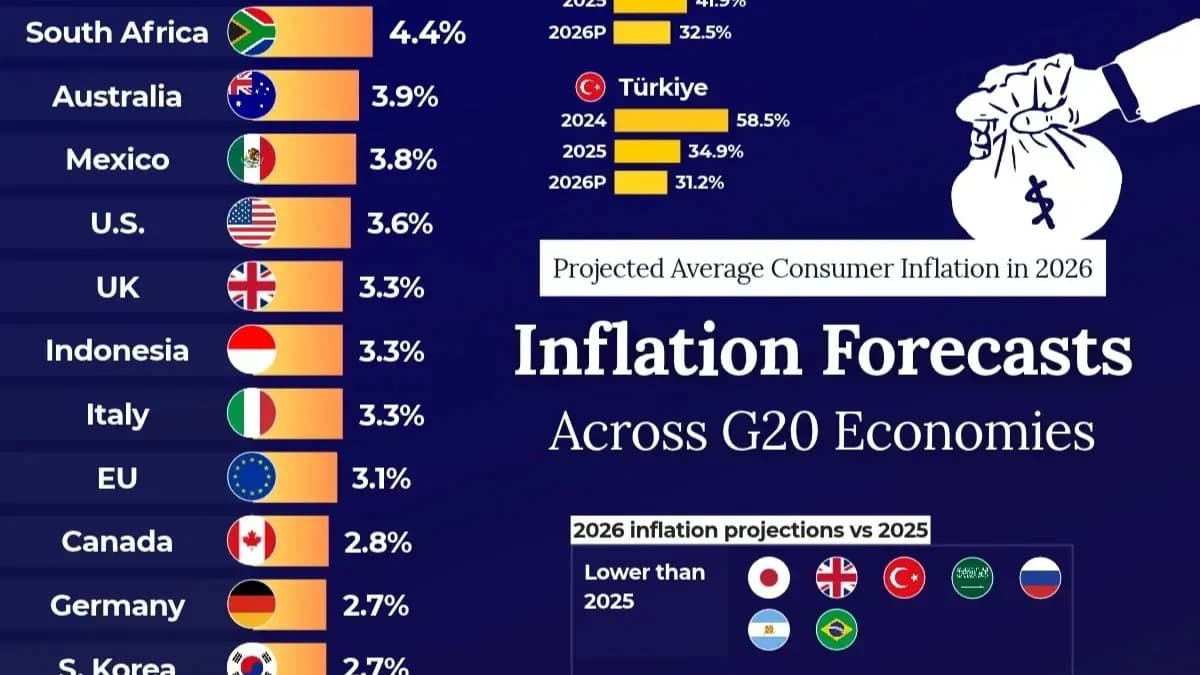
Argentina (32.5%) and Türkiye (31.2%) are projected to have the highest inflation rates among G20 economies in 2026.
Inflation in both countries is easing, but their projected rates remain more than five times Russia’s 6.1%, the next-highest rate.
China has the lowest projected inflation rate at 1.0%, reflecting subdued consumer demand and weak price pressures.
Inflation remains a major economic challenge in 2026, with some of the world’s largest economies facing persistent price pressures while others contend with weak demand.
This visualization, created by Aneesh Anand, uses the IMF’s World Economic Outlook (October 2026) to compare projected average annual consumer price inflation across G20 economies.
Inflation Forecasts Across G20 Economies in 2026
The following table presents the IMF’s 2026 inflation projections alongside 2025 figures.
Economies2026 Projections (%)2025 (%)
Argentina32.541.9
Turkiye31.234.9
Russia6.18.7
India5.02.0
Brazil4.45.0
S. Africa4.43.2
Australia3.92.8
Mexico3.83.8
U.S.3.62.7
UK3.33.4
Indonesia3.31.9
Italy3.11.6
EU3.12.5
Canada2.82.1
Germany2.72.3
S. Korea2.72.1
France2.40.9
Japan2.03.2
Saudi Arabia1.92.0
China1.00.0
Beyond Argentina and Türkiye, inflation is projected to remain in single digits across the rest of the G20. Russia ranks third at 6.1%, followed by India at 5.0%, while most other economies are clustered between 2% and 4%.
However, inflation is not moving in the same direction everywhere. The U.S. is projected to see inflation rise from 2.7% in 2025 to 3.6% in 2026, while Japan’s rate is expected to fall from 3.2% to 2.0%.
Why Is Inflation So High in Argentina and Türkiye?
Both countries have experienced prolonged inflationary pressures, though their underlying challenges differ. Argentina’s history of currency depreciation and entrenched inflation expectations has made price stability difficult to restore. Despite inflation falling dramatically from 219.9% in 2024 to a projected 32.5% in 2026, currency pressures and other economic challenges continue to complicate stabilization.
Türkiye faces persistent inflation linked to currency weakness, elevated inflation expectations, and earlier monetary policies that allowed price pressures to become entrenched. Its projected rate of 31.2% represents substantial progress from 58.5% in 2024, but remains exceptionally high.
These disparities are also evident in inflation rates around the world, where national economic conditions produce vastly different outcomes.
Why Does China Have the Lowest Inflation?
China’s projected 1.0% inflation reflects a different economic challenge: weak domestic demand rather than overheating. A prolonged property-sector downturn, excess industrial capacity, and subdued consumer spending have restrained price growth.
While low inflation can support purchasing power, persistently weak price growth may also signal sluggish economic activity. The relationship between inflation and consumer confidence offers another perspective on how price pressures can shape household sentiment.
Learn More on the Voronoi App
Explore How Inflation Has Eroded $100 Since 2019, by Country to see how rising prices have reduced purchasing power across different economies.
Get the latest news delivered to your inbox.
Related articles