Ranked: Best Real Estate Returns by Country (2015–2025)
Which countries offer the best real estate returns? Discover the global leaders in property appreciation and rental yields.
Where Did Real Estate Deliver the Best Returns?
Key Takeaways:
Portugal led the ranking with an estimated annualized real estate return of 14.6% over the decade ending in 2025, followed by Hungary (14.4%) and Russia (13.5%).
European and transcontinental countries occupied all 10 of the highest-ranking positions, with Central and Eastern Europe particularly well represented.
Strong property appreciation can benefit existing owners while making homeownership less affordable for new buyers.
Over the past decade, some of the world’s strongest real estate returns came from countries outside the largest and most familiar property markets.
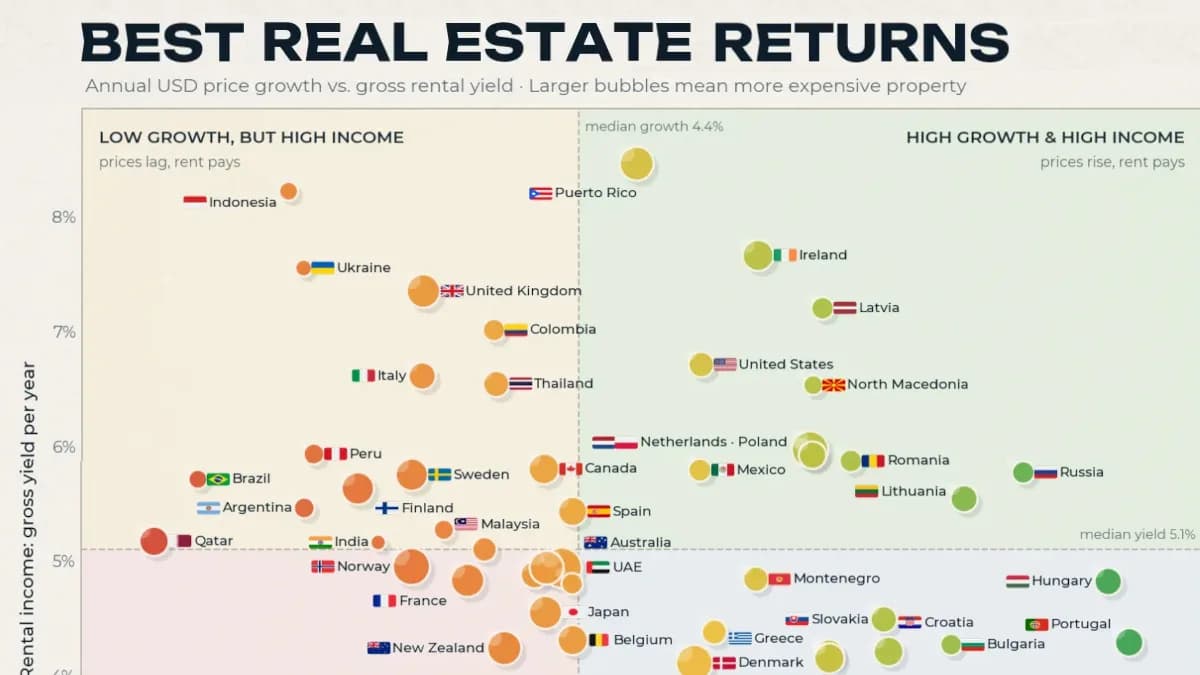
This visualization by Valerii Emelianov compares estimated annualized residential property returns across 60 countries over the 10 years to 2025, combining property-price appreciation in U.S. dollars with rental income.
The analysis uses property-price growth and gross rental yields from Global Property Guide, exchange rates from the World Bank, and city-center property prices from Numbeo.
Which Countries Had the Highest Real Estate Returns?
The following ranking shows estimated annualized returns combining 10-year property-price appreciation in U.S. dollars with rental income approximated using current gross yields. Rental income is not reinvested, and taxes, maintenance, financing, and transaction costs are excluded.
RankCountryGross Yield Current Annual (%)Total Return Annualized 10Y (%)
1 Portugal4.2914.55
2 Hungary4.8214.41
3 Russia5.7713.52
4 Lithuania5.5412.64
5 Iceland5.4112.16
6 Czech Republic3.3912.15
7 Bulgaria4.2712.01
8 Latvia7.211.39
9 Romania5.8711.25
10 Slovakia4.4911.16
11 Croatia4.2111.12
12 North Macedonia6.5311.02
13 Ireland7.6610.78
14 Poland5.9210.77
15 Netherlands5.9710.76
16 Estonia4.1910.29
17 Slovenia4.1510.27
18 Puerto Rico8.469.71
19 United States6.719.7
20 Montenegro4.849.58
21 Mexico5.799.28
22 Greece4.388.82
23 Denmark4.118.42
24 South Africa11.538.01
25 Spain5.437.53
26 Colombia7.017.44
27 Israel3.057.39
28 Canada5.87.38
29 Thailand6.547.22
30 Taiwan2.267.2
31 Chile4.87.19
32 Australia4.947.14
33 United Arab Emirates4.946.95
34 Belgium4.316.93
35 United Kingdom7.356.87
36 Singapore3.066.84
37 Cyprus4.886.77
38 Japan4.556.72
39 Luxembourg3.276.62
40 Kazakhstan10.956.55
41 Switzerland2.916.55
42 Germany3.426.51
43 Italy6.616.44
44 Philippines5.16.29
45 New Zealand4.246.03
46 Indonesia8.226.03
47 France4.835.92
48 Malaysia5.275.91
49 Sweden5.755.83
50 Ukraine7.555.78
51 Austria3.315.77
52 Norway4.955.33
53 Finland5.635.15
54 India5.165.08
55 Peru5.934.86
56 Argentina5.464.45
57 Brazil5.713.52
58 Qatar5.172.67
59 Macau2.081.25
60 Egypt7.610.89
Portugal topped the ranking at 14.6%, narrowly ahead of Hungary at 14.4%. Russia, Lithuania, and Iceland also exceeded 12%.
At the other end of the spectrum, Qatar (2.7%) and Brazil (3.5%) recorded some of the lowest estimated returns. The gap between these markets highlights how dramatically real estate investment outcomes can differ across countries, even over a full decade.
Why Did Europe Dominate the Rankings?
All 10 of the highest-ranking markets were European or transcontinental countries, with Central and Eastern Europe particularly prominent.
However, the sources of returns differed. Portugal’s performance was driven largely by property-price appreciation, while Latvia combined price growth with a relatively high gross rental yield of 7.2%. This distinction matters because rising property values and rental income contribute differently to overall returns.
Are High Returns Good for Homebuyers?
Strong property appreciation creates wealth for homeowners and investors, but it can also push prices beyond what local incomes can support. For example, the Missing Middle Initiative found that Canada’s home-price-to-income ratio increased by more than 80% between 2004 and 2024, illustrating how rising housing values can erode affordability.
This tension also appears in the United States, where housing consumes a substantial share of household income in many states. Meanwhile, low investment returns do not automatically indicate a healthier housing market. They may reflect weak demand, currency depreciation, or slower price appreciation.
Ultimately, the ranking highlights how differently housing markets performed over the past decade. Strong historical investment returns do not necessarily mean properties are affordable today or that similar gains will continue.
Because these estimates combine historical price appreciation with current gross rental yields, they are best understood as a comparison of market performance rather than the actual net returns earned by individual investors.
Learn More on the Voronoi App
For another perspective on international property markets, explore How Much Prime Real Estate Can You Buy for $1M?, which compares the purchasing power of $1 million across global luxury real estate markets.
Source: https://www.visualcapitalist.com/cp/ranked-best-real-estate-returns-by-country-2015-2025/
Get the latest news delivered to your inbox.
Related articles