10.5-million-square-mile Antarctic ozone hole ranks seventh largest on record
The ozone hole over Antarctica was the seventh largest in nearly five decades of satellite...
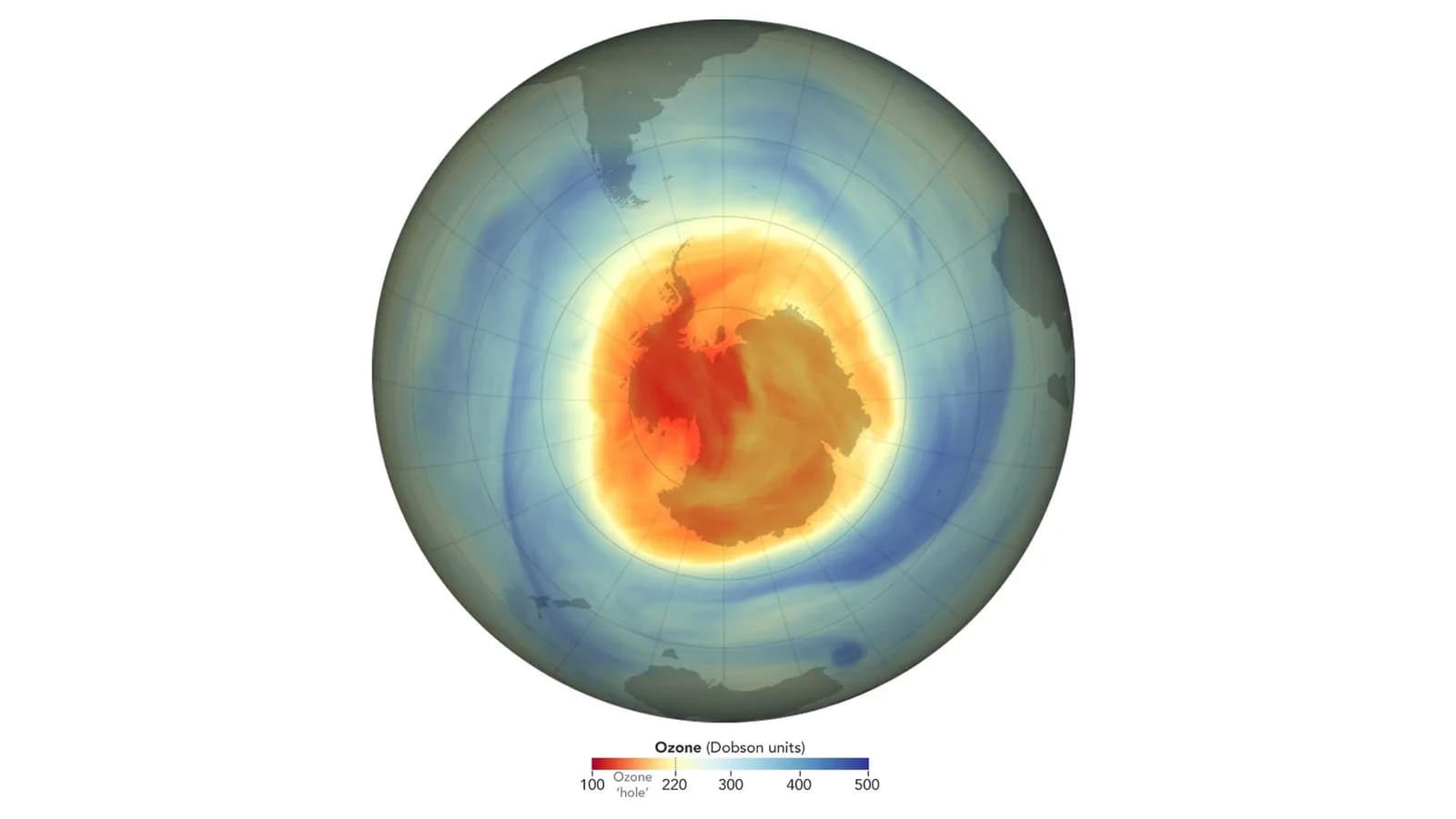
The ozone hole over Antarctica was the seventh largest in nearly five decades of satellite observations in 2026, expanding unusually far despite signs of long-term recovery. NASA’s November 9 report attributed its size largely to an exceptionally strong polar vortex that trapped extremely cold air over the continent. However, measurements showed that ozone loss was less severe than during several major events in previous decades. The hole reached its maximum extent on September 18, covering about 10.5 million square miles (27.1 million square kilometers). Its average area between September 7 and October 13 was approximately 9.6 million square miles (25 million square kilometers).
The ozone layer, located in the stratosphere, protects life by absorbing most of the Sun’s ultraviolet (UV) radiation. Excessive exposure can damage DNA and increase the risk of skin cancer and other health problems. Scientists define an ozone hole as a region where ozone concentrations fall below 220 Dobson Units (DU). The term does not mean ozone has disappeared completely, but indicates a substantial reduction in this protective gas.
Strong polar vortex drives expansion
A persistent polar vortex trapped extremely cold air over Antarctica in 2026, creating conditions that favor ozone-destroying chemical reactions. The vortex is a system of strong winds that forms around the South Pole during winter and spring. It holds cold air over the region and promotes the formation of polar stratospheric clouds. Reactions involving chlorine and bromine take place on particles in these clouds. When sunlight returns during the Antarctic spring, these reactions accelerate the destruction of ozone molecules. Weak atmospheric wave activity in August and September helped maintain the strong vortex, NASA and the National Oceanic and Atmospheric Administration (NOAA) reported.
The hole’s size, however, does not necessarily reflect the severity of ozone loss. NOAA measurements showed that ozone concentrations directly above the South Pole fell to 105 Dobson Units on October 17. That was higher than the record low of 92 DU recorded in October 2006, indicating that the 2026 event was not among the most severe in terms of ozone concentration.
Montreal protocol supports recovery
The Antarctic ozone hole is primarily linked to human-made chemicals, particularly chlorofluorocarbons (CFCs), once widely used in refrigerators, air conditioners, aerosol sprays and industrial products. These substances can remain in the atmosphere for decades. Ultraviolet radiation breaks them down in the stratosphere, releasing chlorine atoms that destroy ozone. International efforts led to the Montreal Protocol in 1987. The agreement restricted the production and use of ozone-depleting substances and encouraged safer alternatives.
NASA and NOAA scientists say these measures are producing results. Chlorine levels in the Antarctic stratosphere associated with ozone-depleting substances have fallen by about one-third compared with the 1980s. Researchers estimate that the 2026 hole could have been considerably larger if chemical concentrations had remained near their peak around 2000.
Earlier observations show atmospheric conditions affect ozone loss. In 2018, scientists reported satellite evidence of a 20 percent reduction in ozone depletion during Antarctic winter between 2005 and 2016. In 2019, unusual atmospheric conditions sharply limited ozone loss, producing the smallest hole since 1982. Seasonal weather influences the hole’s annual size, but long-term observations also indicate gradual recovery. Models suggest chlorine and other ozone-depleting substances may not return to pre-1980 levels until later in the 21st century. Scientists estimate that the Antarctic ozone layer could recover to its 1980 levels by the 2070s.
Source: https://interestingengineering.com/science/antarctica-ozone-hole-expanding-rapidly
Get the latest news delivered to your inbox.
Related articles