94% accuracy: New hydrogel brain-cap electrodes hold stable EEG for eight hours of daily activity
Chinese researchers have built a soft-to-rigid hydrogel electrode that keeps non-invasive brain-computer interfaces accurate and...
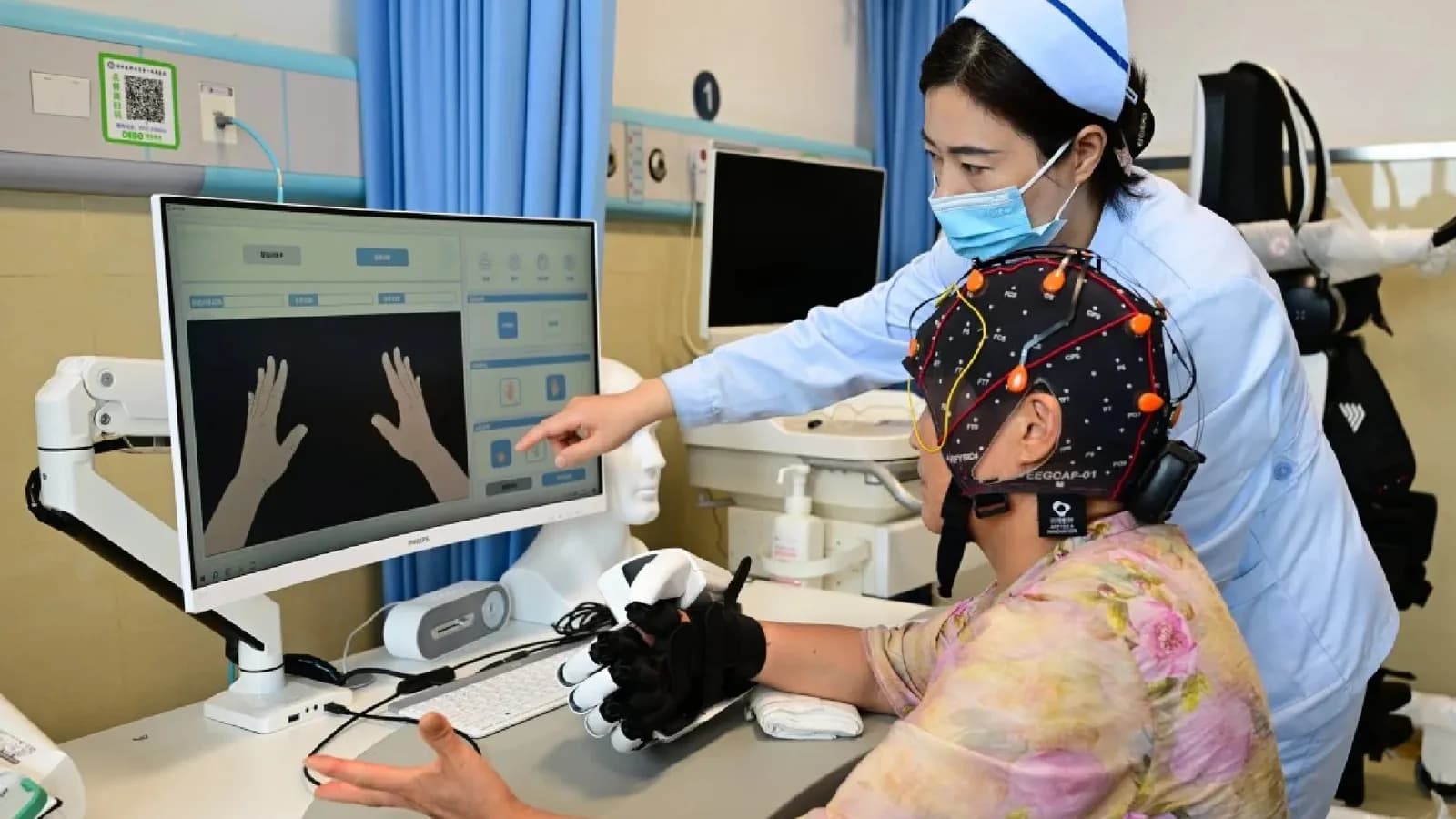
Chinese researchers have built a soft-to-rigid hydrogel electrode that keeps non-invasive brain-computer interfaces accurate and comfortable through a full day of wear. In a 14-hour test, a user typing with a flickering virtual keyboard kept accuracy above 94%.
The team from Guangxi University, Guangxi Medical University and Tsinghua University published the work last month in the journal NPJ Flexible Electronics. The electrodes were built into a commercial EEG cap.
Brain-computer interfaces translate brain signals into actions such as typing or controlling electronics. Unlike semi-invasive or invasive devices that place electrodes inside the skull or directly in brain tissue, non-invasive versions use wearable sensors.
The wet electrode problem
Many non-invasive brain-computer interfaces rely on electroencephalogram (EEG) caps lined with electrodes that touch the scalp. Conventional versions often use rigid metal covered in wet gel, which typically stays stable for only two to four hours because the gel dehydrates.
The mismatch between a rigid electrode and a soft scalp can also cause sliding and motion-induced fluctuations in readings. That makes today’s non-invasive systems suitable for laboratory use when people sit still but less stable when users move around.
Semi-dry, dry, and patch electrodes have been explored, the researchers wrote, but they generally fail to match both the soft scalp and the rigid EEG circuitry.
A gradient hydrogel design
To solve this, the team made an adaptive hydrogel electrode that is soft where it touches the scalp and firm where it connects to the circuit. It also has a pore gradient that releases electrolyte steadily.
To make it, researchers poured a hydrogel precursor containing a conductive polymer and silver nanosheets into a mold and froze it. During later freeze-thaw cycles, they heated one side and cooled the other while thawing, so the hydrogel set with a gradient of stiffness and pores.
The process is compatible with large-scale manufacturing, the team said, and can produce 300 electrodes at a time in custom sizes for commercial EEG caps. It called that capability important for cost-effective, scalable supply.
Test results in humans
Before human trials, the team tested the electrodes on mice and found no adverse reactions. The human tests used an eight-channel cap that captured brain activity and sent it wirelessly to a computer.
One subject wore the electrodes for eight hours of continuous EEG recording while walking, eating, reading, and sleeping. Another subject was tested for 14 hours under resting conditions, performing steady-state and motion-state tasks every hour.
In the steady-state task, subjects typed the numbers one to nine and the date by looking at a flickering virtual keyboard, keeping accuracy above 94%. In the motion task, colored lines swept across an array of virtual boxes and subjects focused on target boxes, with accuracy above 90%.
Commercial gel electrodes tested alongside showed “severe performance degradation” over time as they dehydrated, with channels nearly unusable within four to five hours.
What it could enable
The researchers said the design could make non-invasive brain-computer interfaces more practical outside the lab, including for daily healthcare, sleep monitoring, and warnings for conditions such as epilepsy. They said it could be applied across diverse BCI paradigms to record high-quality EEG signals.
The team said the results establish a “skin-mimetic gradient design” for robust, long-duration non-invasive BCIs and advance their use in ambulatory neuroscience and clinical monitoring.
Get the latest news delivered to your inbox.
Related articles