Ranked: The World’s Most and Least Trade-Dependent Countries
Luxembourg trades goods and services worth 350% of its GDP, while the U.S. trades just 25%. See where 170 countries rank.
Which Countries Rely Most on International Trade?
Key Takeaways
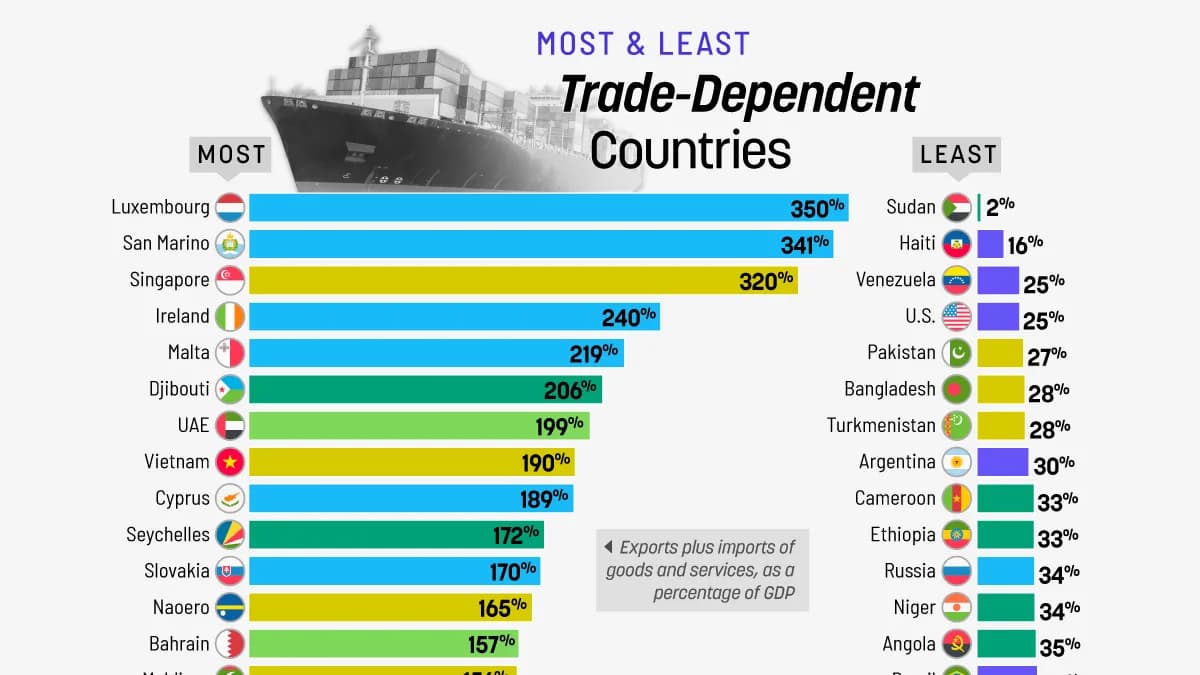
Luxembourg’s exports and imports equaled 350% of its GDP in 2025, the highest among 170 countries, ahead of San Marino (341%) and Singapore (320%).
The U.S. ranks fourth from the bottom at 25%, and none of the world’s 10 largest economies trades more than 80% of its GDP, the median across all countries.
Some countries rely heavily on international trade, importing goods they cannot easily produce at home or exporting products and services that sustain major industries. In some cases, their combined exports and imports are worth several times their annual economic output.
Others, including the U.S. and China, trade trillions of dollars annually but have much lower trade-to-GDP ratios, partly because of their large domestic markets.
This graphic shows the 20 most and least trade-dependent countries using data from the World Bank. Trade is measured as exports and imports of goods and services as a share of GDP.
Most figures are for 2025, with data from 2022 to 2024 for some countries. Territories such as Hong Kong are excluded.
Small Countries Are the Most Dependent on Trade
Sixteen of the 20 most trade-dependent countries have fewer than 10 million people, and half have fewer than 2 million.
Smaller economies often cannot produce everything their households and businesses need, so they rely on imports and exports. Many also serve larger neighboring markets as financial centers, ports, or transit hubs.
Trade can exceed GDP because exports and imports are counted at their full value, while GDP measures only the value an economy adds. The table below ranks all 170 countries by trade as a share of GDP:
RankCountryTrade (% of GDP)
1 Luxembourg349.9
2 San Marino341.0
3 Singapore320.3
4 Ireland240.0
5 Malta219.0
6 Djibouti206.3
7 United Arab Emirates199.0
8 Vietnam190.3
9 Cyprus189.5
10 Seychelles172.3
11 Slovakia170.3
12 Nauru165.4
13 Bahrain157.5
14 Maldives156.5
15 Estonia155.8
16 Lesotho154.0
17 Belgium152.9
18 Slovenia151.9
19 Netherlands150.1
20 Switzerland147.2
21 Lithuania142.1
22 Hungary140.8
23 Mauritius139.9
24 Thailand138.4
25 Libya137.7
26 Malaysia136.4
27 Cambodia136.1
28 North Macedonia133.0
29 Mongolia130.7
30 Latvia129.7
31 Denmark129.2
32 Somalia128.1
33 Czechia128.0
34 Cuba124.9
35 Brunei123.6
36 Fiji119.0
37 Antigua and Barbuda118.3
38 Kosovo118.2
39 Marshall Islands115.9
40 Oman114.9
41 Serbia112.9
42 Belarus112.1
43 Solomon Islands111.4
44 Belize109.0
45 Namibia108.6
46 Eswatini107.5
47 Austria107.0
48 Montenegro105.8
49 Palau105.8
50 Sweden104.3
51 Guinea103.7
52 Bulgaria102.5
53 Kiribati102.1
54 Armenia101.7
55 Tunisia101.4
56 Croatia101.0
57 Georgia100.6
58 Qatar100.2
59 Mozambique97.1
60 Poland97.0
61 Nicaragua96.4
62 Timor-Leste95.4
63 Cabo Verde95.3
64 Bosnia and Herzegovina95.1
65 Kuwait94.0
66 Mauritania94.0
67 Micronesia93.1
68 Morocco93.1
69 Moldova92.7
70 Kyrgyzstan92.4
71 Republic of the Congo91.7
72 Honduras91.5
73 El Salvador88.2
74 Democratic Republic of the Congo87.3
75 Portugal86.4
76 South Korea86.4
77 Gabon84.9
78 Afghanistan83.8
79 Panama83.7
80 Greece83.5
81 Finland83.4
82 Iceland82.5
83 Lebanon82.2
84 Mexico79.9
85 Azerbaijan79.8
86 Albania79.5
87 Bhutan79.4
88 Bahamas79.2
89 Norway79.1
90 Germany78.5
91 Tonga77.6
92 Ukraine77.2
93 Iraq77.1
94 Paraguay76.5
95 Romania76.2
96 Equatorial Guinea74.9
97 West Bank and Gaza74.8
98 Vanuatu73.4
99 Costa Rica71.5
100 Senegal71.1
101 Samoa70.6
102 Botswana69.5
103 Spain69.5
104 Ghana69.0
105 France67.2
106 Philippines66.8
107 Burkina Faso65.0
108 Chile65.0
109 Canada63.5
110 Italy62.5
111 U.K.62.5
112 Zambia62.5
113 Gambia62.2
114 South Africa60.9
115 Iran60.2
116 Togo59.9
117 Ecuador59.4
118 Tajikistan59.1
119 Saudi Arabia57.9
120 Uzbekistan57.4
121 Kazakhstan57.2
122 Rwanda56.7
123 Cote d'Ivoire54.6
124 Madagascar54.2
125 Israel53.0
126 Central African Republic52.9
127 Peru51.8
128 Dominican Republic51.5
129 Egypt51.3
130 New Zealand50.7
131 Uganda50.2
132 Türkiye49.9
133 Uruguay49.7
134 Sierra Leone49.1
135 Mali48.8
136 Bolivia47.0
137 Sao Tome and Principe46.6
138 Guatemala46.5
139 India46.3
140 Chad46.1
141 Australia45.9
142 Japan44.9
143 Indonesia43.4
144 Nepal42.6
145 Sri Lanka41.8
146 Zimbabwe41.5
147 Comoros40.9
148 Guinea-Bissau40.9
149 Malawi39.4
150 Algeria39.0
151 Tanzania39.0
152 China38.0
153 Kenya37.5
154 Benin37.1
155 Colombia35.4
156 Syria35.4
157 Brazil35.3
158 Angola34.6
159 Niger33.9
160 Russia33.7
161 Ethiopia33.5
162 Cameroon33.4
163 Argentina30.4
164 Turkmenistan28.2
165 Bangladesh28.0
166 Pakistan27.2
167 U.S.25.0
168 Venezuela25.0
169 Haiti15.9
170 Sudan2.4
Across the full ranking, 58 countries trade more than their GDP, while the median country trades about 80%. Europe accounts for 11 of the top 20, ranging from microstates like San Marino to countries like Belgium and the Netherlands, home of two of Europe’s busiest ports.
The reasons for high trade dependence vary. Luxembourg’s exports are dominated by services, particularly financial services linked to its investment fund industry, according to STATEC. In Singapore, re-exports accounted for about 62% of merchandise exports in 2025, according to Singapore’s Department of Statistics.
Djibouti offers another example. Its trade equals 206% of GDP, compared with just 33% for neighboring Ethiopia. Landlocked Ethiopia routed more than 95% of its seaborne trade through Djibouti in early 2024, making ports and logistics a major part of Djibouti’s economy.
U.S. and China Have Low Dependence Despite Their Trade Scale
The U.S. is one of the biggest surprises in the ranking. Despite being the world’s largest economy, its exports and imports equaled just 25% of GDP in 2024, the fourth-lowest ratio among 170 countries.
Only Sudan (2.4%), Haiti (16%), and Venezuela (25%) ranked lower. All three have experienced severe economic disruptions, including civil war in Sudan, gang violence in Haiti, and sanctions and a collapse in oil output in Venezuela.
China, the world’s largest goods exporter, also ranks near the bottom, placing 19th from the bottom at 38% in 2025.
A low ratio can still mean trillions of dollars crossing borders. U.S. exports and imports totaled about $7.3 trillion in 2024, while China’s reached about $7.4 trillion in 2025, each roughly 20 times Luxembourg’s total.
Large domestic markets allow more business to take place between producers and customers within the same country, without contributing to cross-border trade totals.
None of the world’s 10 largest economies trades more than 80% of its GDP, the median across the dataset. Germany comes closest at 79%, while Japan (45%) and India (46%) sit well below it.
Vietnam is a striking exception to the pattern among large economies. With more than 100 million people, it ranks eighth globally at 190% of GDP, well ahead of Thailand (138%), the next-highest country with more than 50 million people.
Trade with the U.S. alone equaled 44% of Vietnam’s GDP in 2025, making it one of the economies most exposed to American consumer demand.
Learn More on the Voronoi App
If you enjoyed today’s post, check out Which Economies Rely on International Trade the Most? on Voronoi.
Get the latest news delivered to your inbox.
Related articles