Mapped: Where Americans Have the Most Debt Per Person
Americans owe trillions in personal debt. See how much residents owe in every state, and why some carry nearly three times as much.
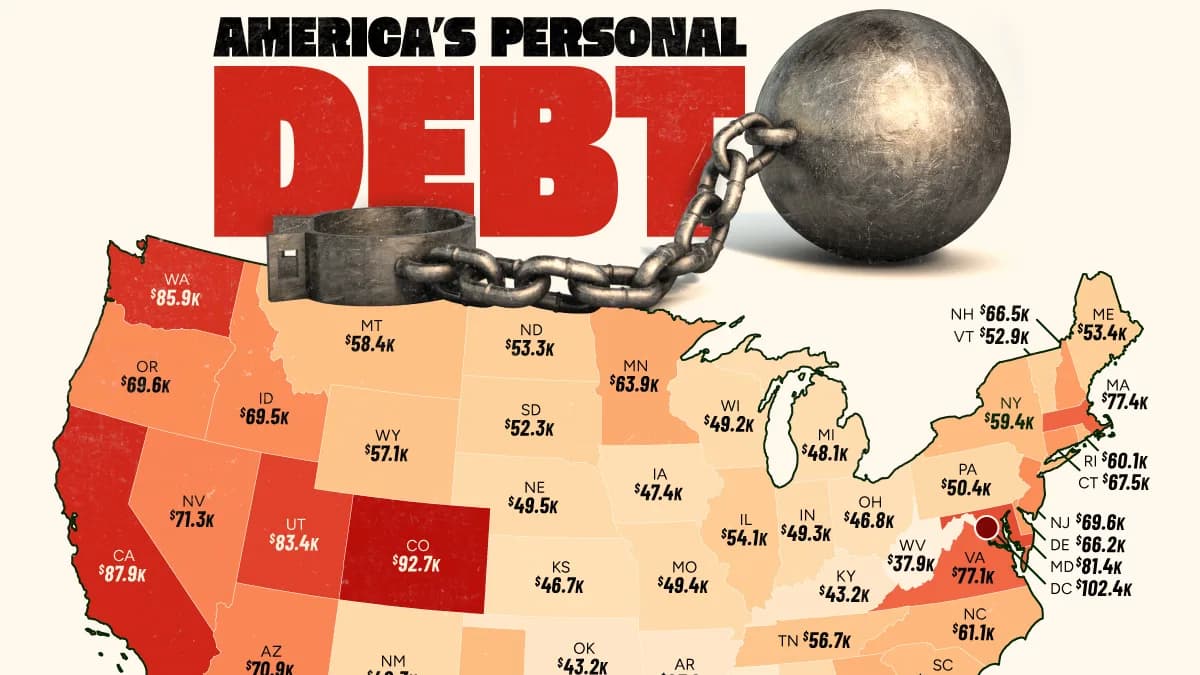
How Personal Debt Varies Across America
Key Takeaways
Americans with a credit report carry an average of $63,200 in personal debt, including mortgages, auto loans, credit cards, and student loans.
Washington, D.C. has the highest average debt at $102,400 per person, nearly three times West Virginia’s $37,900.
Colorado ranks second nationally at $92,690, ahead of California, Washington, and Hawaii.
Americans owe trillions of dollars across mortgages, credit cards, auto loans, and student debt. But the amount people owe varies dramatically by location, with some of the highest balances concentrated in expensive housing markets.
This graphic maps average debt per person by state using Q4 2025 data from the Federal Reserve Bank of New York.
The figures cover residents with a credit report and combine major forms of household borrowing, making the map a measure of outstanding debt balances rather than financial distress or ability to repay.
Where Americans Carry the Most Personal Debt
Washington, D.C. leads the country in average personal debt, followed by Colorado and California. Colorado’s second-place ranking is particularly notable, putting it ahead of several states known for expensive housing, including California and Hawaii.
At the other end of the spectrum, West Virginia, Mississippi, and Arkansas have the lowest average debt balances.
RankState or DistrictTotal Personal Debt Per Person (Q4 2025)
1District of Columbia$102,400
2Colorado$92,690
3California$87,850
4Washington$85,880
5Hawaii$83,480
6Utah$83,350
7Maryland$81,390
8Massachusetts$77,400
9Virginia$77,060
10Nevada$71,260
11Arizona$70,850
12Oregon$69,640
13New Jersey$69,550
14Alaska$69,460
15Idaho$69,450
16Connecticut$67,530
17New Hampshire$66,480
18Delaware$66,170
19Minnesota$63,860
20Georgia$62,070
21Florida$61,890
22North Carolina$61,070
23Rhode Island$60,090
24Texas$60,020
25South Carolina$59,460
26New York$59,420
27Montana$58,390
28Wyoming$57,120
29Tennessee$56,690
30Illinois$54,050
31Maine$53,360
32North Dakota$53,300
33Vermont$52,910
34South Dakota$52,270
35Pennsylvania$50,360
36Nebraska$49,530
37Missouri$49,420
38Indiana$49,330
39New Mexico$49,260
40Wisconsin$49,210
41Alabama$48,910
42Louisiana$48,250
43Michigan$48,050
44Iowa$47,410
45Ohio$46,780
46Kansas$46,720
47Oklahoma$43,170
48Kentucky$43,160
49Arkansas$43,090
50Mississippi$41,450
51West Virginia$37,850
-- U.S. Average$63,200
Housing helps explain large differences in personal debt between states. In Colorado, mortgages account for 78% of average personal debt, compared with 55% in West Virginia.
Nationally, mortgages made up roughly 70% of America’s $18.8 trillion in household debt at the end of 2025. Because mortgages make up such a large share of debt, higher home prices can translate into larger average debt balances.
What Higher Debt Means for Americans Today
The amount Americans owe tells only part of the story. Monthly payments, interest rates, and household income ultimately determine how manageable that debt is.
For instance, Harvard’s 2026 housing report found that homeowners who moved in before 2020 had median first-mortgage payments roughly $800 lower per month than more recent movers, based on 2024 data.
For households facing higher housing costs and borrowing rates, those monthly payments can leave significantly less room for savings and everyday expenses.
The key distinction is between how much Americans owe and how difficult that debt is to repay. A homeowner with a large, low-interest mortgage may face less financial pressure than someone with a smaller balance carrying much higher interest costs.
Learn More on the Voronoi App
To learn more about this topic, check out this graphic on the world’s most indebted households in 2026.
Get the latest news delivered to your inbox.
Related articles