Mapped: EU Countries by Government Debt (% of GDP)
Which EU countries have the most government debt? Explore debt-to-GDP ratios across 27 nations and why Greece tops the list.
How Does Government Debt Compare Across the EU?
Key Takeaways:
EU government debt reached €15.95 trillion in Q2 2026, equivalent to 82.9% of GDP.
Greece (140.8%) and Italy (139.9%) have the highest debt-to-GDP ratios in the EU.
Five EU countries have government debt exceeding 100% of GDP, while three have ratios below 30%.
How much debt do European governments carry relative to the size of their economies?
The answer reveals striking differences across the EU, shaped by past financial crises, government spending, and economic growth.
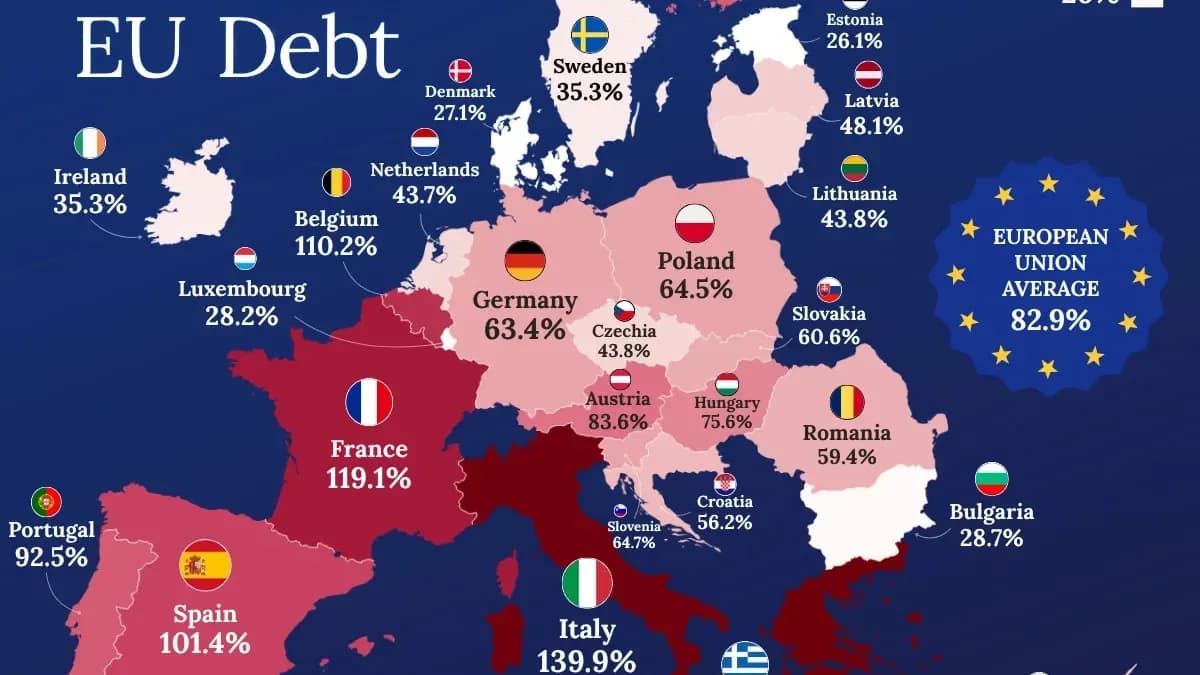
This visualization, created by Aneesh Anand, ranks all 27 EU member states by government debt as a percentage of GDP in Q2 2026, using data from Eurostat.
Government Debt-to-GDP Ratios Across Europe
The following table shows each EU country’s general government gross debt relative to its economic output in Q2 2026.
RankMember NationDebt-to-GDP (%)
1 Greece140.8
2 Italy139.9
3 France119.1
4 Belgium110.2
5 Spain101.4
6 Portugal92.5
7 Finland90.2
8 Austria83.6
9 EU Average82.9
10 Hungary75.6
11 Slovenia64.7
12 Poland64.5
13 Germany63.4
14 Slovakia60.6
15 Romania59.4
16 Croatia56.2
17 Cyprus48.5
18 Latvia48.1
19 Malta47
20 Czechia43.8
21 Lithuania43.8
22 Netherlands43.7
23 Ireland35.3
24 Sweden35.3
25 Bulgaria28.7
26 Luxembourg28.2
27 Denmark27.1
28 Estonia26.1
France, Belgium, and Spain join Greece and Italy as the five EU countries whose government debt exceeds their annual economic output.
Among the EU’s largest economies, Germany stands out with a considerably lower debt ratio than France, Italy, or Spain.
At the other end of the ranking, Estonia has the lowest ratio at 26.1%, followed by Denmark and Luxembourg, both of which also remain below 30%.
Why Is Greece’s Government Debt So High?
Greece’s elevated debt burden largely stems from longstanding fiscal deficits, structural weaknesses, and the sovereign debt crisis that erupted in 2009.
The country subsequently received international bailouts, accompanied by austerity measures and economic reforms. A prolonged recession reduced GDP, further inflating its debt-to-GDP ratio.
Despite remaining the EU’s most indebted country relative to GDP, Greece has made substantial progress in reducing its debt burden. According to Eurostat, its ratio fell by 11.2 percentage points year over year, highlighting how a country can carry a high debt burden while making significant progress in reducing it.
Why Does the EU Carry So Much Debt?
Europe’s debt burden reflects accumulated spending commitments, aging populations, and government interventions during the 2008 financial crisis and COVID-19 pandemic. These pressures have contributed to differences in public and private debt levels across economies.
EU fiscal rules generally establish reference values of 60% of GDP for government debt and 3% for annual deficits. Countries can exceed these thresholds, but may face additional fiscal oversight and adjustment requirements.
Higher interest costs, defense spending, and infrastructure investment are adding pressure to government budgets across Europe.
Debt-to-GDP as a metric is useful for comparing debt burdens across countries, although it does not capture every factor affecting a government’s ability to repay its obligations.
Learn More on the Voronoi App
To explore government borrowing from another perspective, check out Ranked: Countries With the Most Government Debt Per Person on Voronoi.
Get the latest news delivered to your inbox.
Related articles