Unitree humanoid robots paint and play chess with zero training, claims CEO
Unitree Robotics says its humanoid robots can now paint pictures and play chess without any...
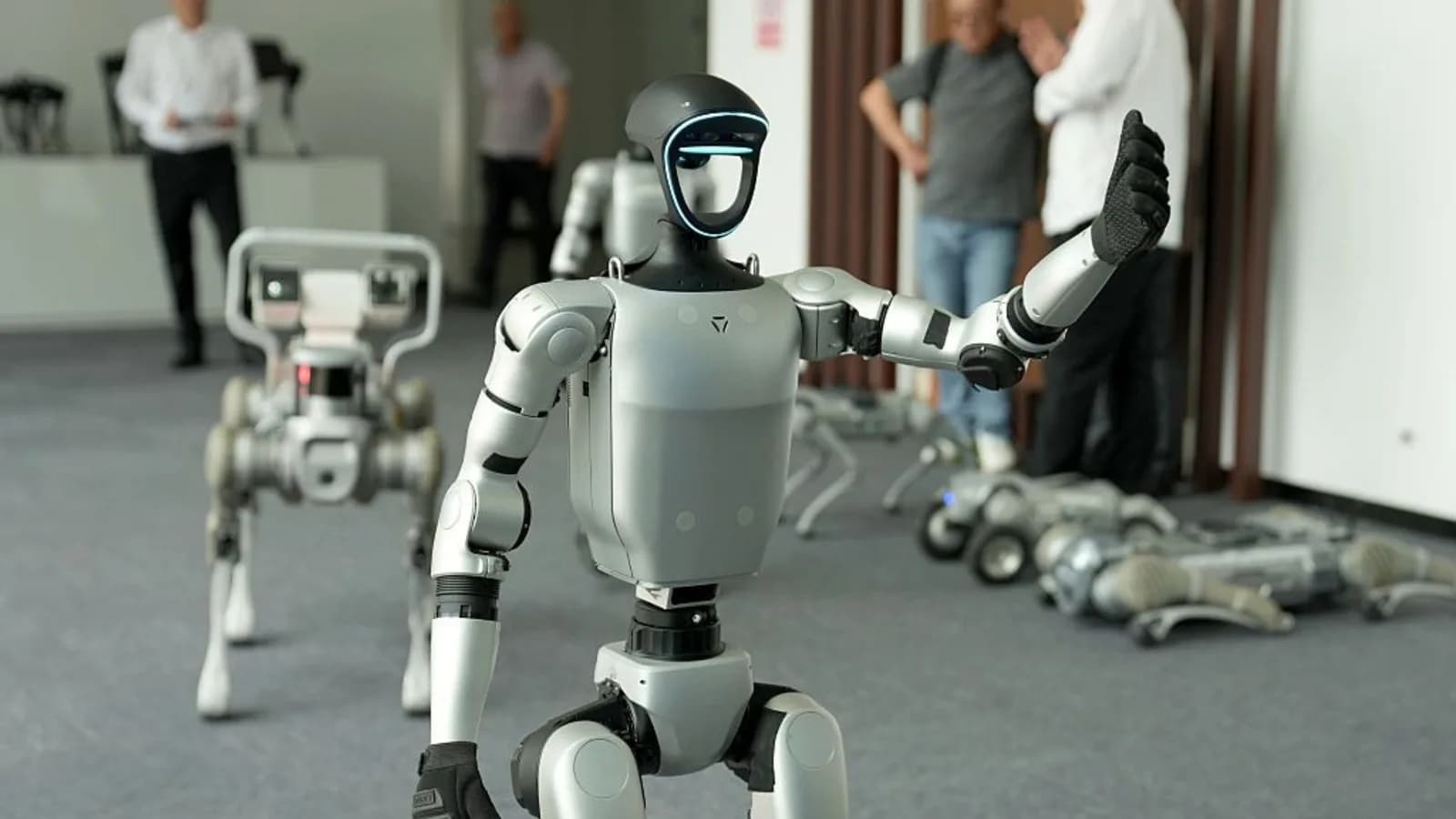
Unitree Robotics says its humanoid robots can now paint pictures and play chess without any prior training, relying on frontier AI models. Founder and CEO Wang Xingxing made the claim Thursday at the China International Import Expo (CIIE) in Shanghai, saying the machines are powered by OpenAI’s GPT-6.
Painting and chess claims
Wang said the robots perform intricate sequences, such as dynamically replacing brush water and blending pigments, guided purely by real-time model inference. “The precision required to change pigments without error is quite high,” he said.
Unitree showed video clips of the robots painting but did not run a live demonstration on stage, so the claims rest on company footage and statements.
The remarks follow comments Wang made last month, when he said GPT-6 had pulled the industry’s breakthrough timeline forward to “within one or two years.” He suggested next year’s GPT-7 could crack core challenges in embodied artificial intelligence.
The ‘last-millimeter’ mechanical gap
Translating model commands into precise physical motion remains an uphill battle, Wang said. He called the industry’s biggest hurdle no longer digital reasoning or planning but a “last-millimeter” mechanical gap.
The core problem, he said, is the alignment error between the model’s inputs and outputs. He projected the industry would overcome that physical bottleneck within one or two years.
To speed that up, Unitree is developing a “self-evolving” feedback loop that would let humanoid robots write code, run simulations, and autonomously improve their real-world performance.
Industry peers split
Other executives at the expo shared Wang’s optimism. Wang Qian, founder of robotics start-up X Square Robot, said embodied AI is on the verge of a watershed leap. He pushed back against forecasts that mass adoption is half a decade away. A “GPT moment” for embodied AI is “highly likely within a year or so,” he said, adding he hopes to see robots building robots and chips manufacturing chips.
Chip suppliers struck a more cautious tone. Wang Dong, co-founder of domestic GPU designer Moore Threads, warned that embodied AI development continues to lag expectations because of severe data scarcity and crippling hardware costs.
Collecting real-world interaction data remains difficult, so developers are leaning heavily on synthetic training sets, he said. Moore Threads is working to supply its own chips and solutions to domestic robotics developers because Nvidia chips are extremely expensive.
Unitree’s H2 humanoid stands nearly 6 feet (180 centimeters) tall and weighs about 154 pounds (70 kilograms). Earlier reporting on its launch listed 31 degrees of freedom and joint output of up to 360 newton-meters. At CES in January, company representatives said customer shipments of the H2 were expected to begin in April.
Wang has described a long-term benchmark called the “80/80 goal,” in which robots perform 80% of tasks in 80% of environments. Unitree has reportedly aimed to ship roughly 20,000 humanoids in 2026. A Unitree video earlier showed a G1 humanoid assembling motor components on a factory workbench.
Those capabilities are separate from the new claims, which Unitree has so far supported only with painting video clips.
Source: https://interestingengineering.com/ai-robotics/unitree-humanoid-robot-painting-chess
Get the latest news delivered to your inbox.
Related articles