Mapped: The Best Countries for Travel and Tourism in 2026
Which countries lead tourism development in 2026? Explore global rankings, from Japan and Europe to emerging destinations.
Which Countries Lead the World in Travel and Tourism?
Key Takeaways:
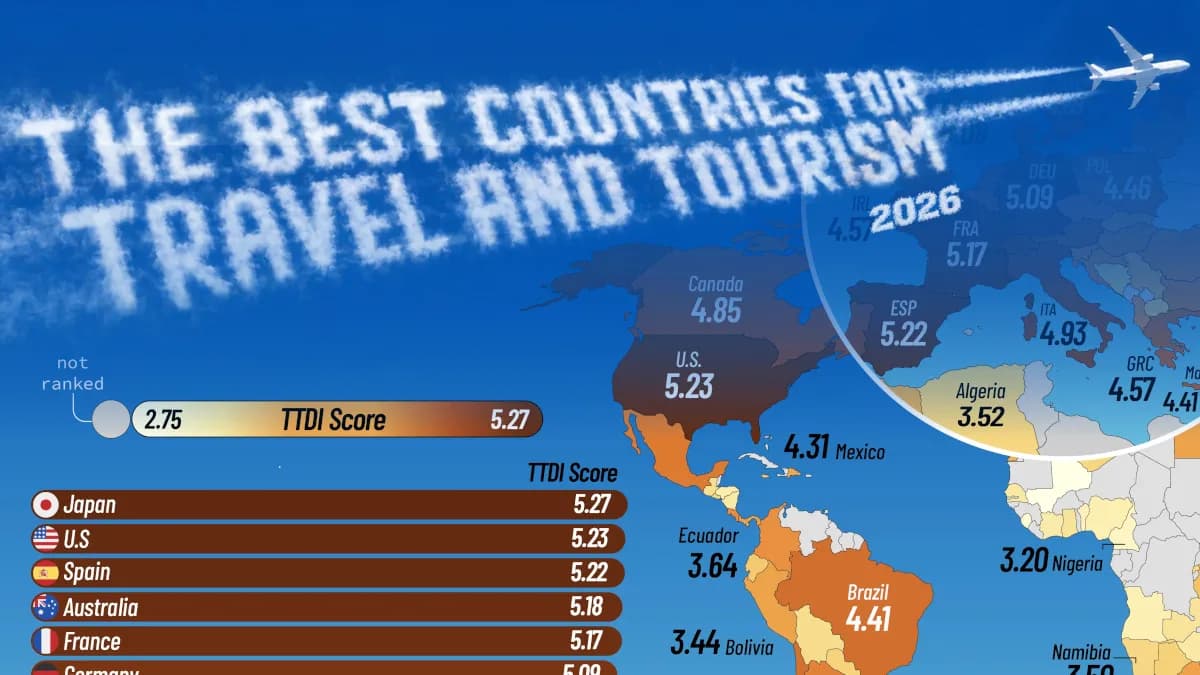
Japan leads the 2026 Travel & Tourism Development Index with a score of 5.27, followed closely by the United States (5.23) and Spain (5.22).
Europe accounts for six of the top 10 economies, reflecting its strong tourism infrastructure, connectivity, and cultural resources.
Lower-ranking countries, particularly in parts of sub-Saharan Africa, face infrastructure and investment challenges despite their natural and cultural attractions.
What makes a country a global leader in tourism?
Beyond famous landmarks and popular destinations, transportation networks, infrastructure, and government policies all play an important role.
The World Economic Forum’s Travel & Tourism Development Index (TTDI) measures the conditions supporting competitive and sustainable tourism development, rather than simply counting visitors or tourism revenue.
Ranking the Best Countries for Tourism Development
The following table ranks 110 economies using the World Economic Forum’s 2026 TTDI scores, measured on a scale from 1 (worst) to 7 (best).
The index combines 102 indicators across 17 pillars covering tourism policy, enabling environments, infrastructure, natural and cultural resources, and sustainability.
Rank (2026)CountryTTDI Score (1–7)
1 Japan5.27
2 United States5.23
3 Spain5.22
4 Australia5.18
5 France5.17
6 Germany5.09
7 United Kingdom5.08
8 China5.00
9 Switzerland4.97
10 Italy4.93
11 Portugal4.91
12 Korea, Rep.4.90
13 Singapore4.89
14 Canada4.85
15 Austria4.72
16 Denmark4.70
17 Netherlands4.69
18 Sweden4.68
19 Finland4.60
20 Ireland4.57
21 Greece4.57
22 United Arab Emirates4.56
23 Indonesia4.56
24 Belgium4.53
25 New Zealand4.51
26 Malaysia4.50
27 Luxembourg4.46
28 Poland4.46
29 Saudi Arabia4.45
30 Cyprus4.43
31 India4.42
32 Brazil4.41
33 Malta4.41
34 Iceland4.40
35 Chile4.39
36 Türkiye4.37
37 Czechia4.35
38 Thailand4.35
39 Bulgaria4.34
40 Georgia4.32
41 Mexico4.31
42 Hungary4.31
43 Romania4.31
44 Estonia4.30
45 Slovenia4.26
46 Croatia4.25
47 Qatar4.23
48 Argentina4.22
49 Lithuania4.18
50 Israel4.18
51 Costa Rica4.16
52 Viet Nam4.15
53 Albania4.14
54 Colombia4.13
55 Bahrain4.11
56 Kazakhstan4.09
57 Philippines4.08
58 Azerbaijan4.07
59 Mauritius4.07
60 Slovak Republic4.04
61 South Africa3.99
62 Oman3.98
63 Egypt3.97
64 Peru3.96
65 Panama3.96
66 Dominican Republic3.93
67 Latvia3.89
68 Serbia3.89
69 Sri Lanka3.85
70 Morocco3.84
71 Uruguay3.82
72 Armenia3.81
73 Jordan3.80
74 Tanzania3.70
75 Lao PDR3.69
76 Uzbekistan3.69
77 Kenya3.67
78 Jamaica3.65
79 Mongolia3.64
80 Ecuador3.64
81 North Macedonia3.64
82 Tunisia3.62
83 Bosnia and Herzegovina3.58
84 Botswana3.57
85 Paraguay3.56
86 Nepal3.55
87 El Salvador3.53
88 Kuwait3.53
89 Algeria3.52
90 Namibia3.50
91 Rwanda3.47
92 Bolivia3.44
93 Kyrgyz Republic3.44
94 Guatemala3.43
95 Pakistan3.42
96 Zambia3.37
97 Ghana3.35
98 Bangladesh3.34
99 Senegal3.29
100 Nicaragua3.28
101 Zimbabwe3.27
102 Côte d’Ivoire3.26
103 Honduras3.22
104 Nigeria3.20
105 Angola3.18
106 Benin3.13
107 Malawi3.08
108 Cameroon3.05
109 Sierra Leone2.91
110 Mali2.75
The top three countries are separated by just 0.05 points, making the race for first place remarkably close. Australia (5.18) and France (5.17) round out the top five.
At the opposite end, Mali (2.75), Sierra Leone (2.91), and Cameroon (3.05) have the lowest scores among the economies assessed. These results reflect challenges involving transportation infrastructure, investment, and tourism services rather than a lack of attractive destinations.
As countries compete to attract visitors, shifting international tourism flows highlight the importance of developing destinations that can accommodate growth while protecting local communities and natural resources.
Why Europe Dominates the Rankings
Europe dominates the upper end of the rankings, with six economies in the top 10: Spain (5.22), France (5.17), Germany (5.09), the United Kingdom (5.08), Switzerland (4.97), and Italy (4.93).
The region benefits from extensive transportation networks, well-established tourism infrastructure, and a high concentration of cultural and historical attractions. Cross-border rail connections and relatively short distances between major destinations also make it easier for travelers to visit multiple countries in a single trip.
Sustainability is becoming another priority. Several European destinations are introducing incentives that reward environmentally responsible tourism, including benefits for visitors who use public transportation or participate in local conservation efforts.
However, Europe’s tourism success also brings challenges. Popular destinations face overcrowding, housing pressures, and environmental strain, making visitor management increasingly important. Maintaining the region’s competitive advantage will depend on balancing tourism growth with the needs of local communities.
Japan Leads as Sustainability Gains Importance
Japan’s top ranking reflects its extensive transportation network, rich cultural heritage, and well-developed tourism infrastructure. Other major Asian economies also perform strongly, including China (5.00), South Korea (4.90), and Singapore (4.89).
Japan is increasingly focused on making tourism more sustainable and spreading its economic benefits beyond major destinations such as Tokyo, Kyoto, and Osaka. The country is promoting community-focused tourism and encouraging visitors to explore lesser-known regions, helping reduce overcrowding while supporting local businesses and rural economies.
Elsewhere in Asia, tourism development varies considerably. Southeast Asian destinations such as Thailand (4.35), Malaysia (4.50), and Indonesia (4.56) benefit from abundant natural attractions and growing tourism industries but score below the region’s leading economies.
As international travel demand grows, Asian countries face the challenge of balancing tourism expansion with environmental protection and community well-being. Japan’s approach illustrates how established tourism destinations can prioritize long-term sustainability alongside visitor growth.
Learn More on the Voronoi App
For another perspective on global tourism, see Mapped: Daily Cost of Traveling in Europe, which compares travel expenses across European destinations.
Source: https://www.visualcapitalist.com/mapped-the-best-countries-for-travel-and-tourism-in-2026/
Get the latest news delivered to your inbox.
Related articles