New quantum detector can distinguish between one, two, or more particles of light
A Dutch physicist has reportedly come up with a superconducting light detector that can distinguish...
A Dutch physicist has reportedly come up with a superconducting light detector that can distinguish between one, two, and even three or more photons at once, and make quantum computers more accurate.
Built by Erik Baalbergen, PhD, a physicist at Leiden University in the Netherlands, the detector can not only identify whether light is present. It can also count how many individual light particles, or photons, hit its surface.
The finding could improve the accuracy of quantum calculations and support the development of future optical quantum computers, according to Baalbergen. The research was part of his PhD project, which he successfully defended on Tuesday, November 3.
“I always enjoyed the experiments with light the most,” Baalbergen said. “And this project brings together the fields of optics, electronics and solid-state physics. It is precisely that intersection that I find incredibly interesting.”
Photon counting, explained
Optical quantum computers rely on photons as qubits to process information and perform calculations. However, while most detectors can detect light, they struggle to count individual photons.
To address this limitation, Baalbergen and his team investigated superconducting nanowire detectors. These devices contain ultrathin wires that exhibit no electrical resistance at very low temperatures.
Hence, once a photon hits one of these wires, it changes the wire’s electrical state and produces a measurable signal. The researchers also improved the connection between the detector and its readout electronics. This reduced the signal loss and made it easier to extract information from the measurements.
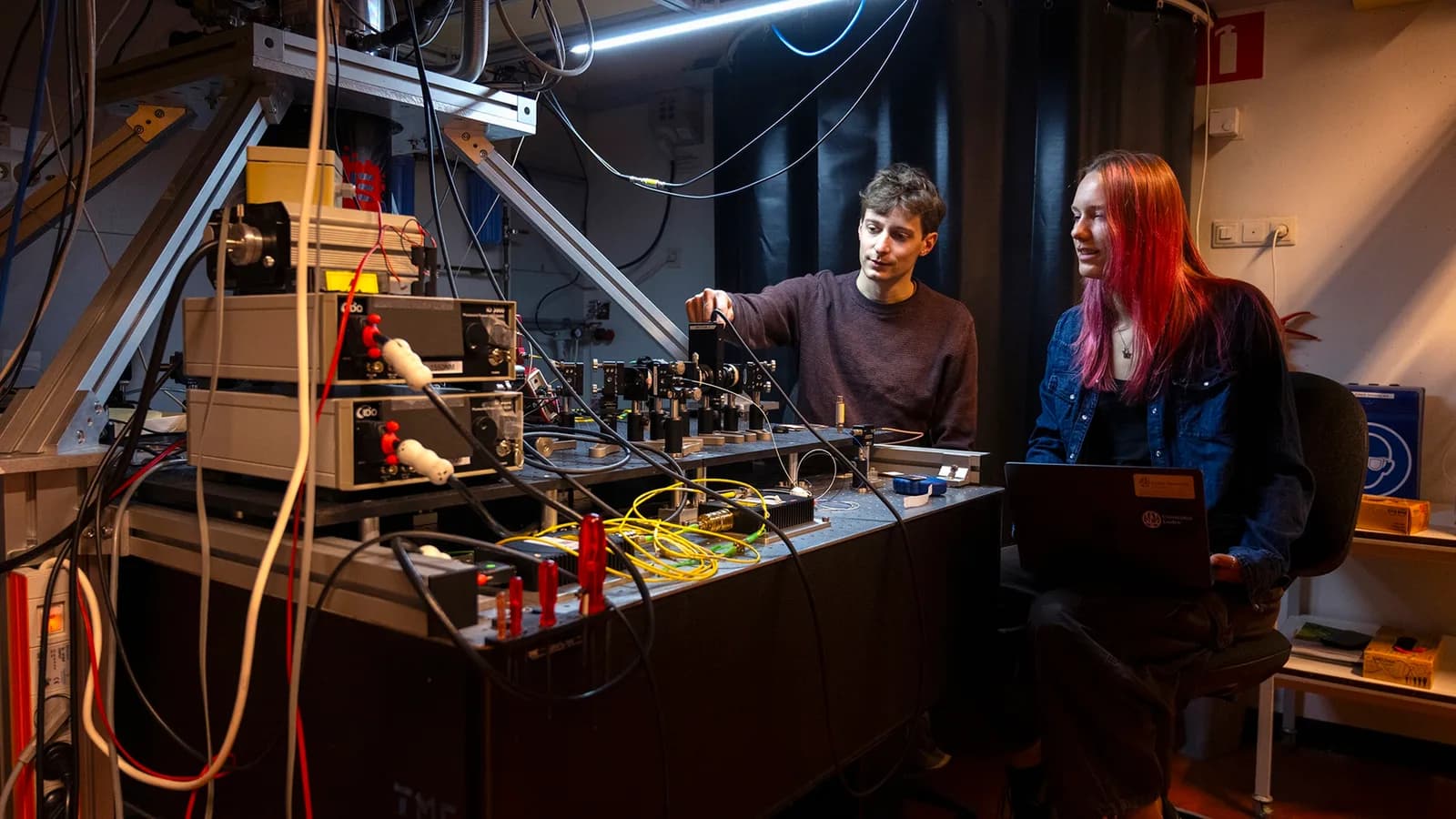
Ilse Kuijf and Erik Baalbergen in the laser lab at the Leiden Institute of Physics. Credit: Leiden University
“We have developed a technique that allows you to distinguish between one, two and three (or more) photons (individual particles of light),” Baalbergen explained.
According to the physicist, the new method also shows how certain each photon count is. “It may seem like a small step forward, but it is in fact quite a significant, fundamental step forward,” he noted. “Admittedly, our detector still needs further development, but with the path we have now embarked upon, we will get there.”
Precise light detection
The initiative also involved Ilse Kuijf, a PhD candidate in theoretical physics at the university, and master’s student Lars Seldenthuis. Instead of examining only the amplitude, the scientists also analyzed how each signal changed over time.
This made it far easier to count photons accurately without the need for complex electronics. The young scientists believe that the technology could support more powerful optical quantum computers capable of tackling calculations that remain extremely difficult for conventional machines.
Other potential applications include studying chemical reactions and developing new molecules and materials. Baalbergen noted that optical quantum computers have an advantage as most of their components work at room temperature. “So we don’t need a large cooling system to lower the temperature to near absolute zero,” he said. “That saves a lot of money and time.”
With that in mind, superconducting nanowire detectors still require extremely low temperatures. Baalbergen also cooperated with Dutch firm QuiX Quantum, which launched its first working optical quantum computer prototype in summer 2026.
He expects similar photon-counting detectors to be used in the company’s future systems. “With this detector, the quantum computer will soon be able to perform calculations with even greater accuracy,” Baalbergen concluded in a press release.
Source: https://interestingengineering.com/science/quantum-detector-distinguish-particles
Get the latest news delivered to your inbox.
Related articles