Ranked: The World’s Biggest Economies vs. Debt in 2026
The U.S. leads the world in economic size, but Sudan tops the government debt ranking. See how the two lists compare.
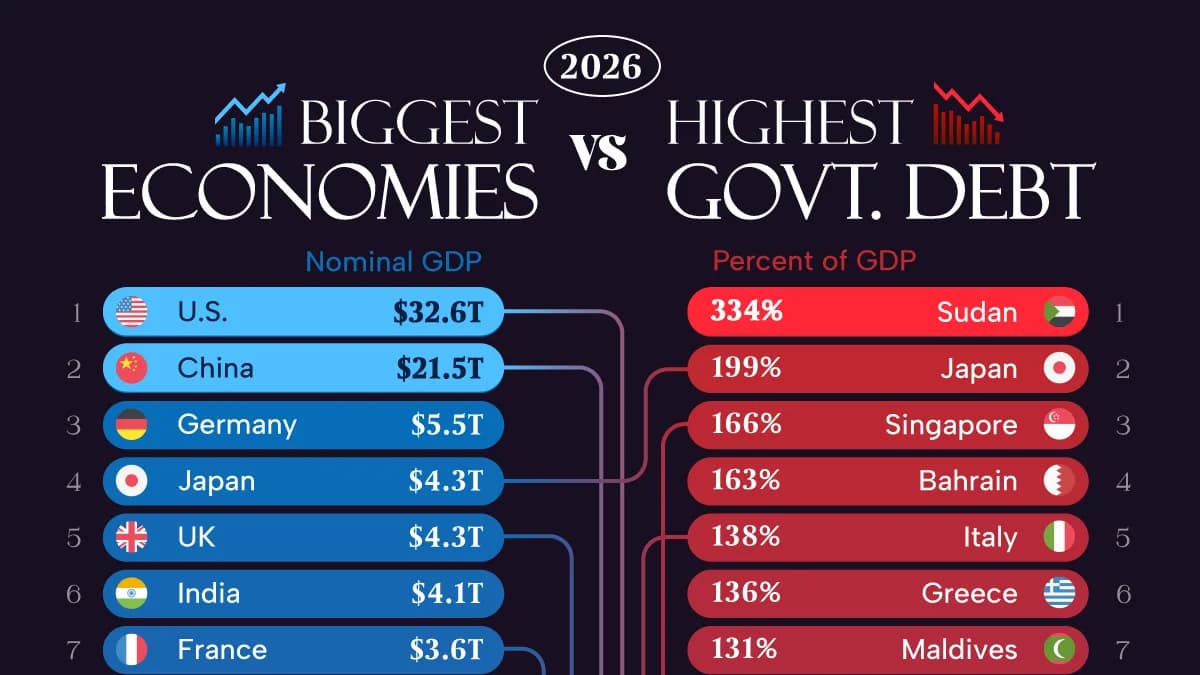
The World’s Largest Economies vs. the Most Indebted Countries
Key Takeaways
The U.S. has the world’s largest economy at $32.6 trillion, but ranks eighth for government debt relative to GDP, at 126.8%.
Only 11 countries appear in both the 30 largest economies and the 30 with the highest debt-to-GDP ratios.
Sudan is highest in the debt ranking at 334.4% of GDP, followed by Japan at 199.4% and Singapore at 166.4%.
A large economy gives a government a broad tax base, but economic size does not necessarily translate into a lower debt burden. Some of the world’s largest economies owe more than a year’s worth of economic output, while smaller countries can carry even higher debt ratios for very different reasons.
This graphic compares the 30 largest economies by nominal GDP with the 30 highest government debt-to-GDP ratios in 2026, using estimates and projections from the International Monetary Fund’s October 2026 World Economic Outlook.
GDP is measured in current U.S. dollars, while debt refers to general government gross debt.
The U.S. Leads in GDP, but Ranks Eighth for Debt
The U.S. ($32.6 trillion) and China ($21.5 trillion) lead the world in economic size. However, their government debt ratios differ, with the U.S. at 126.8% of GDP and China at 104.4%, ranking eighth and 17th globally, respectively.
Germany, the world’s third-largest economy ($5.5 trillion), ranks much further down the debt list at 65th, with a ratio of 64.6%.
The table below ranks the world’s 30 largest economies by nominal GDP forecasts for 2026:
RankCountryNominal GDP (USD, Billions)
1 United States32,642.4
2 China21,546.4
3 Germany5,471.3
4 Japan4,342.0
5 United Kingdom4,268.4
6 India4,060.2
7 France3,554.2
8 Russia2,861.2
9 Italy2,701.7
10 Brazil2,654.8
11 Canada2,490.3
12 South Korea2,245.8
13 Mexico2,176.2
14 Australia2,110.7
15 Spain2,085.3
16 Türkiye1,818.0
17 Indonesia1,480.0
18 Netherlands1,423.9
19 Saudi Arabia1,343.3
20 Switzerland1,135.7
21 Poland1,133.1
22 Taiwan1,019.6
23 Belgium772.7
24 Argentina768.2
25 Israel747.0
26 Sweden745.1
27 Ireland710.0
28 Singapore667.9
29 United Arab Emirates661.0
30 Norway651.7
Several of the world’s largest economies have government debt exceeding annual output, including Italy (137.9%), France (118.5%), and the UK (102.0%).
Russia sits at the opposite end, ranking 170th globally at just 19.3%, the lowest ratio among the 10 largest economies. Its relatively low debt partly reflects years of spending restraint and reserve-building before the war in Ukraine.
India, one of 2026’s fastest-growing major economies, has a GDP of $4.1 trillion and a government debt ratio of 83.1%, below the global ratio of 94.6%.
Japan presents one of the starkest contrasts. It ranks fourth in GDP at $4.3 trillion, yet its government debt is equivalent to nearly two years of economic output. The IMF has highlighted persistent budget deficits, rising interest costs, and growing healthcare and long-term care spending for an aging population as challenges to reducing its debt burden.
The Countries With the Highest Government Debt Relative to GDP
Sudan’s government debt is projected at 334.4% of GDP, more than three times its annual economic output. Its economy ranks just 120th by size, at approximately $31 billion. The World Bank documents how the country’s ongoing war has damaged productive capacity, disrupted trade, and reduced agricultural production, leaving a much smaller economic base to support its debt.
The table below ranks the 30 economies with the highest general government gross debt as a share of GDP in 2026:
RankCountryGovernment Gross Debt (% of GDP)
1 Sudan334.4
2 Japan199.4
3 Singapore166.4
4 Bahrain162.8
5 Italy137.9
6 Greece136.0
7 Maldives130.7
8 United States126.8
9 Libya125.2
10 France118.5
11 Bhutan116.2
12 Canada115.6
13 Ukraine111.8
14 St. Vincent and the Grenadines111.6
15 Cabo Verde109.9
16 Belgium109.8
17 China104.4
18 United Kingdom102.0
19 Bolivia100.2
20 Dominica99.7
21 Spain97.6
22 Brazil97.0
23 Sri Lanka95.2
24 Barbados93.8
25 Mozambique91.0
26 Finland90.6
27 Mauritius87.6
28 Tunisia86.1
29 Portugal85.1
29 Suriname85.1
Singapore offers an important reminder that high government debt does not always signal financial distress. Despite ranking third globally at 166.4% of GDP, its borrowing model differs significantly from those of many other highly indebted countries.
According to Singapore’s Ministry of Finance, government securities help develop domestic bond markets and support the investment needs of the Central Provident Fund, the country’s retirement savings system. Borrowing proceeds are largely invested rather than used to fund day-to-day government spending.
European countries occupy nine of the top 30 places in the debt ranking. Alongside major economies such as Italy and France are Greece (136.0% of GDP), Belgium (109.8%), Finland (90.6%), and Portugal (85.1%).
These figures highlight the varied fiscal positions of European governments, with several carrying debt burdens approaching or exceeding a full year of economic output.
Learn More on the Voronoi App
If you enjoyed today’s post, check out Ranked: Countries With the Most Government Debt in 2026 on Voronoi.
Get the latest news delivered to your inbox.
Related articles