Ex-lawmaker sentenced to 12.5 years in prison in closed-door trial in Macau
Macau recorded its first conviction under the city’s national security law on November 6, 2026, sentencing 69-year-old former lawmaker Au Kam San to 12.5 years in prison.
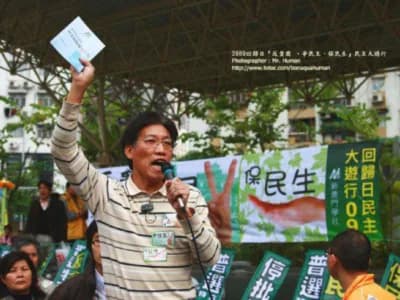
Au Kam San's international legal representative called the trial a ‘sham’ with ‘manufactured allegations’
Originally published on Global Voices
Au Kam San. Photo from Au Kam San's Facebook page.
This post is part of Global Voices’ November 2026 Spotlight series, “Justice as infrastructure**.” In this Spotlight, Global Voices is partnering with The Hague Institute for Innovation of Law (HiiL) to highlight the ways justice functions as critical infrastructure for any society. You can support this coverage by donating here.
The Chinese territory of Macau recorded its first conviction under the city’s national security law on November 6, 2026, sentencing 69-year-old former lawmaker Au Kam San to 12.5 years in prison. The Macau Court of First Instance tried the case behind closed doors, and international observers and rights groups have criticized the verdict, calling it a “bogus prosecution” that included “serious violations of his right to a fair trial.” The case raises broader questions about how justice is carried out in Macau, and whether its courts offer a fair, open way to challenge the state.
Au served in Macau’s legislature for over 20 years and remained an outspoken current affairs commentator after his retirement in 2021. He was convicted on one count of subverting state power, three counts of contacting foreign organizations to endanger national security, and one count of violating confidentiality.
According tothe court’s statement, the closed-door trial was held on September 16 and 18. Au was prosecuted under Macau’s domestic security law, enacted on March 3, 2009, and tightened in 2023.
He was accused of cooperating with hostile foreign organizations to collect and disseminate “numerous political propositions that were clearly permeated with [the intent of] subversion of state power” and to assist in the collection and dissemination of false information that intended to incite hatred against the central government, overthrow and undermine the fundamental national system established by the Chinese Constitution, cause foreign countries to take hostile actions against China and Macau, and disrupt the Macau Chief Executive election in 2024.
Au’s family members, several media outlets, and dozens of citizens attended the court’s public sentencing.
Au’s wife, Cheng Miu-shan, responded to the sentencing with an open letter, stating that the closed-door hearing and public sentencing were politically motivated and a baseless persecution to humiliate and smear her husband’s character.
Au’s daughter, Cherry Au, defended her father’s innocence in her interview with UK-based media outlet, the Independent:
“What saddens me the most is seeing him being portrayed as a villain by the very government that he served for so many years,” she said. “I hope people remember the person they knew throughout his career, the reason why they placed their trust in him and elected him time and again. Right now he is facing profound injustice. I hope those who remember his years of service will stand by him.”
Au Kam San has been detained since his arrest in July 2025. He was initially charged with three counts of “subverting state power,” three counts of “establishing contacts with organizations, groups or individuals outside the Macau Special Administrative Region to commit acts that endanger national security,” and one count of “violating confidentiality.” The court reduced the subversion charge to one count after the closed-door hearing.
After the public sentencing, the court issued a press release stressing that it appointed a lawyer to defend Au and that during the trial, Au did not dispute most of the facts and acknowledged that his collusion with and conspiracy with multiple overseas organizations constituted a crime.
It also pointed out that Au did not stop colluding with foreign and overseas organizations to subvert state power after the 2023 amendment of Macau national security law. The amendment has expanded the definition of subversive acts from “violent means” to “any illegal means,” to more closely align with Hong Kong’s 2020 version of national security law.
However, Au’s daughtertold the press that her father had been barred from contacting his family and accessing a private lawyer to represent him in court.
Michael Polak, director of Justice Abroad, who has represented Au to submit an official complaint to the UN Working Group on Arbitrary Detention, called Au’s trial a “sham” with “manufactured allegations”which brought Macau “in line with the most repressive state around the world, where the executive has the power to imprison those with whom it disagrees, with no semblance of a proper, fair legal process.”
In a statement following Au’s public sentencing, Polak also criticizedthat the private “hearing” had prevented any scrutiny of the Macao Authorities’ so-called evidence, thus creating a scenario where they could present anything, or nothing at all, to the Court and a conviction was inevitable.
So far, the public has not had any information about which foreign organizations, groups, or individuals Au Kam San conspired with to endanger national security and what distorted information he had spread to incite hatred against the Macau government, or undermine China’s socialist system.
The EU also issued a statement criticizing the conviction as “the erosion of political pluralism and freedom of speech” in Macau. It also expressed regret concerning the closed-door trial:
“We regret that access for the public, press and diplomats was restricted. After his arrest on July 30, 2025, Au Kam San had spent almost one year in incommunicado detention.”
Given that Au holds Portuguese citizenship, Polak called on Portugal and the EU to press for his release.
Au Kam San, a retired school teacher, is a prominent pro-democracy activist. After the 1989 pro-democracy movement, along with other pro-democracy figures such as António Ng Kuok Cheong, he established the “Macau Democratic Development Joint Committee” to “respond to the Chinese democratic movement and promote the democratic development of Macau.” They organized and participated in annual activities to commemorate China’s June 4, 1989, Tiananmen Square protests and massacre, until 2021, after the Macau authorities banned the Tiananmen vigil co-organized by Au, claiming that the event would incite state subversion.
Au started his public service career as a Macau municipal councilor from 1993 to 2001. In the first Legislative Council election after Macau’s reunification with China in 1999, Au and Ng formed a political team, “Democratic New Macau,” which won the race with 21 percent of the vote in their constituency. He was re-elected four times until 2021, when he announced his retirement. That year, the Election Committee disqualified 21 candidates from running in the legislative race, citing the Macau Court of Appeal ruling that supported Macau’s decision to ban commemoration of the June 4th Tiananmen Incident as subversive.
Written by Global Voices East Asia
Get the latest news delivered to your inbox.
Related articles