Mapped: Europe’s Most Indebted Countries in 2026
Persistent budget deficits have led to sizable government debt burdens across most major European countries.
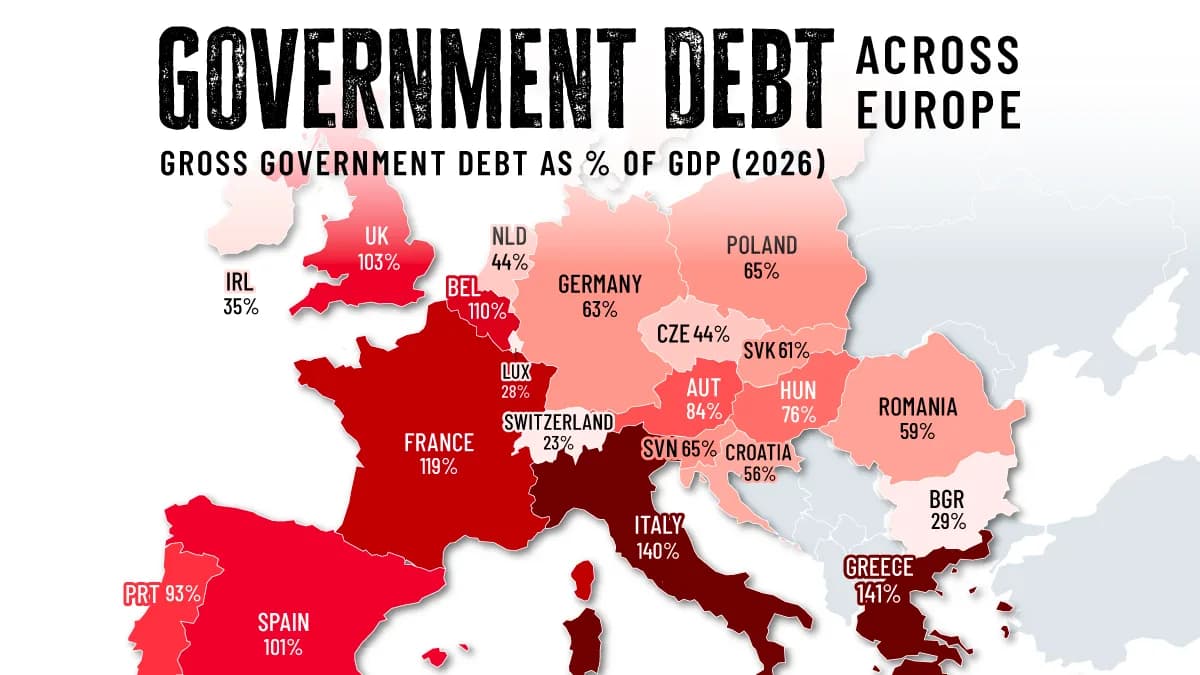
How Europe’s Biggest Economies Compare on Government Debt
Key Takeaways
Greece and Italy have Europe’s highest government debt burdens, at roughly 140% of GDP.
France’s debt-to-GDP ratio is nearly twice Germany’s, highlighting a major divide between Europe’s two largest EU economies.
Six European countries have government debt exceeding their annual economic output, including the UK and Spain.
Europe’s largest economies face vastly different debt burdens. France, Italy, Spain, and the UK all have government debt exceeding their annual economic output, while Germany’s debt stands at less than two-thirds of GDP.
This map compares gross government debt relative to GDP using figures from Eurostat, the Office for National Statistics, and the Swiss Federal Finance Administration for the second quarter of 2026.
Europe’s Uneven Starting Point
Government debt ranges from just 23.4% of GDP in Switzerland to 140.8% in Greece. Italy follows closely at 139.9%, while France ranks third at 119.1%.
Among Europe’s largest economies, Germany stands apart. Its debt ratio of 63.4% is far below France’s and less than half Italy’s, giving it a comparatively stronger starting position as governments consider new spending commitments.
The table below ranks European countries by their debt burdens as of Q2 2026.
RankCountryDebt (% of GDP) in 2026
1 Greece140.8
2 Italy139.9
3 France119.1
4 Belgium110.2
5 United Kingdom102.6
6 Spain101.4
7 Portugal92.5
8 Finland90.2
9 Austria83.6
10 Hungary75.6
11 Slovenia64.7
12 Poland64.5
13 Germany63.4
14 Norway60.8
15 Slovakia60.6
16 Romania59.4
17 Croatia56.2
18 Cyprus48.5
19 Latvia48.1
20 Malta47.0
21 Czechia43.8
22 Lithuania43.8
23 Netherlands43.7
24 Ireland35.3
25 Sweden35.3
26 Bulgaria28.7
27 Luxembourg28.2
28 Denmark27.1
29 Estonia26.1
30 Switzerland23.4
Switzerland’s figure is a full-year 2025 estimate.
Geography alone does not explain Europe’s debt burdens. Finland’s debt ratio of 90.2% is more than twice Sweden’s (35.3%) and more than three times Denmark’s (27.1%), despite all three being Nordic economies.
These differences matter as governments weigh new spending commitments. Higher debt burdens can leave budgets more exposed to financing costs, while lower debt levels can provide greater flexibility to invest or respond to economic shocks.
The UK’s Inflation-Sensitive Debt Bill
For the UK, the pressure comes from both accumulated borrowing and the cost of servicing it. Central government debt interest spending is forecast to exceed $160 billion in 2026–27, rising to more than $200 billion by 2031–32. That creates a substantial recurring claim on public funds before decisions about additional services or investment.
Britain is particularly exposed to inflation through its government bonds, known as gilts. At the end of 2025, about a quarter of its government debt portfolio was index-linked, a larger proportion than in other G7 countries. Historically, demand from pension funds seeking inflation protection helped build this market.
When inflation rises, the obligations attached to these bonds increase. Higher inflation forecasts alone added more than $15 billion to projected debt interest spending for 2026–27 compared with the previous forecast. This comes as the UK economy is expected to grow by just 1% in 2026.
Germany Opens the Door to More Borrowing
Germany is using its comparatively lower debt burden to support a major shift in fiscal policy. In March 2025, constitutional reforms relaxed its borrowing restrictions, allowing qualifying defense and security spending above 1% of GDP to be excluded from the debt brake’s borrowing limit.
A separate infrastructure and climate fund of more than half a trillion dollars also received its own borrowing authorization. Investments can be approved over 12 years, from 2025 through 2036, supporting priorities including transportation networks, energy infrastructure, and modernization.
Germany’s lower debt burden provides more room to borrow than many of its European peers, but the long-term payoff will depend on how effectively that money is invested. The country faces mounting pressure to modernize infrastructure and strengthen its industrial competitiveness amid higher energy costs and global trade tensions.
Learn More on the Voronoi App
To compare European debt with the U.S. fiscal outlook, check out U.S. Federal Debt is Forecasted to Surge on Voronoi.
Source: https://www.visualcapitalist.com/mapped-the-most-indebted-european-countries-in-2026/
Get the latest news delivered to your inbox.
Related articles