Ranked: The Best and Worst Countries for Taxes in 2026
Discover which OECD countries have the most competitive tax systems in 2026, and how the U.S. compares across key tax categories.
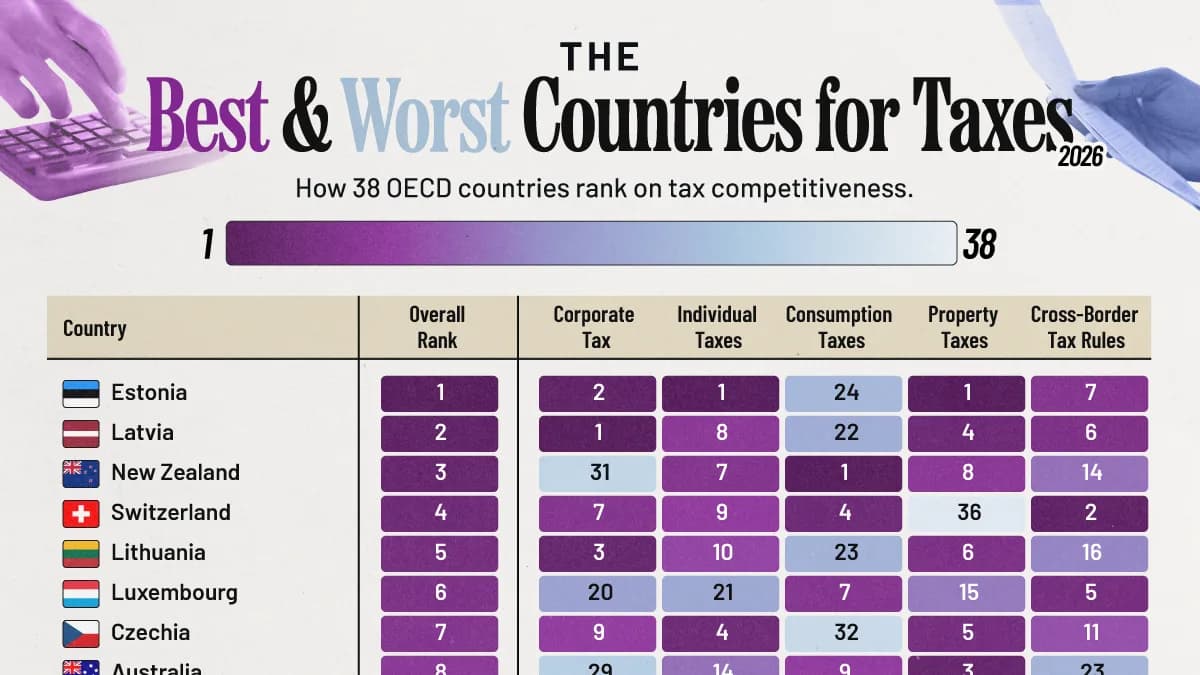
How 38 Countries Compare on Tax Competitiveness
Key Takeaways:
Estonia leads all 38 OECD countries in tax competitiveness, followed by Latvia and New Zealand.
The U.S. ranks 17th overall, placing eighth for corporate taxes but 37th for cross-border tax rules.
France ranks last, with Colombia and Italy rounding out the bottom three.
Tax systems can shape investment, business decisions, and economic activity. Some countries favor simpler rules and investment incentives, while others have more complex tax structures.
The Tax Foundation’s 2026 International Tax Competitiveness Index evaluates 38 OECD countries using more than 40 policy variables across five categories: corporate, individual, consumption, property, and cross-border taxes.
The index focuses on tax competitiveness and neutrality, rather than the overall amount of taxes collected.
Which Countries Have the Most Competitive Tax Systems?
The following table ranks all 38 OECD countries using the Tax Foundation’s 2026 index.
Overall
RankCountryOverall
ScoreCorporate
RankIndividual
RankConsumption
RankProperty
RankCross-Border
Rank
1 Estonia100.0212417
2 Latvia92.5182246
3 New Zealand88.23171814
4 Switzerland86.8794362
5 Lithuania82.631023616
6 Luxembourg81.920217155
7 Czech Republic79.49432511
8 Australia78.929149323
9 Turkey76.021615228
10 Hungary75.65338234
11 Israel75.11131111018
12 Slovak Republic74.724233717
13 Sweden74.661826912
14 Costa Rica73.3351361129
15 Canada72.2172882528
16 Netherlands71.6233014203
17 United States71.281732737
18 Austria70.91827171710
19 Germany69.2303413129
20 Norway67.51529271615
21 Mexico66.9282612238
22 Finland66.21024282124
23 Greece65.9225293019
24 Chile65.23223101336
25 Slovenia64.51412302430
26 Korea63.8263823134
27 Belgium63.51615252821
28 Japan62.3363552631
29 Ireland62.2436351827
30 United Kingdom61.9252234331
31 Denmark61.61937201432
32 Poland61.21211362925
33 Portugal59.63419211933
34 Iceland59.01332193426
35 Spain57.53320183520
36 Italy50.82716373822
37 Colombia47.33725163735
38 France45.73833313213
Three Baltic countries rank among the top five: Estonia, Latvia, and Lithuania. All three perform particularly well in corporate and property tax competitiveness.
The top 10 also includes New Zealand, Switzerland, Luxembourg, Czechia, Australia, Turkey, and Hungary, reflecting a wide range of approaches to taxation.
Why Tax Competitiveness Varies by Country
Estonia’s system stands out for taxing corporate profits primarily when they are distributed rather than when they are earned, encouraging reinvestment.
Countries can perform very differently across individual tax categories. New Zealand ranks first for consumption taxes but 31st for corporate taxes, while the UK ranks first for cross-border tax rules but just 30th overall.
The U.S. presents another contrast, ranking eighth for corporate taxes but 37th for cross-border rules. Beyond federal tax policy, its lifetime tax burden also varies considerably across states.
Tax Competitiveness vs. Tax Burden
Tax competitiveness and overall tax burden measure different aspects of a country’s tax system. The former focuses on the structure of tax rules and their effects on economic decisions, while the latter concerns how much tax is paid.
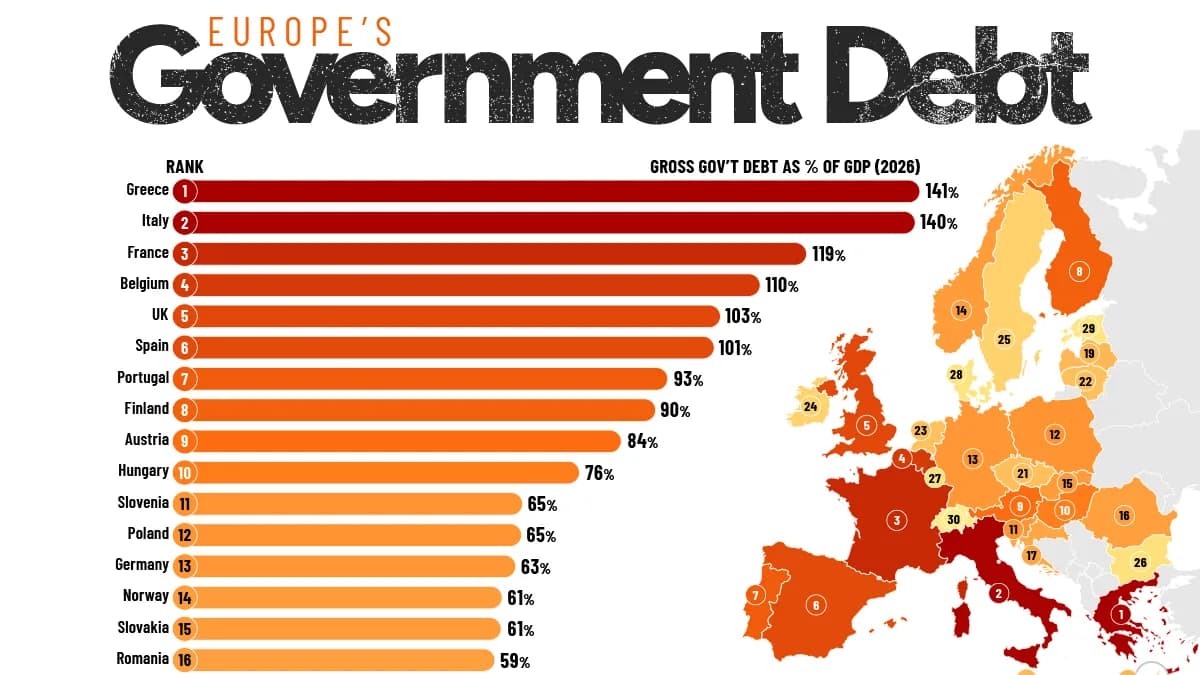
This distinction is particularly relevant in Europe, where some countries combine competitive tax systems with substantial tax revenues that fund public services.
For another perspective, compare these rankings with tax revenue as a share of GDP, which measures how much governments collect relative to the size of their economies.
Learn More on the Voronoi App
Explore Visualized: How Family Incomes Compare to Taxes in Europe to see how taxes affect household incomes across European countries.
Get the latest news delivered to your inbox.
Related articles