Scientists overcome decades-old barrier to unlock metallic conductivity in new crystal
Turns out we know very little about the world of materials. In a recent development,...
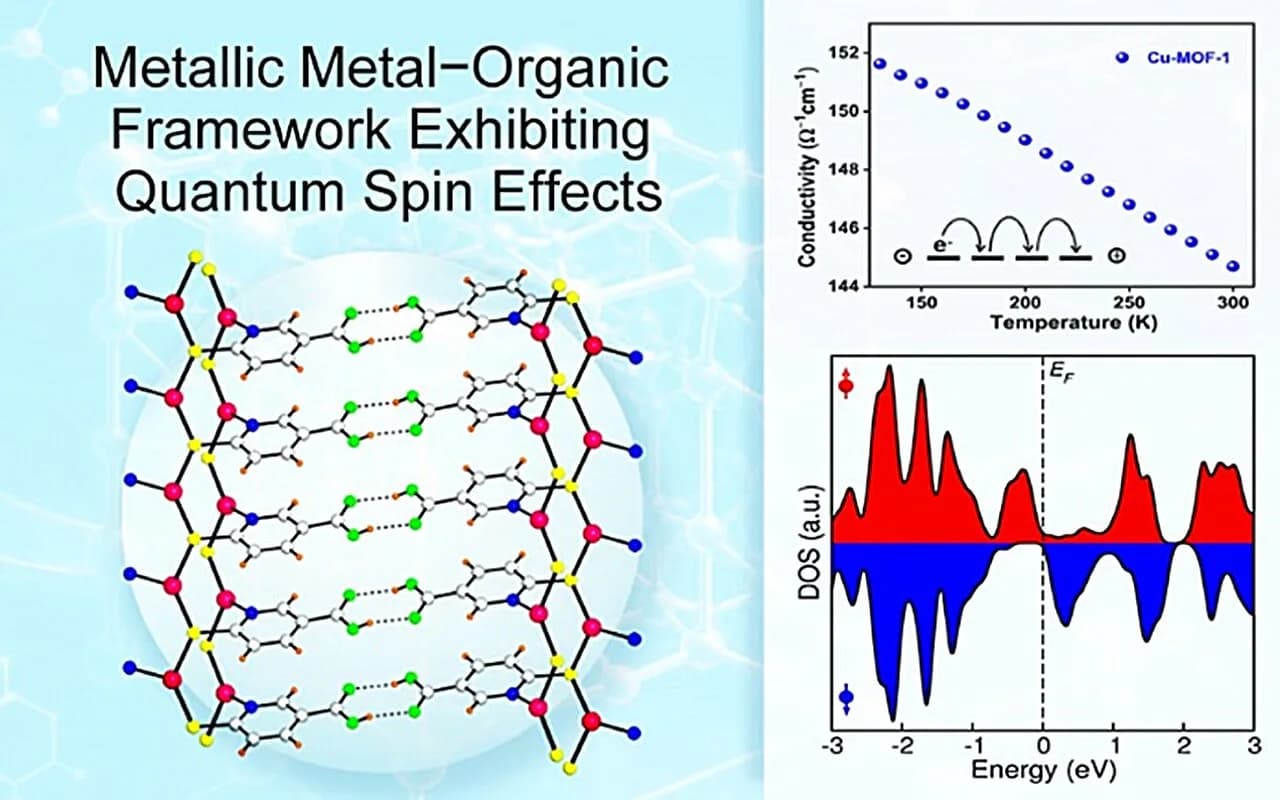
Turns out we know very little about the world of materials. In a recent development, a Taiwan-based team has designed a crystalline copper–sulfur metal–organic framework (MOF). And this material has triple power: it achieves rare metallic conductivity, exhibits strong infrared photoresponse, and half-metallic spin behavior.
Scientists have long faced a tough choice between metals, which conduct electricity well but are hard be customize. Metal-organic frameworks offer flexible molecular design but act as electrical insulators. Researchers overcame this limitation by synthesizing a new copper-based crystalline framework. This material merges metallic conductivity with the tunable chemistry of a molecular lattice.
It opens up several high-impact applications across electronics, sensing, and energy.
Metallic conductivity
Normally, customizable frameworks block electricity, and metals can’t be easily tweaked at the molecular level. This crystal gives scientists both in one material, plus two big bonuses.
The study introduces a single-crystal MOF built from self-assembled copper-sulfur chains that allow electrons to glide smoothly across the crystal structure.
Single-crystal device testing demonstrated an unusually high electrical conductivity of up to 120 siemens per centimeter for a crystalline metal-organic framework. Temperature-dependent measurements further verified zero activation energy, proving that the material supports genuine metallic charge transport.
The crystals proved equally impressive when exposed to light. When exposed to infrared light, the crystal converts faint optical signals into a remarkably strong electrical current, reaching a responsivity of 8,100 amperes per watt. Long carrier lifetimes keep electrical charges moving before they fade away, allowing the sensor to capture even weak light signals with high accuracy.
A wide linear dynamic range also ensures the material responds reliably across both dim and bright infrared conditions.
These traits position the crystal as a compelling candidate for high-speed infrared sensors, energy storage systems, and next-generation optoelectronic hardware. It could help advance night-vision cameras, medical imaging, and high-speed optical communication.
Copper atoms (pink) and sulfur atoms (yellow) form repeating zigzag chains in the crystal. Credit: Advanced Science (2026).
Future applications
Quantum-mechanical simulations revealed an even deeper surprise hidden inside the lattice.
Theoretical modeling showed that the material enters an exotic half-metallic state, splitting electron behavior along spin lines.
“This work redefines the understanding of MOF conductivity by establishing spin as a key quantum descriptor of electronic transport,” said co-corresponding author Dr. Michitoshi Hayashi, a research fellow at the Center for Condensed Matter Sciences at National Taiwan University.
Spintronics relies on controlling both electron spin and electrical charge to enable faster, more energy-efficient memory and logic devices. Chemists could now use this new copper-sulfur framework to design and build such quantum electronic properties from the ground up.
Its spin-selective conductivity makes it ideal for faster, lower-power spintronic memory, logic circuits, and quantum computing hardware. Exceptional infrared sensitivity also positions the crystal for high-speed photodetectors, night-vision imaging, autonomous vehicle LiDAR, and optical communications.
Furthermore, its high electrical conductivity and thermal stability support advanced chemical sensors, supercapacitors, batteries, and light-driven energy conversion systems.
The study was published in Advanced Science.
Get the latest news delivered to your inbox.
Related articles