Mapped: The Price of a Big Mac Around the World
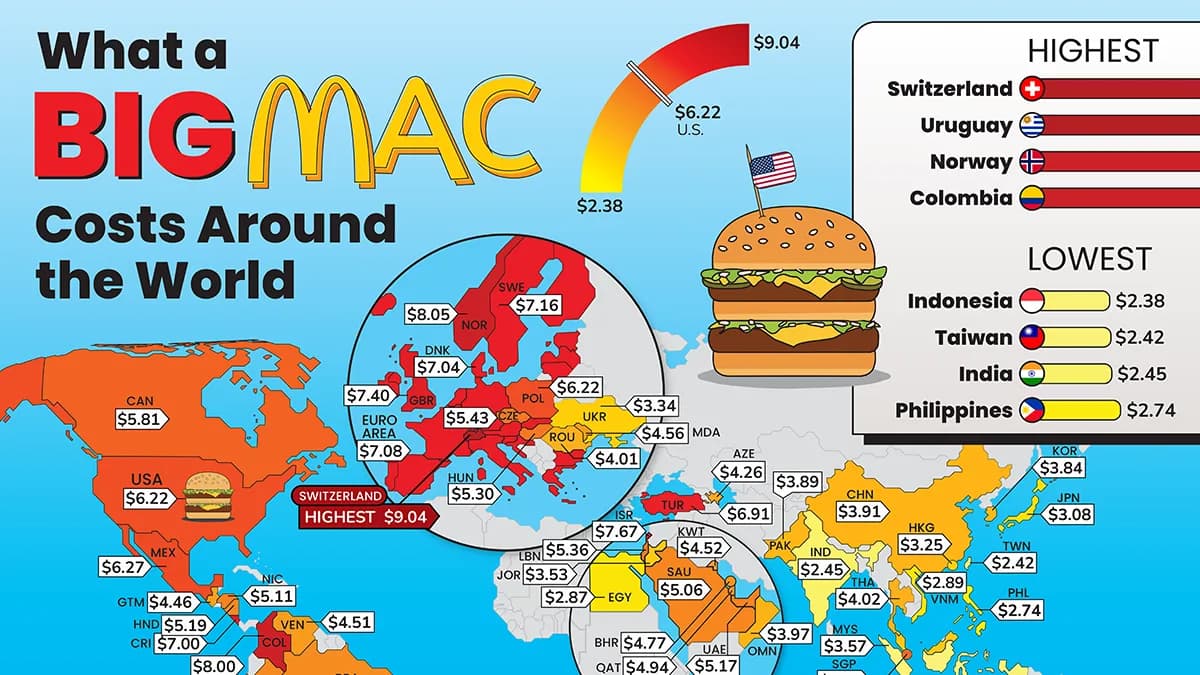
A Big Mac costs $9.04 in Switzerland and $2.38 in Indonesia. See how Big Mac prices compare across 54 markets in 2026.
What Big Mac Prices Reveal About the Global Economy
Key Takeaways
The Big Mac Index uses the price of a McDonald’s burger to compare purchasing power and currency valuations around the world.
Switzerland has the most expensive Big Mac at $9.04, nearly four times the price in Indonesia ($2.38).
Seven of the 10 lowest-priced Big Macs are in Asian countries, highlighting significant differences in dollar-denominated prices across economies.
What can the price of a Big Mac tell us about the global economy? Quite a lot, according to The Economist’s Big Mac Index.
The index uses the price of the same McDonald’s burger across countries to explore purchasing power parity, an economic concept that compares what money can buy in different countries and whether currencies appear overvalued or undervalued.
This graphic compares Big Mac prices across 53 countries, territories, and the euro area using The Economist’s July 2026 data.
Switzerland Has the Most Expensive Big Mac
Switzerland’s $9.04 Big Mac costs about 45% more than the $6.22 U.S. benchmark. Uruguay follows just 10 cents behind at $8.94, with Norway third at $8.05.
European markets occupy six of the top 10 positions, including the euro area, which ranks eighth at $7.08. The euro area is reported as a single aggregate rather than as separate prices for each member country.
The table below ranks each country, territory, and area by the price of a Big Mac in U.S. dollars:
RankCountry / Territory / AreaBig Mac Price (USD)
1 Switzerland9.04
2 Uruguay8.94
3 Norway8.05
4 Colombia8.00
5 Israel7.67
6 United Kingdom7.40
7 Sweden7.16
8 Euro area7.08
9 Denmark7.04
10 Costa Rica7.00
11 Türkiye6.91
12 Mexico6.27
13 United States6.22
14 Poland6.22
15 Australia5.95
16 Argentina5.91
17 Canada5.81
18 Singapore5.77
19 Czechia5.43
20 Chile5.41
21 Lebanon5.36
22 Hungary5.30
23 Honduras5.19
24 United Arab Emirates5.17
25 New Zealand5.14
26 Nicaragua5.11
27 Saudi Arabia5.06
28 Peru4.99
29 Qatar4.94
30 Bahrain4.77
31 Brazil4.71
32 Moldova4.56
33 Kuwait4.52
34 Venezuela4.51
35 Guatemala4.46
36 Azerbaijan4.26
37 Thailand4.02
38 Romania4.01
39 Oman3.97
40 China3.91
41 Pakistan3.89
42 South Korea3.84
43 Malaysia3.57
44 Jordan3.53
45 South Africa3.49
46 Ukraine3.34
47 Hong Kong3.25
48 Japan3.08
49 Vietnam2.89
50 Egypt2.87
51 Philippines2.74
52 India2.45
53 Taiwan2.42
54 Indonesia2.38
These price differences offer a window into currency valuations. Under the Big Mac Index’s purchasing power parity framework, a burger that costs more than the U.S. benchmark can suggest that a currency is overvalued against the dollar, while a cheaper burger can suggest the opposite.
Why is a Big Mac so expensive in Switzerland? One contributing factor is the country’s high food prices. Agricultural import protections limit competition from cheaper foreign products, with an OECD review finding that these policies raise consumer food costs.
Despite being the birthplace of the Big Mac, the United States ranks 13th at $6.22. That’s cheaper than Switzerland, Uruguay, and much of Western Europe, but more expensive than neighboring Canada ($5.81) and most Asian markets. See how McDonald’s locations compare across countries.
Indonesia Has the Cheapest Big Mac
Indonesia has the lowest Big Mac price at $2.38, about one-quarter of Switzerland’s. Taiwan ($2.42) and India ($2.45) round out the three cheapest markets.
Japan also falls near the bottom. Its local price of 500 Japanese yen (about $3.08) converts at roughly 162 yen per U.S. dollar during the survey period, leaving the dollar price at about half the U.S. level.
Exchange rates play an important role in these comparisons. When a currency weakens against the dollar, a Big Mac becomes cheaper in dollar terms even if the restaurant hasn’t changed its local price. This is one reason the index can highlight potential currency misalignments.
However, a cheaper Big Mac doesn’t necessarily mean it’s more affordable for local residents. The index doesn’t directly account for local wages and their purchasing power. A tourist exchanging dollars and a resident earning local wages can experience the same menu price very differently.
The Big Mac Index isn’t a precise measure of currency value, but that’s part of its appeal. By using one familiar product sold across dozens of markets, it makes the abstract concept of purchasing power parity easier to understand. It also offers a more standardized comparison than broader restaurant meal price rankings, where dishes can vary significantly between countries.
Learn More on the Voronoi App
If you enjoyed today’s post, explore The Big Mac Index: Price Trends by Country (2000–2025) on Voronoi.
Get the latest news delivered to your inbox.
Related articles