Mapped: Which European Countries Invest the Most Abroad?
Companies in one European country invested over $100 billion overseas in 2025. The country only has 700,000 residents.
Where Europe’s Biggest Overseas Investments Come From
Key Takeaways
Luxembourg leads Europe with over $100 billion in outward investment, reflecting its role as a multinational financial hub.
Germany and the UK follow, with each recording more than $80 billion in foreign direct investment outflows in 2025.
Five European countries recorded negative investment outflows, led by Belgium at -$18.6 billion.
Companies across Europe invested nearly $650 billion abroad in 2025. Remarkably, the largest source was a country with fewer than one million people.
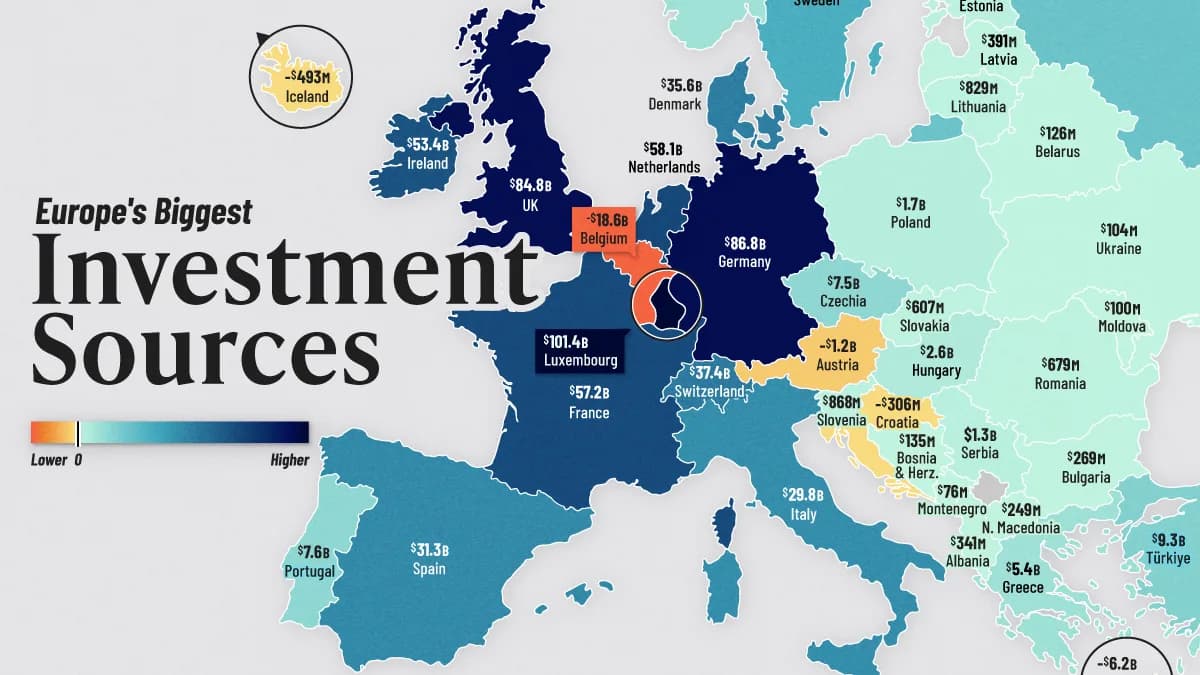
This map shows European countries’ foreign direct investment (FDI) outflows in 2025, using data from the World Investment Report 2026.
FDI involves a lasting stake in a business abroad, including acquisitions, reinvested earnings, and intercompany loans. These figures include investment flows between European countries, not just investments outside the continent.
Europe’s Largest Overseas Investors
Luxembourg recorded $101.4 billion in outward investment in 2025, followed by Germany at $86.8 billion and the United Kingdom at $84.8 billion. Together, the three countries accounted for over 40% of Europe’s total.
Luxembourg’s lead partly reflects its role as a financial conduit for multinational companies, a role shared by the Netherlands ($58.1 billion). Investments routed through locally registered companies can ultimately originate with owners elsewhere.
The table below ranks European countries by their FDI outflows in 2025.
RankCountryFDI Outflows in 2025 (millions $)
1 Luxembourg101,384
2 Germany86,837
3 UK84,759
4 Netherlands58,105
5 France57,156
6 Ireland53,410
7 Switzerland37,433
8 Denmark35,631
9 Spain31,346
10 Italy29,793
11 Sweden18,179
12 Russia12,924
13 Malta11,403
14 Finland9,635
15 Turkiye9,252
16 Portugal7,597
17 Czechia7,516
18 Greece5,428
19 Norway5,078
20 Hungary2,633
21 Poland1,732
22 Serbia1,349
23 Slovenia868
24 Estonia836
25 Lithuania829
26 Romania679
27 Slovakia607
28 Latvia391
29 Albania341
30 Bulgaria269
31 North Macedonia249
32 Bosnia and Herzegovina135
33 Belarus126
34 Ukraine104
35 Moldova100
36 Montenegro76
37 Croatia-306
38 Iceland-493
39 Austria-1,234
40 Cyprus-6,235
41 Belgium-18,584
The leading FDI sources include both major economies and smaller countries with extensive international business networks. Denmark ($35.6 billion), for example, ranks ahead of much larger economies such as Italy and Spain.
Five countries recorded negative outflows, with Belgium posting the largest net reduction at $18.6 billion. Negative figures can reflect divestments, reductions in equity positions, or repayments of intercompany loans from overseas affiliates. They do not necessarily mean that companies stopped investing abroad.
German Companies Expand Across Major Markets
Germany’s strong position reflects the global reach of Europe’s largest economy, whose industrial companies operate far beyond their home market. Recent projects illustrate how German firms are expanding closer to customers in the United States and China, two of their largest export markets.
In March 2025, Siemens unveiled a $285 million investment in electrical equipment facilities in California and Texas. The expansion more than doubled its U.S. production capacity for equipment supporting infrastructure such as data centers, illustrating how the technology boom is creating demand for European industrial suppliers.
Meanwhile, BASF began production at its Zhanjiang chemical complex in November 2025. The approximately $10 billion multiyear project is designed primarily to serve Chinese customers.
Pharmaceuticals and Acquisitions Shape Investment
European drugmakers are also expanding their U.S. operations. In 2025, UK-based AstraZeneca announced plans to invest $50 billion in U.S. manufacturing and research through 2030. France’s Sanofi announced plans to invest at least $20 billion over the same period.
The commercial incentive is substantial. AstraZeneca aims to generate half of its targeted $80 billion in 2030 revenue in the United States. Expanding manufacturing and research facilities strengthens its presence in a critical market while potentially reducing exposure to future U.S. tariffs.
Investment also reshapes businesses within Europe. Denmark’s DSV completed its acquisition of Germany’s Schenker in April 2025, in a transaction with an enterprise value of over $15 billion. The combination brought together nearly 160,000 employees across more than 90 countries, illustrating how a cross-border European acquisition can rapidly expand a company’s global reach.
These corporate examples illustrate the scale of European investment abroad, although announced multiyear commitments do not necessarily correspond to FDI outflows recorded in a single year.
Learn More on the Voronoi App
To explore the industries attracting foreign investment, check out The Top 10 Sectors for Foreign Direct Investment (FDI) on Voronoi.
Source: https://www.visualcapitalist.com/mapped-european-countries-invest-the-most-abroad-fdi/
Get the latest news delivered to your inbox.
Related articles