‘Who will respond?’: Jailed Hong Kong pro-democracy activist Joshua Wong fears being forgotten amid 10-year sentence
The 30-year-old pro-democracy activist has spent almost six years behind bars and was set for release in January 2026, until authorities charged him with conspiring to foreign collusion last year.
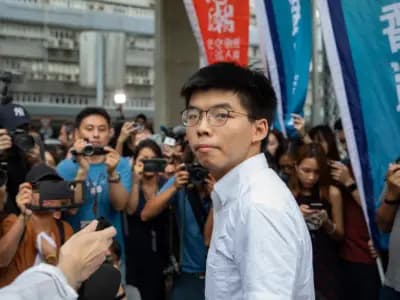
The activist admits his mental state has been negatively affected by the 10-year sentence increase
Originally published on Global Voices
Joshua Wong released from Lai Chi Kok Reception Centre on June 17, 2019. HKFP's File photo.
This article was originally published by Hong Kong Free Press on November 16, 2026. The following version is edited and republished on Global Voices under a content partnership agreement. It is also part of Global Voices’ November 2026 Spotlight series, “Justice as infrastructure.” You can support this coverage by donating here.
In a letter from a Hong Kong prison earlier this year, jailed activist Joshua Wong expressed dread over the looming sentence in his foreign collusion case. “Fretting about whether it’s 2032 or 2037, my mental state is hardly all right,” he wrote in Chinese, weighing when he might regain his freedom.
The agony inevitably stems from this: What if it’s 2037? Well, it’s easy [for people] to sympathise in the moment, but it’s difficult to be consistent, and it will only get harder.
The 30-year-old pro-democracy activist has already spent almost six years behind bars over various offences and was set for release in January 2026, until authorities charged him last year with conspiring to collude with foreign forces — the second case against him under the Beijing-imposed national security law. His case is one of the most high-profile examples of changing judicial norms in Hong Kong.
A prison letter Joshua Wong wrote to friend and former fellow student activist Louis Lee in February 2026. This photo was taken on September 30, 2026. Photo by Kyle Lam/HKFP. Used with permission.
On November 5, just two months before he was due to be released, a court sentenced him to 10 more years in prison for colluding with foreign forces. He is now expected to serve until late 2036, when he turns 40.
Standing in the courtroom as his new sentence was announced, Wong shook his head slightly and made notes, but appeared calm. Judge William Tam ruled that Wong’s offence was one of a “grave nature” under the national security law, which carries a minimum penalty of 10 years in jail and up to life imprisonment.
The judge knocked off three years from a 13-year starting sentence for Wong’s guilty plea.
In prison correspondence shared with HKFP by two close friends ahead of Wong’s sentencing, the former poster child of Hong Kong’s democracy movement had at times reflected on the weight of facing an additional decade behind bars. He expressed anxiety over fading from the memory of his friends — and from society at large. In one letter, Wong wrote:
I have no idea how much more I will lose in the passing of time. Responsibility is, in fact, response-ability. But who will respond? I can’t help but ponder and doubt.
Once a pro-democracy activist dedicated first and foremost to Hong Kong’s political future, Wong began campaigning as a charismatic, eloquent student leader who dared to stand up to the authorities — even to Beijing. Hong Kong is an overseas territory of China, and has increasingly been pressured to conform to China’s political goals in recent years, despite agreements that Hong Kong would retain “a high degree of autonomy” when handed over to China in 1997. A Netflix documentary about him is succinctly titled “Joshua: Teenager vs. Superpower.”
Yet, after years behind bars, Wong has changed. The teenager who focused single-mindedly on Hong Kong’s democracy movement has become even more caring for those around him despite being separated by prison walls, according to his friends.
Tiffany Chin, a former student activist who campaigned alongside Wong, said. The pair were once romantically involved and are now friends. She shared:
For me, it doesn’t feel like we’re the only ones supporting him. In fact, he has been supporting people on the outside in his own way.
And, with the political causes he once championed now firmly crushed, Wong has turned inward to reflect on himself. In another letter, he wrote:
We had held such high aspirations for society from a young age, we should hold ourselves to the same standard. Only by refusing a life of mediocrity can we be worthy of the world we envisioned.
From “robot” tocaring friend
On a bright summer day in June 2025, while serving a sentence for subversion at Stanley Prison, Wong was arrested behind bars and brought to court the same day on a fresh charge of conspiracy to collude with foreign forces.
The prosecution came without warning. That day, Chin and Louis Lee, another longtime friend of Wong’s, rushed to the court after hearing the news, but failed to see him in person.
Authorities accused him of conspiring with Nathan Law — another high-profile, pro-democracy student activist — in 2020 to collude with foreign elements, citing Wong’s sharing of Law’s social media posts calling for international sanctions against Hong Kong as evidence.
The unexpected new charge was devastating to Wong. That month, he confessed he was under a lot of pressure — a vulnerability he rarely showed in the past, Chin said.
After so many prison terms and all the ups and downs over the last decade… he seldom openly showed vulnerability. So when he felt the need to say so bluntly that he was not OK, I truly believed he wasn’t.
Having begun campaigning at the age of 14, Wong has been in and out of prison throughout his years of activism. He now has a total of eight criminal convictions, including three separate offences linked to unlawful assembly and two national security offences.
Joshua Wong is photographed inside the Lai Chi Kwok Reception Centre on March 4, 2021. Photo via HKFP. Used with permission.
Born in 1996 to a Christian family – one year before Hong Kong was handed over to China from British rule – Wong rose to prominence in 2011 when he co-founded student protest group Scholarism amid a public outcry against a proposed patriotic education curriculum.
The following year, Scholarism activists occupied the forecourt outside Hong Kong government headquarters and staged a hunger strike to protest what they described as a “brainwashing” curriculum. In a widely reported encounter, the teenager Wong twice refused to shake hands with then-city leader Leung Chun-ying, who visited the protest site alongside education officials.
Hundreds of thousands of people rallied behind Wong and his fellow student activists, forcing the government to back down and shelve the proposal.
But the teenage campaigner was also viewed as somewhat distant and domineering among the inner circle of Scholarism. Lee, who mainly handled protest logistics at that time, described his relationship with Wong as “almost like that of a boss and subordinate.”
Chin, who joined Scholarism around 2013, similarly described Wong as a deeply rational figure who seldom expressed his emotions. “Ten years ago, everyone described him as someone without many feelings,” she said. “Like a robot.”
Wong might even come across as “rude,” she added, noting that he rarely said thanks to others during that period.
A large part of Wong’s youth coincided with a period of escalating social movements in Hong Kong. Just two years after the anti-patriotic education protests, the city saw the 79-day Umbrella Movement in 2014. Wong, then aged 17, took centre stage in mobilising public support for student protesters, who demanded democratic reform and universal suffrage.
In a demonstration that sparked the Umbrella Movement, Wong and other student leaders led protesters into the forecourt of the government headquarters in an action dubbed “Reclaiming Civic Square,” seeking to escalate their campaign. That eventually resulted in Wong’s first criminal conviction.
In 2016, Wong and fellow student leaders Alex Chow and Nathan Law were found guilty of unlawful assembly. Though initially spared prison, Wong later served around 69 days behind bars – his first jail term – following a government appeal in 2017. His penalty was ultimately quashed by the Court of Final Appeal in 2018.
Scholarism disbanded in 2016. Wong and several former members, as well as young activists like Law, went on to establish Demosisto, a political party advocating for “democratic self-determination” in the city. Wong served as general secretary.
Lee and Chin did not join the new party, and they grew estranged from Wong during that period.
That year, Law was elected to the Legislative Council, making him the youngest lawmaker in Hong Kong history at the age of 23. He won over 50,000 votes, giving Demosisto a strong popular mandate. The prospect of youth democracy activism appeared bright at the time, but Law was eventually disqualified from his seat in 2017 following an oath-taking controversy.
From left: Joshua Wong, Agnes Chow, and Nathan Law, photographed on March 10, 2018. Photo via HKFP. Used with permission.
Reconnections
It was only after Wong’s detention in late 2020 that Lee and Chin reconnected with him, beginning with an exchange of letters.
In 2019, citywide protests and unrest triggered by a controversial extradition bill engulfed the city. Wong and Demosisto were heavily involved in the protests, with the activist frequently lobbying foreign governments to impose sanctions on Hong Kong officials and halt the export of crowd control equipment to the city’s police force.
Then, in June 2020,Beijing imposed the national security law, effectively crushing political dissent in the city. Demosisto disbanded on the eve of the law’s enactment, while Nathan Law left Hong Kong in self-exile.
In November that year, Wong was remanded in custody after pleading guilty to an unlawful assembly charge linked to the 2019 unrest, marking the beginning of his prison stint that continues to this day.
For Chin, the catalyst for reconnecting with Wong was realising how much their relationship meant to her following his incarceration.
We were like family to each other. And I felt it was time to resolve our past grievances and carry on our relationship. Not a romantic one, but one with the kind of care you find in a family.
Tiffany Chin uploaded this photo of herself and Joshua Wong after Wong was sentenced to 10 years in jail for foreign collusion. Photo via HKFP. Used with permission.
Their correspondence, Chin said, focused mostly on daily life – the routine details of what was happening on both sides of the prison walls. Some of those Chin received stretched across multiple pages, covered in Wong’s slightly angular handwriting.
A major change in Wong, Chin noticed, was how often he reflected on his past interactions with people, rather than his public advocacy.
He has changed quite a bit after nearly six years in prison. Like I said, he would reflect on things he didn’t handle well in the past. Age is certainly a factor. But, like he said, he has had plenty of time to contemplate now. One of the big differences is that he has cherished his connections and bonds with friends even more.
Meanwhile, Lee’s exchanges with Wong centred on their wide-ranging shared interests, touching on everything from Taiwanese politics and Japanese idols to popular anime series and Cantopop.
While in prison, Wong was charged with conspiring to subvert state power under the national security law, in a landmark case known as the “Hong Kong 47” – a reference to the number of defendants.
The defendants were prosecuted over an unofficial primary in 2020 aimed at fielding viable candidates, in a bid to secure an unprecedented legislative majority for the pro-democracy camp. Once achieved, the camp had planned to veto government budgets and force the chief executive to resign.
Wong was among those who pleaded guilty before the trial opened. In 2024, he was sentenced to four years and eight months in jail.
Lee and Chin both described Wong as being “prepared” for the subversion term. Chin said:
He was able to predict a range within which the sentence would fall. And eventually his prediction was just two months off. You weren’t overly worried about him. Because at that time you had the feeling that he was capable of handling this, both physically and mentally.
Wong even started imagining what he would do after his release in January 2027, Lee said, before the new charge dimmed his hope.
“Await your return”
In September, Wong pleaded guilty to the collusion offence. His lawyer argued for a sentence of less than 10 years, submitting that his role in the conspiracy was limited and that the activist demonstrated genuine remorse.
At times, he has lamented the dwindling attention he receives over the years. Chin said:
He once mentioned that, for him, not receiving letters meant not feeling cared for. Some people might have written at first, but gradually stopped… He certainly never feels people have a responsibility or obligation to write to him, but the reality is that fewer have.
The uncertainty of a potentially heavy sentence has weighed on Wong and his close friends. Lee noted that many mutual friends had either left the city or drifted away:
Honestly speaking, not only does he worry about a long jail term, those of us on the outside also worry that one day we may no longer be able to help as we enter new stages of life.
It was a “great pain” to face the years ahead, Chin said. Lee said he would wait for Wong’s release for as long as it takes.
Louis Lee, photographed on November 12, 2026. Photo by Kyle Lam/HKFP. Used with permission.
Written by Hong Kong Free Press
Get the latest news delivered to your inbox.
Related articles