Mapped: The Top Crop in Every U.S. County
Explore America’s crop belts in 2025, from corn across the Midwest to wheat in the Great Plains and specialty crops in California.
What America Grows, County by County
Key Takeaways
Corn, hay and alfalfa, and soybeans are the leading crops in more than 71% of U.S. counties in the dataset.
Corn dominates Iowa, ranking first by acreage in 95% of the state’s counties.
Neither corn nor soybeans is the leading crop in any California county.
From the wheat fields of the Great Plains to the vineyards of California, America’s agricultural landscape changes dramatically from one region to the next. Differences in climate, soil, and water availability help shape what farmers grow across the country.
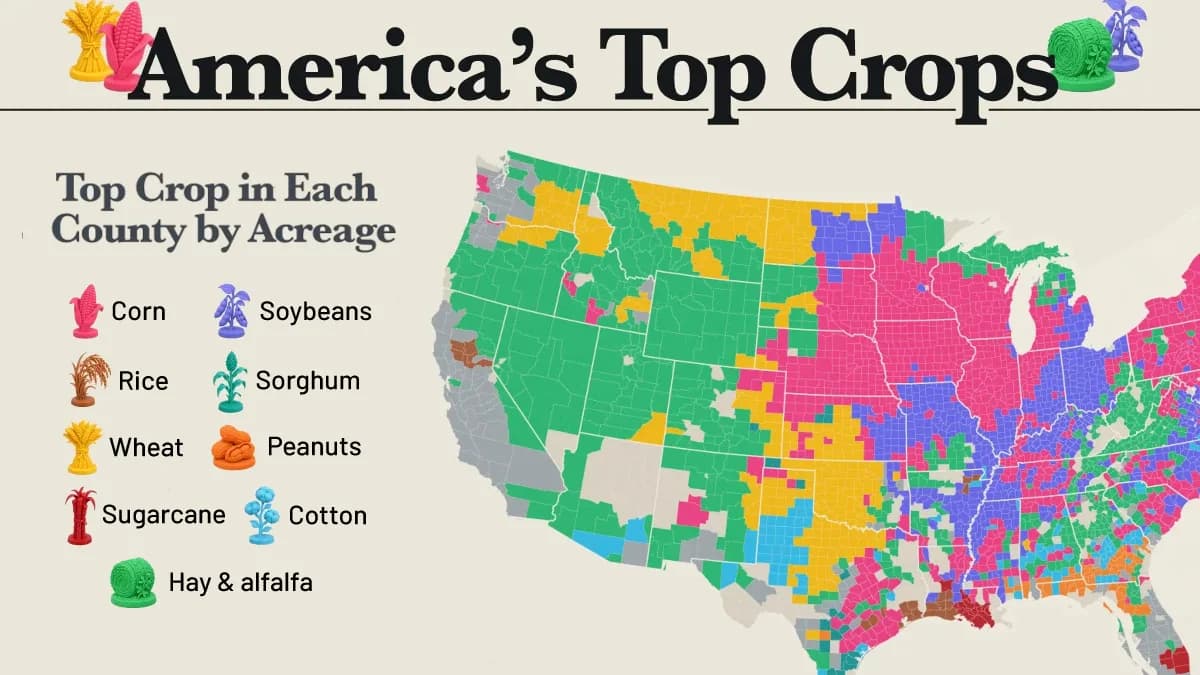
This map visualizes America’s crop belts in 2025, highlighting the leading crop by acreage in each county.
The data for this visualization comes from the U.S. Department of Agriculture’s (USDA) Cropland Data Layer, compiled by Serō Ag Strategies.
The dataset uses satellite imagery to identify the leading crop across 3,107 counties and county equivalents, excluding Alaska and Hawaii.
Corn Dominates the American Midwest
Corn ranks first by acreage in more counties than any other crop, leading in 945 counties, or roughly three in every 10.
Its dominance is particularly striking in Iowa, where corn leads in 94 of the state’s 99 counties. Nebraska and Illinois follow with 84 and 75 counties, respectively, reflecting the concentration of production across America’s traditional Corn Belt.
The table below shows the crop that leads by acreage in the greatest number of counties in each state, rather than the crop with the largest total statewide acreage.
StateLeading cropCountiesShare of counties
AlabamaHay and alfalfa2334%
ArizonaHay and alfalfa747%
ArkansasSoybeans3344%
CaliforniaGrapes1424%
ColoradoHay and alfalfa3148%
ConnecticutCorn563%
DelawareCorn3100%
FloridaPeanuts1522%
GeorgiaHay and alfalfa5031%
IdahoHay and alfalfa2250%
IllinoisCorn7574%
IndianaSoybeans5560%
IowaCorn9495%
KansasCorn3937%
KentuckySoybeans6050%
LouisianaCorn1625%
MaineHay and alfalfa1275%
MarylandCorn1875%
MassachusettsHay and alfalfa1071%
MichiganHay and alfalfa3137%
MinnesotaCorn6676%
MississippiSoybeans4049%
MissouriSoybeans7868%
MontanaHay and alfalfa3257%
NebraskaCorn8490%
NevadaHay and alfalfa1482%
New HampshireHay and alfalfa10100%
New JerseyCorn / Soybeans (tie)5 each24% each
New MexicoHay and alfalfa1752%
New YorkCorn3963%
North CarolinaSoybeans4242%
North DakotaWheat2649%
OhioSoybeans6776%
OklahomaWheat4964%
OregonHay and alfalfa1953%
PennsylvaniaCorn5176%
Rhode IslandHay and alfalfa480%
South CarolinaCorn1635%
South DakotaCorn4568%
TennesseeSoybeans3840%
TexasWheat6325%
UtahHay and alfalfa2793%
VermontHay and alfalfa1393%
VirginiaHay and alfalfa4030%
WashingtonWheat1333%
West VirginiaHay and alfalfa3767%
WisconsinCorn6286%
WyomingHay and alfalfa2296%
Corn’s versatility as a source of livestock feed, ethanol, and food ingredients makes it an important commodity in the U.S. agricultural economy.
Beyond the Corn Belt
While corn dominates much of the Midwest, hay and alfalfa define large stretches of the American West. These forage crops, primarily used to feed livestock, lead in 652 counties nationwide, followed by soybeans in 618 counties.
Hay and alfalfa are particularly widespread across the Mountain West, dominating 22 of Wyoming’s 23 counties and nearly all of Utah’s 29 counties.
Meanwhile, wheat leads in 253 counties nationwide, with significant concentrations across the Great Plains, while cotton and peanuts remain prominent across parts of the South.
California’s Specialty Crop Economy
California presents a striking contrast to the commodity crop belts of the central U.S., with an agricultural landscape characterized by vineyards, orchards, and vegetable farms.
Grapes are the leading crop in 14 California counties, including the renowned wine-producing regions of Napa and Sonoma. Almonds dominate eight counties, including Fresno and Kern, while pistachios lead in Kings and San Bernardino counties.
The South’s Diverse Crop Belts
The South’s warmer climate and longer growing seasons support a wide variety of crops.
Peanuts and cotton dominate across much of southern Georgia and parts of Alabama, while rice is the leading crop in several counties in eastern Arkansas.
Florida has its own distinct agricultural landscape, with oranges leading across much of the central part of the state and sugarcane dominating several counties near Lake Okeechobee.
What America Doesn’t Grow Enough Of
Despite America’s vast agricultural resources, the country’s major crop belts tell only part of the story of its food supply.
According to the USDA, imports accounted for 59% of America’s fresh fruit supply and 35% of its fresh vegetable supply in 2023.
The country is particularly dependent on imports of tropical crops such as coffee, cocoa, and bananas, which are difficult to grow commercially across most of the U.S.
Imports also help meet year-round demand for crops like avocados, tomatoes, and berries outside of domestic growing seasons.
Learn More on the Voronoi App
If you enjoyed today’s post, check out The States with the Most Farmland on Voronoi.
Get the latest news delivered to your inbox.
Related articles