New model beats standard background subtraction on particle jets in simulated collisions
Physicists at Brookhaven National Laboratory have built a machine-learning model that learns on its own...
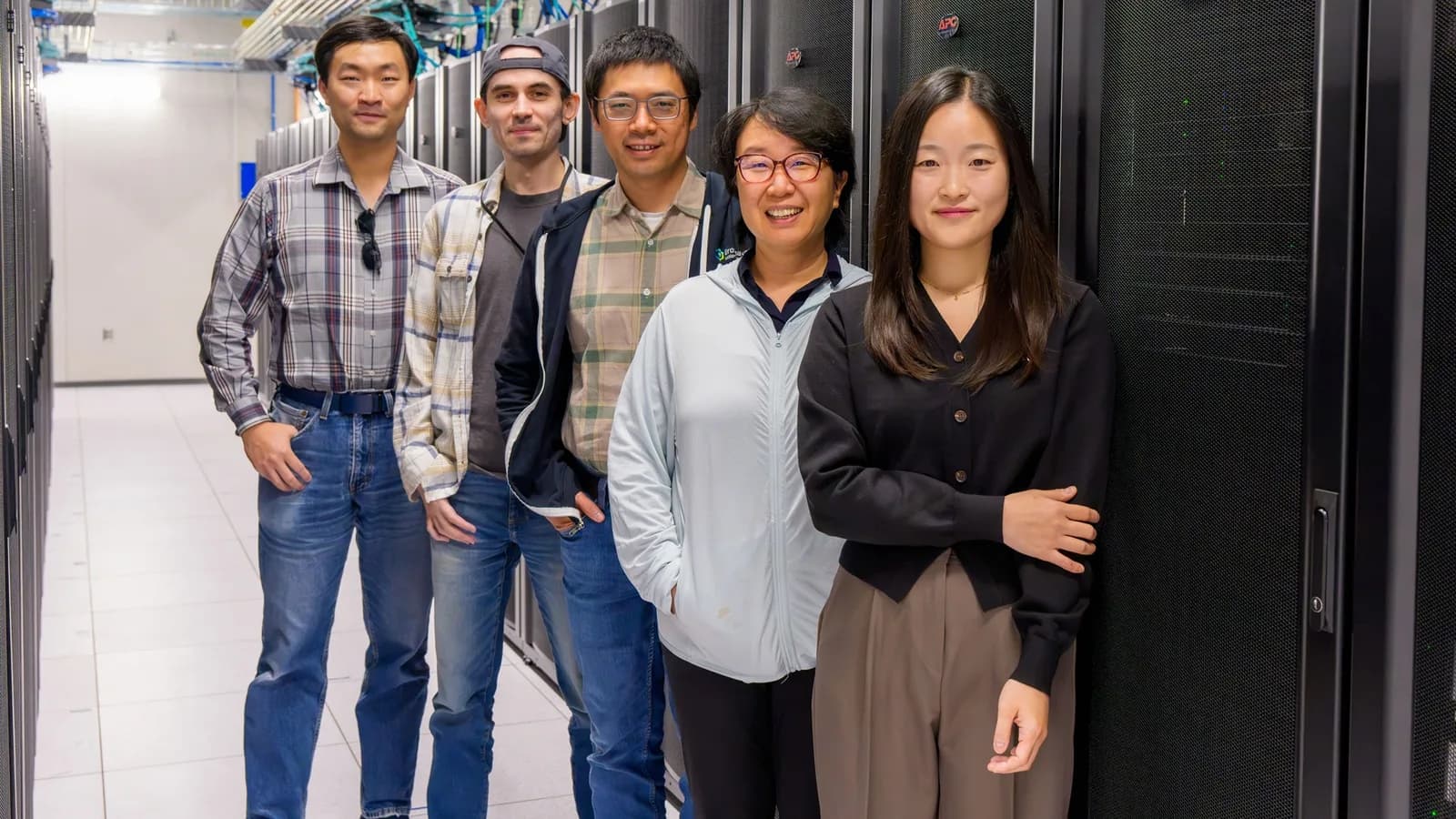
Physicists at Brookhaven National Laboratory have built a machine-learning model that learns on its own to pick out particle jets from the huge background of debris in heavy-ion collisions. The advance could sharpen measurements of the quark-gluon plasma, the hot, dense state of matter that existed a microsecond after the Big Bang.
A team led by Brookhaven, with researchers from Columbia University and the University of Colorado Boulder, describes the method in Scientific Reports. It’s the first use of an “unpaired, unsupervised” generative model for this job, the lab says. The model learns directly from simulated collision data instead of from labels supplied by scientists.
Why jets are hard to see
At the Relativistic Heavy Ion Collider (RHIC), which completed operations in early 2026, beams of heavy ions collide at nearly the speed of light and briefly recreate a “soup” of free quarks and gluons. Jets, collimated sprays of high-energy particles, are among the best probes of that plasma. They lose energy and change structure as they pass through it.
But a jet’s signal is buried in an enormous background of other particles, a problem that has long limited the precision of jet measurements. “Improving background subtraction can enable more precise measurements of how quarks and gluons interact under extreme conditions,” said Yeonju Go, a Brookhaven physicist and assistant professor at Stony Brook University.
Learning without an answer key
Normally, teaching an algorithm means labeling thousands of examples, like marking pictures as cats or dogs. That doesn’t work here, said Brookhaven computer scientist Dmitrii Torbunov, because real experimental data doesn’t come with answer keys.
The new model skips labels. It’s shown pure background from the plasma and, separately, ideal simulated jets, and it works out how to extract the jet signal while removing the background. Go compares it to splitting a crowded image into two parts: the jet and everything else.
Better than conventional methods in tests
The team tested it on simulated data from sPHENIX, a RHIC detector that operated during the collider’s final three runs. In those tests, the model reconstructed jets’ positions, energies, and internal structure more accurately than conventional background-subtraction methods, especially for larger jets, where background fluctuations are strongest. The results so far are on simulated data.
Nearly 300 petabytes to go
The next step is applying it to real data. sPHENIX collected nearly 300 petabytes during its runs, equivalent to tens of billions of smartphone photos. Go said this would be the first use of such a model in the nuclear and particle physics community. The team expects it to apply to calorimeter-based measurements at the planned Electron-Ion Collider and the Large Hadron Collider in Europe.
Because the model works on image-like detector data, the researchers say it could also help in other experiments that must disentangle overlapping signals.
Part of a wider push
The project ties to a Department of Energy Genesis Mission Phase I award led by Baruch College, with Brookhaven, Stony Brook University, Columbia and Colorado Boulder contributing. Brookhaven’s Laboratory Directed Research and Development funding and the DOE Office of Science supported the work.
Go credited close collaboration with Brookhaven computer scientists, saying it isn’t a one-time project and she’s excited for new opportunities for machine learning in science.
Get the latest news delivered to your inbox.
Related articles