NVIDIA speeds up cell analysis 900x, cuts black-hole data correlation to 8 minutes
NVIDIA is combining open models designed for scientific research with expanded GPU-accelerated computing libraries to...
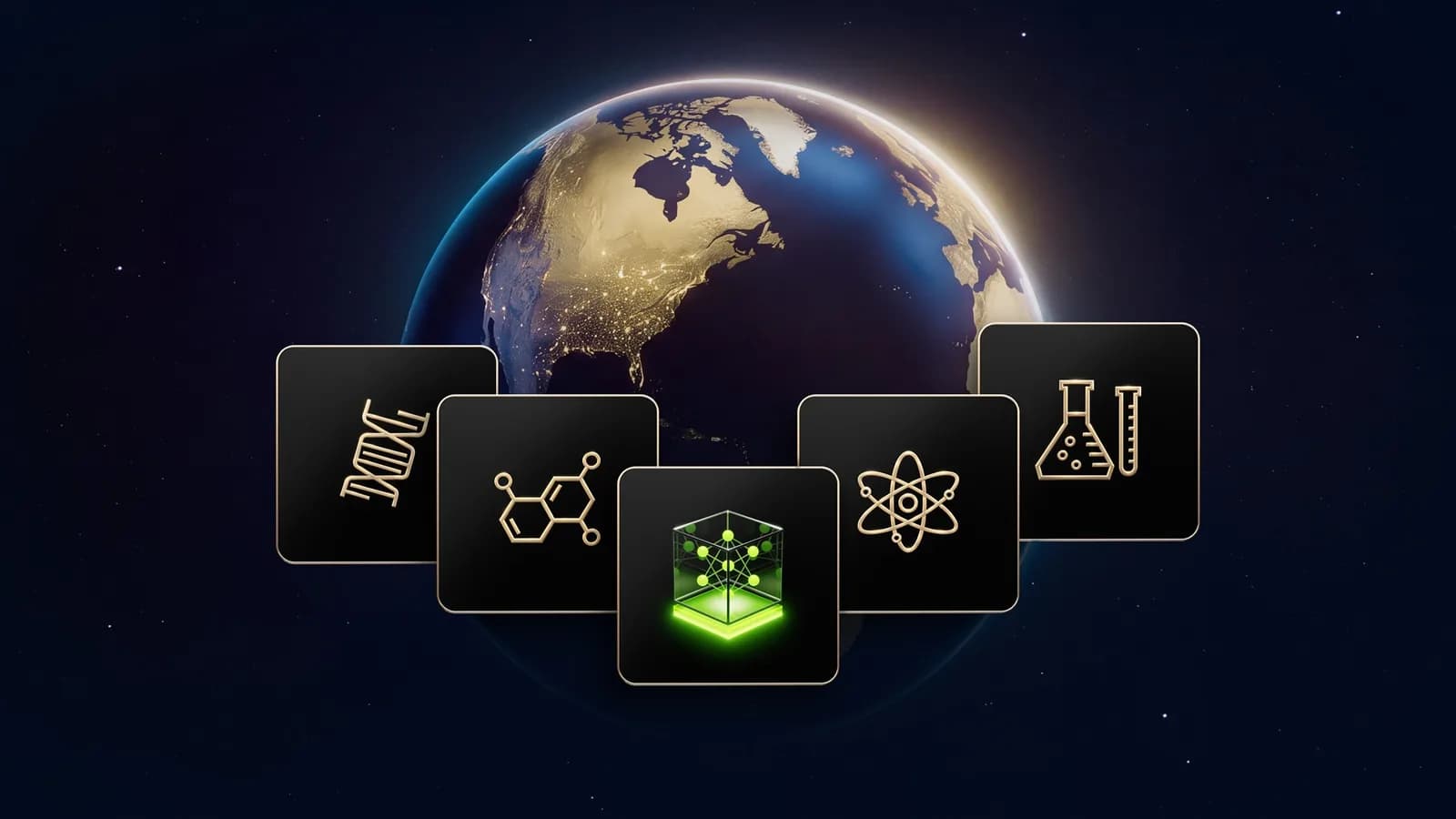
NVIDIA is combining open models designed for scientific research with expanded GPU-accelerated computing libraries to help researchers analyze complex data, run simulations, and speed up discoveries across fields ranging from astrophysics to drug development.
The company introduced NVIDIA Nemotron for Science, a package built around its Nemotron 3.5 Super VL model, a new open chemistry dataset and post-training recipes. It also expanded its CUDA-X libraries with tools for scientific workloads, including black-hole imaging, molecular simulations, materials research and single-cell biology.
The developments aim to help researchers build specialized agents that can reason through scientific problems and use computational tools to carry out research tasks.
New tools target research bottlenecks
A key addition is LitmusBench v0.2, an open dataset containing nearly 50,000 questions for training and evaluating models on chemistry reasoning. Drawing on molecular properties and experimental drug-discovery data, it helps researchers improve predictions of molecular behavior, including solubility and how the human body processes compounds.
NVIDIA’s CUDA-X expansion targets the computing bottlenecks that can slow down scientific work. Its cuPhoton toolkit, for example, includes modules that accelerate the processing of astronomical observations.
Using cuPhoton.xBeam, researchers can correlate data from the Event Horizon Telescope in eight minutes, compared with more than a month previously, NVIDIA said. The telescope links radio dishes around the world to create an Earth-sized observing instrument, generating petabytes of data that require extensive processing.
The company also highlighted work with Pacific Fusion, whose researchers used the cuPhoton.xLens module to extract insights while plasma simulations were running. Coupled with a locally running Nemotron-powered agent, the workflow could help researchers analyze results and steer simulations in real time.
From molecules to biology
In drug discovery, NVIDIA’s cuPotential accelerates molecular simulation software by up to three times while improving calculation stability and accuracy. The technology can help researchers investigate molecular binding sites and interactions before committing to costly laboratory experiments.
NVIDIA is working with Schrödinger and several molecular simulation software communities to bring the acceleration to existing workflows. Drug discovery companies including Terray Therapeutics, Topos Bio and Genesis Molecular AI are adopting the technology.
For materials research, Daviator GPU kernels for the Vienna Ab initio Simulation Package are coming to NVIDIA ALCHEMI. They can accelerate quantum-mechanical calculations by up to 22 times while reducing costs by as much as 75%, according to NVIDIA.
The expanded toolkit also includes cuSpa, which accelerates cell polygon calculations. At Memorial Sloan Kettering Cancer Center, it enabled the generation of large spatial graphs with a reported 900-fold speedup over CPUs.
Researchers adapt open models
Research organizations and life sciences companies are also adapting Nemotron for specialized scientific tasks.
Terray Therapeutics used post-training to extract chemical reactions and conditions from scientific diagrams, while Lila Sciences applied the model to laboratory protocols and quantum-dot production. Therna used it for agent-based mRNA therapeutic design.
Argonne National Laboratory is integrating Nemotron into its StructBioReasoner multi-agent system to design and evaluate protein-based therapeutic candidates.
Nemotron 3.5 Super VL and LitmusBench v0.2 are available on Hugging Face. NVIDIA has also optimized the model to run locally on its 128GB DGX Spark system, giving researchers an option to work on infrastructure they control.
Together, the model and computing tools are intended to help scientists move from interpreting research data to running more complex computational experiments and developing specialized scientific workflows.
Source: https://interestingengineering.com/ai-robotics/nvidia-scientific-agents-research-tools
Get the latest news delivered to your inbox.
Related articles