OpenAI claims proof that the matrix multiplication exponent is exactly 9/4
A preprint quietly posted to OpenAI's GitHub says square matrix multiplication has an exponent of exactly 2.25, setting a theoretical speed limit; experts say the result is unreviewed and will not by itself make computers faster.
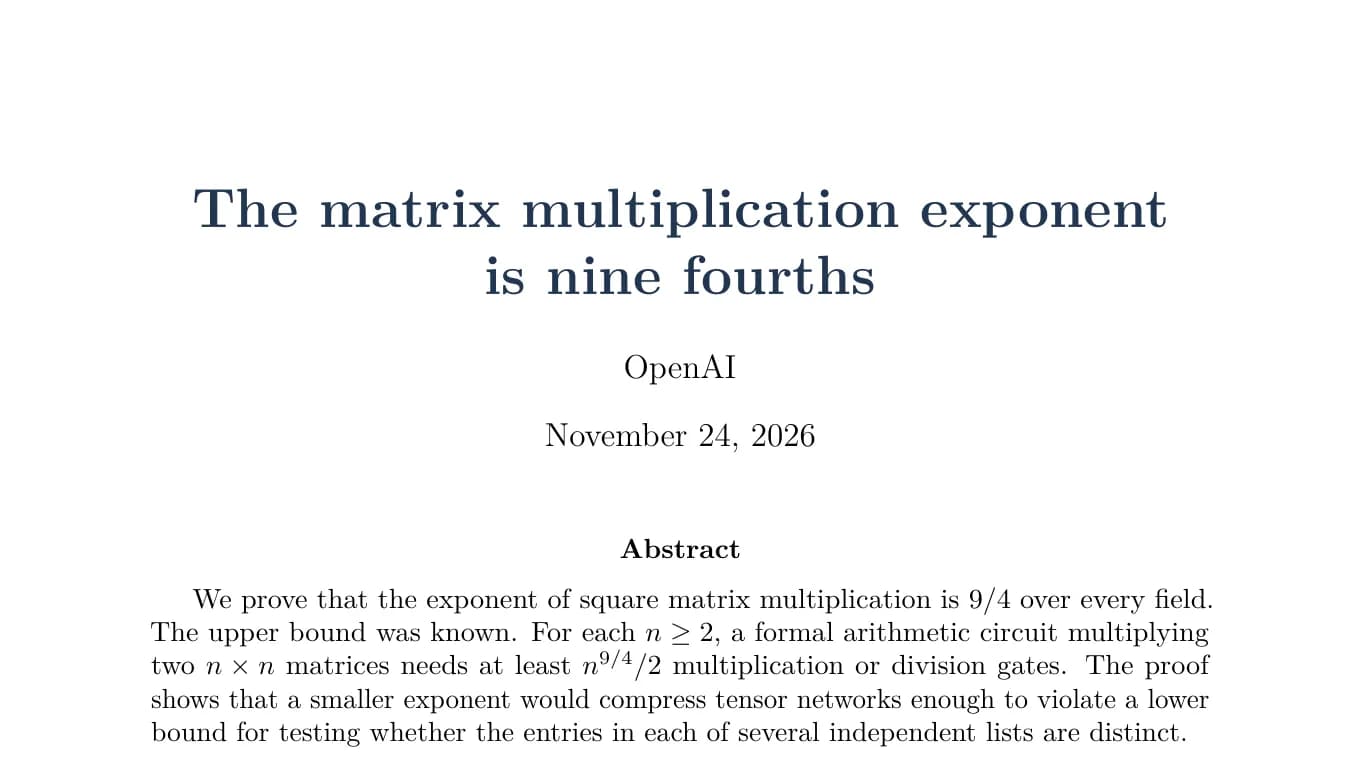
OpenAI says it has settled one of computer science's longest-running open questions: the theoretical speed limit of matrix multiplication. A preprint dated November 24, titled "The matrix multiplication exponent is nine fourths," was posted to the company's math repository on GitHub with no wider announcement, and New Scientist reported on it on November 25.
What the paper claims
Matrix multiplication underpins graphics, AI and scientific simulation and is computed trillions of times a day. The schoolbook method takes on the order of n³ operations for two n×n matrices. Volker Strassen showed in 1969 that this could be cut to about n^2.81, and researchers have spent more than half a century asking how low the exponent can go.
The preprint states that, over every field, the exponent of square matrix multiplication is exactly 9/4 (2.25). According to the paper, the upper bound was already known: OpenAI established 9/4 in work released in October among more than 700 papers, and other researchers later extended it to every field. The new paper claims the matching lower bound, showing that any arithmetic circuit multiplying two n×n matrices needs at least n^(9/4)/2 multiplication or division gates.
What experts say
"It means that the current best-known algorithm for the problem is also the most efficient among any algorithms," Per Kristian Lehre of the University of Birmingham told New Scientist. Mantas Mikaitis of the University of Leeds said the result lets researchers stop searching for theoretically faster algorithms and focus on optimising existing ones, but noted that such algorithms only pay off for enormous matrices, so scientific computing and AI still use the n³ method in practice.
"A theoretical lower bound tells us what may be achievable in principle, but not how to achieve it," said Thomas Ranner, also at Leeds. Silvia Butti of King's College London said human conceptual understanding of these AI-generated results is "so far, quite limited."
Caveats
The paper is a preprint that has not been peer reviewed or independently verified, and OpenAI did not respond to New Scientist's request for comment. TechCrunch cited the result as an example of AI labs increasingly automating their own research.
Sources: OpenAI (GitHub), New Scientist, TechCrunch
Get the latest news delivered to your inbox.
Related articles