
Ranked: Countries Importing the Most Military Drones
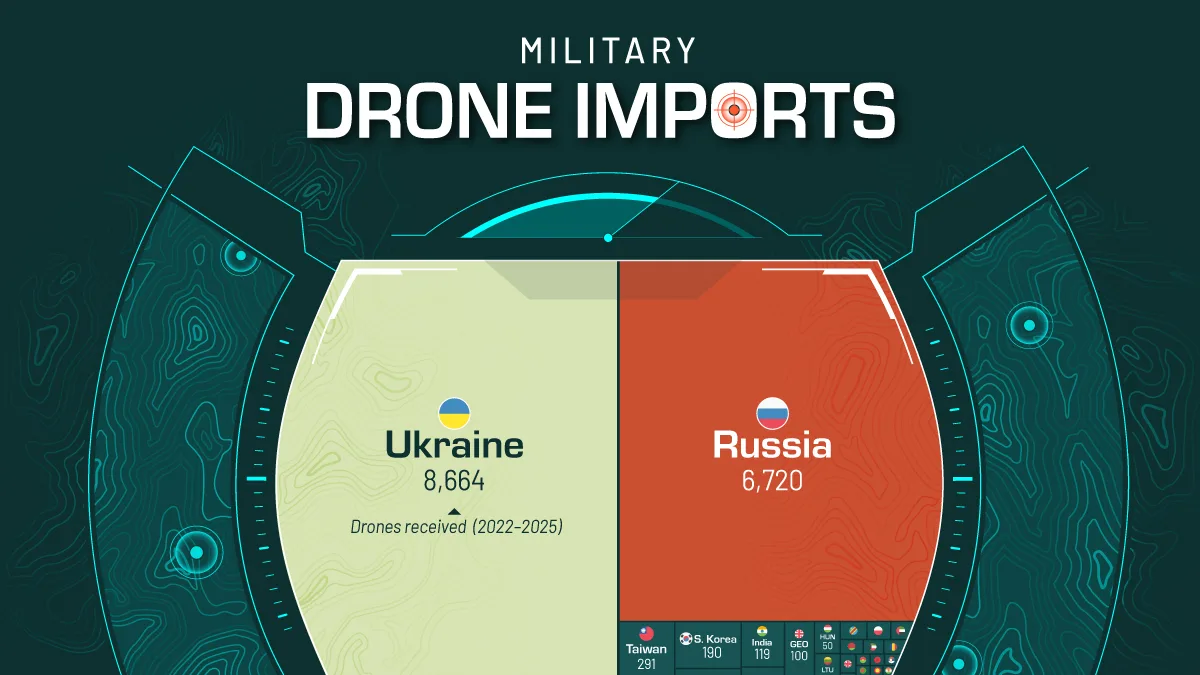
Ukraine and Russia received more than 91% of the 16,822 large military drones traded internationally from 2022 to 2025.
Who Imports the Most Military Drones?
Key Takeaways
Ukraine received 8,664 military drones from foreign suppliers in 2022–2025, more than half of the 16,822 recorded worldwide.
Russia ranks second with 6,720, mostly Shahed-136 drones imported from Iran before Russia expanded domestic production of its Geran-2 version.
Together, the two sides of one war account for more than 91% of all recorded military drone imports.
Drones have become one of the defining weapons of modern warfare, and international trade in them now revolves around a single conflict.
This graphic ranks countries by the number of military drones they received from foreign suppliers from 2022 to 2025, using data from the SIPRI Arms Transfers Database. The figures include drones sent as aid and those built in the recipient country under a foreign license.
SIPRI tracks major weapons only: drone aircraft with a loaded weight of at least 150 kg, plus one-way attack drones and loitering munitions, which it classifies as missiles. Small first-person-view (FPV) and commercial drones fall largely outside its scope.
Ukraine and Russia Dominate Military Drone Imports
The ranking drops off sharply after the top two countries. No other country received even 300 military drones during the period.
Ukraine’s supply was heavily concentrated among U.S. systems, which accounted for 83% of its recorded total. Russia’s recorded imports, meanwhile, were attributed to Iran.
The table below shows the number of military drones each country received in 2022–2025 and its share of the global total.
RankCountryMilitary Drone Imports (2022–2025)
Drones ReceivedShare of Global Total
1 Ukraine8,66451.5%
2 Russia6,72039.9%
3 Taiwan2911.7%
4 South Korea1901.1%
5 Azerbaijan1540.9%
6 India1190.7%
7 Georgia1000.6%
8 Albania560.3%
9 Hungary500.3%
9 Lithuania500.3%
11 Pakistan330.2%
12 DR Congo290.2%
13 Poland260.2%
14 UAE220.1%
15 Belarus200.1%
16 Kuwait180.1%
16 Romania180.1%
16 UK180.1%
19 Sudan170.1%
20 Mali150.1%
21 Burkina Faso100.1%
21 Morocco100.1%
21 Serbia100.1%
24 Bangladesh90.1%
25 Kyrgyzstan8
26 Niger7
26 Nigeria7
26 Thailand7
29 Algeria6
29 Croatia6
29 Kenya6
29 Switzerland6
29 Tajikistan6
34 Kosovo5
34 Saudi Arabia5
--Other1040.6%
--Global Total16,822100.0%
Most of Russia’s drone imports were Shahed-136s, which Russia first imported from Iran and now produces in its own versions as the Geran-2. SIPRI says there is little indication that continued Iranian input is still needed.
Small Military Drone Trade Is Far Bigger
Outside Russia and Ukraine, Taiwan is the largest importer of military drones, with 291 U.S.-made loitering munitions delivered in 2025.
Its drone push has been influenced by Ukraine, and government plans call for up to 200,000 drones over the coming decade, more than 10 times the entire global total recorded from 2022 to 2025.
This gap exists because SIPRI’s database, the same one behind our ranking of the biggest arms importers, tracks major weapons: large drones plus long-range one-way attack drones, with the latter making up 97% of the transfers shown here. The small, inexpensive first-person-view (FPV) drones that now do much of the fighting at the front mostly fall outside its scope.
Those drones move in far larger numbers. The UK alone delivered more than 85,000 smaller military drones to Ukraine in six months of 2025, about five times SIPRI’s recorded global total for the entire four-year period.
Drones built domestically are also excluded, since SIPRI only counts weapons that cross borders or are produced under a foreign license. Ukraine’s defense industry can now produce more than 8 million FPV drones a year, while Ukrainian intelligence estimates that Russia builds about 2,800 Geran-2 drones per month, far above the 2,000 a year SIPRI records under the Iranian license.
Learn More on the Voronoi App
If you enjoyed today’s post, check out this post on how important people in different countries consider defense on Voronoi.
Related articles
Wind turbines reduce radar coverage by 7% and increase blind spots by 15%, study finds
A new Chinese study has found that offshore wind turbines can confuse shore-based radar systems....

Tesla close to making 1,000 Optimus humanoids a week, but robots struggle with tasks
Tesla has reported that it is now in a position to produce hundreds of its...

These Data Centers Could Use More Power Than Major Cities
Meta is building a data center in Louisiana which at full power could consume nearly as much energy as New York City.

Can an ‘eSUV’ e-bike really go from trail to town?
Have you ever wanted an electric bike that easily transitions from the drudgery of urban asphalt to adventures in gravel and dirt?
Commercially viable fusion energy that delivers limitless clean power could be closer to reality
A British company has demonstrated the key fuel compression principle underpinning FLARE, its proprietary approach...

Hydrogen fuel cell that works without air targets long-duration Moon missions
US-based space power and energy systems developer Teledyne Energy Systems will work with NASA to...