Two US Air Force combat drones complete first coordinated flight using new software
Shield AI’s Hivemind autonomy software has enabled two U.S. Air Force Collaborative Combat Aircraft (CCA)...
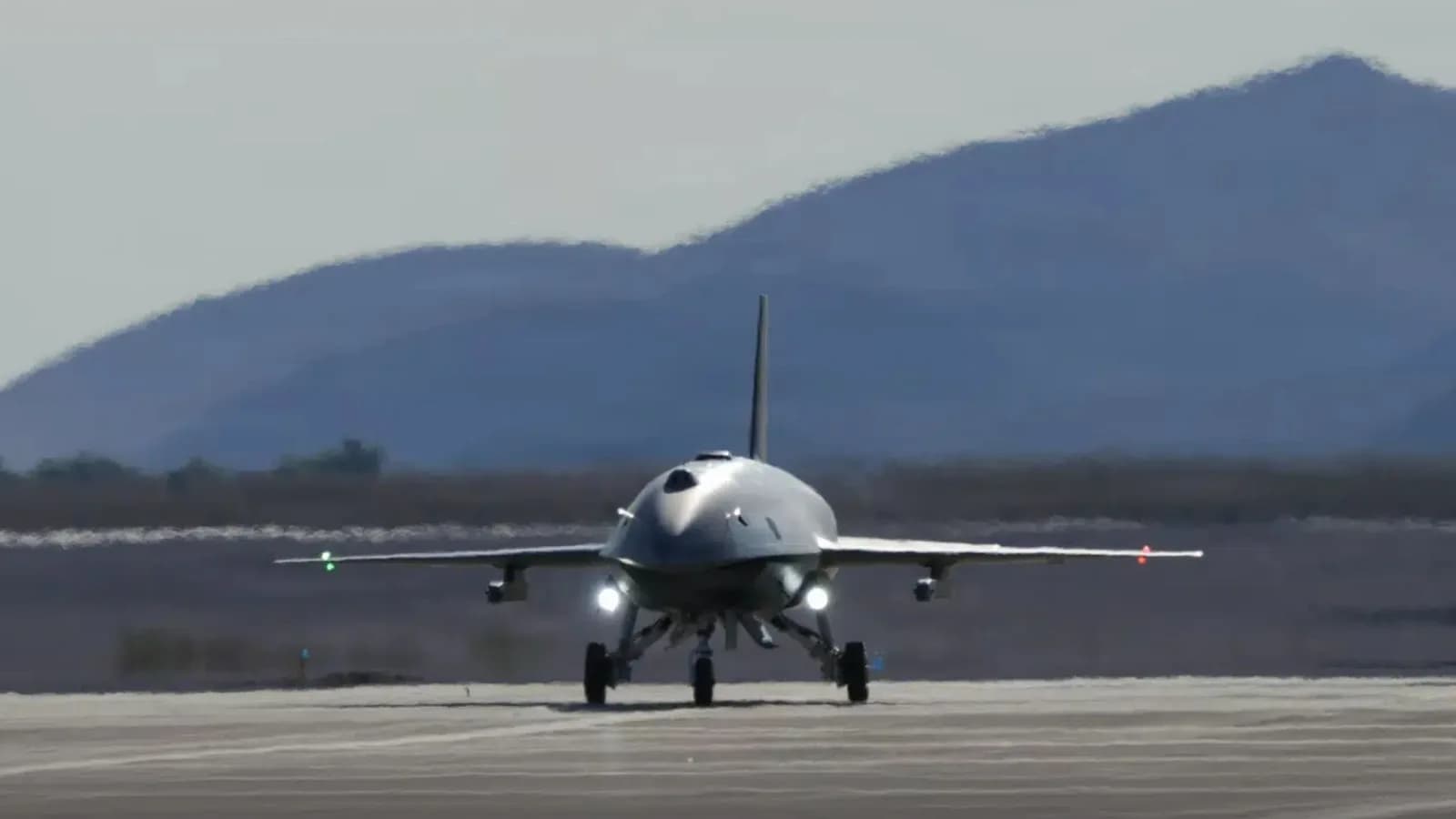
Shield AI’s Hivemind autonomy software has enabled two U.S. Air Force Collaborative Combat Aircraft (CCA) to fly in formation and perform coordinated beyond-visual-range (BVR) air combat maneuvers, marking a new milestone in the service’s effort to develop autonomous combat aircraft.
The demonstration took place on October 26 at the Nevada Test and Training Range. The two uncrewed aircraft used Hivemind to execute coordinated maneuvers against a virtual airborne threat, according to Shield AI. The company described the flight as the first time multiple Air Force CCAs had operated as a coordinated team using its mission autonomy software.
The test followed an October 8 demonstration in which an F-22 Raptor pilot directed an Anduril-built FQ-44A Fury CCA from the cockpit of the airborne fighter. Together, the flights show progress from a human pilot directing an autonomous wingman to multiple uncrewed aircraft coordinating their actions under software control.
From autonomous wingman to coordinated formation
During the October 8 flight at Edwards Air Force Base in California, the F-22 pilot acted as an airborne “quarterback,” sending high-level tactical instructions to a single FQ-44A Fury. Hivemind interpreted those commands and translated them into flight maneuvers and simulated combat tasks in real time.
The October 26 test expanded that capability. Two FQ-44A aircraft flew in formation and performed coordinated air combat maneuvers using Hivemind. Unlike the earlier demonstration, however, an operator on the ground directed the aircraft rather than an airborne fighter pilot. The pair engaged a simulated threat, not a live adversary.
According to Shield AI’s vice president of Hivemind engineering, Todd Wesley, the demonstration was a step toward more complex engagements involving larger groups of autonomous aircraft. Future tests could involve multiple teams and the reassignment of aircraft between formations while in flight.
The company has not announced when the aircraft will test live weapons. The current demonstrations focus on proving the software’s ability to coordinate aircraft and execute simulated missions.
For the first time, Hivemind flew multiple @usairforce Collaborative Combat Aircraft as a coordinated team.
On October 26, Hivemind enabled multiple CCAs to execute a multi-ship formation and beyond-visual-range air combat tactics. Three weeks earlier, an F-22 pilot in flight… pic.twitter.com/zeVJlmzDLT
— Shield (@shieldaitech) November 9, 2026
An open architecture for autonomous combat aircraft
A key part of the effort is the Air Force’s Autonomy Government Reference Architecture (A-GRA). The framework uses standardized interfaces to separate mission autonomy software from aircraft-specific systems.
This means software developers can improve an aircraft’s decision-making and mission capabilities without redesigning its underlying hardware. It also allows the Air Force to integrate competing autonomy solutions across different aircraft, reducing dependence on a single supplier.
The approach is central to the CCA program, which aims to pair uncrewed aircraft with crewed fighters. These aircraft are expected to support missions such as air-to-air combat, electronic warfare, surveillance and reconnaissance, extending the reach and combat capacity of existing fighter fleets.
Shield AI said Hivemind has been integrated into more than 40 uncrewed systems across air, land, sea and space. The company also says data from each flight can inform subsequent software updates, allowing improvements to be carried across compatible platforms.
Building toward larger autonomous teams
The Air Force’s longer-term objective is for human pilots to direct multiple autonomous aircraft rather than control each one individually. This requires software that can coordinate several aircraft while allowing human operators to retain mission-level authority.
Wesley said the combined aircraft and autonomy software development process is approaching a point where the Air Force could fly a sortie, update the software overnight, and conduct another flight the following day.
As the Air Force continues testing, the challenge will be expanding those capabilities while ensuring human operators can understand, direct, and trust increasingly complex autonomous teams.
Get the latest news delivered to your inbox.
Related articles