US-built world’s fastest six-legged soft robot hits 10.6 mph using compressed air
Scientists from the University of California San Diego (UC San Diego) have created what the...
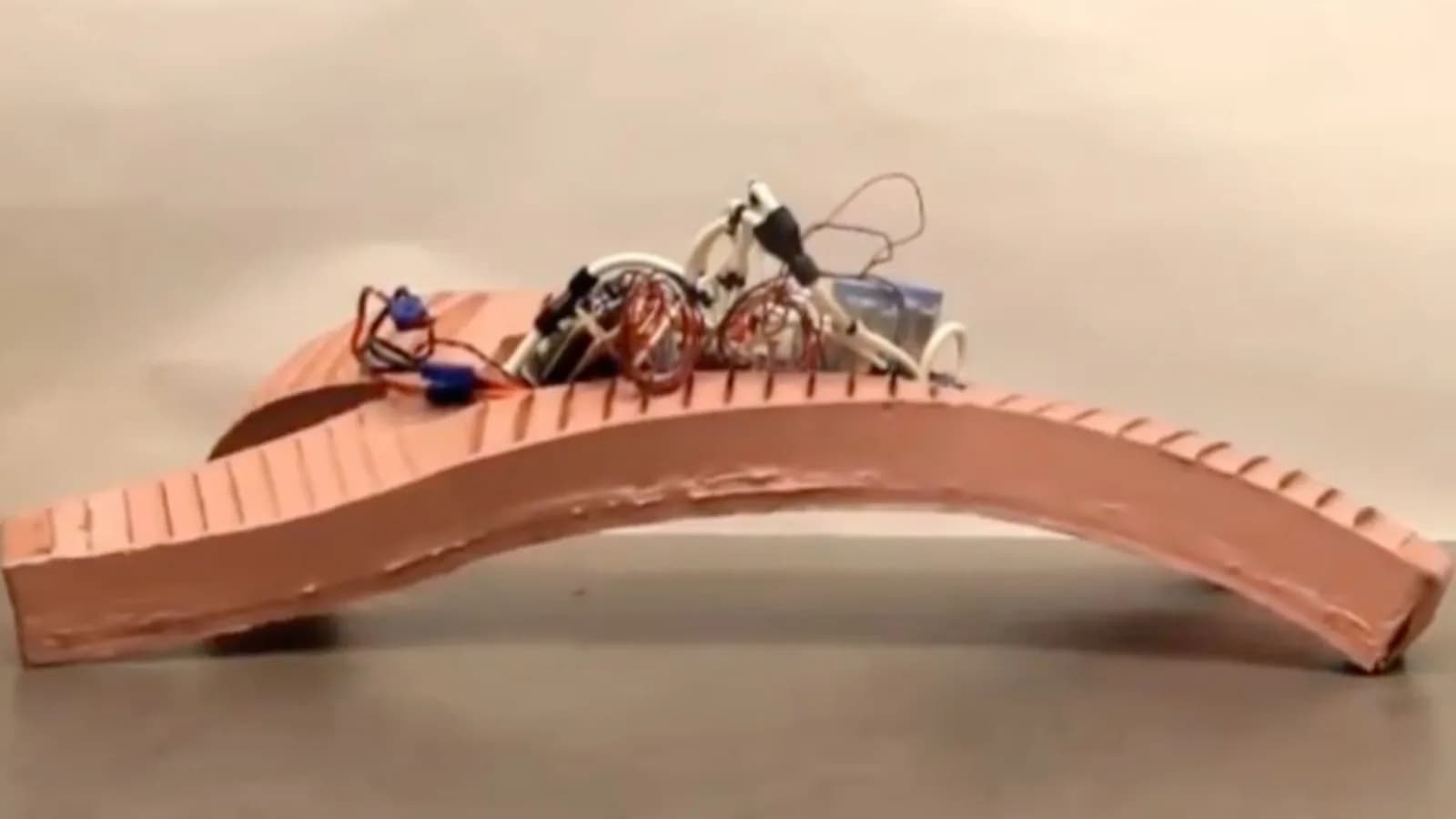
Scientists from the University of California San Diego (UC San Diego) have created what the university describes as the world’s fastest fully soft robot, a six-legged machine that operates without electronic components. It uses compressed air to achieve a top speed of 10.6 mph (15.49 feet per second; 4.72 meters per second) and can traverse different surfaces, including sand, gravel, grass, mulch, and concrete.
In addition, the robot can swim and function in water. Researchers at UC San Diego’s Jacobs School of Engineering 3D-printed the robot as a single structure using just one material.
Building on their previous development in 2022 of a smaller air-operated robot (covered in 2025 in Advanced Intelligent Systems), the earlier robot had a sluggish speed of just 1.6in/s (4cm/s). This was hindered by low pressures and flow rates. Now, the robot is more than 100 times quicker and has an estimated mechanical power of 169 watts.
Pneumatic system drives rapid movement
Researchers at UC San Diego’s Jacobs School of Engineering, including lead researcher Yichen Zhai, 3D-printed the robot as a single structure using just one material.
Within the robot there is a system of cavities, valves, and pipes that controls the robot’s six legs. Compressed air flows around this and variations in air pressure cause movement. Again, although there are no electronic parts, the robot must connect to an external air source.
Simply increasing air pressure was not enough as not all air could be effectively utilized some would leak. Scientists modified the concept of a multi-chamber steam engine. As well as expanding steam, these engines also use several chambers. Initially, highly-pressurized air flows into small-diameter chambers, which in turn activate valves. The air then flows into bigger diameter chambers at a reduced pressure and powers the robot’s legs.
The paper refers to this as a bi-expansion pneumatic oscillator. It transforms a constant high-pressure gas source into a high-frequency, quadruple-phase pressure wave which enables the robot to quicken its motion and better utilize air.
“Our first walking robot demonstrated what was possible, but it was too slow. We hoped to overcome this limitation, and we were fortunate to find a solution to make the new robot 100 times faster,” explained Zhai, a former post-doctoral scientist in Tolley’s group.
Trials revealed that the robot can negotiate concrete, gravel, mulch, lawn, and soil, as well as on the water surface and underwater.
Researchers seek untethered operation
Although the robot is not yet fully self-sufficient and still requires an external air compressor, researchers are working to reduce its air consumption and explore portable air sources, such as pressurized air cartridges. Looking ahead, the group also aspires for their robots to be able to maneuver and manipulate items.
As there are no electronic components, this type of robot may be especially appropriate for situations in which normal electronic systems do not work efficiently. Areas of interest highlighted by the team include conducting research in high radiation or powerful magnetic environments, and for both emergency and space missions.
“The key challenge was to implement a time-tested solution (the compound steam engine) in a soft running robot that can be printed in a single piece out of a single material. We see this as a step towards complex and powerful robots that can be printed on the desktop using inexpensive materials,” said Zhai.
This National Science Foundation-funded research highlights how soft robots can be rapidly produced using single-material 3D printing and compressed air, without requiring electronic components.
The research was published in Science Robotics.
Source: https://interestingengineering.com/ai-robotics/us-electronics-soft-robot-compressed-air
Get the latest news delivered to your inbox.
Related articles