YouTuber turns blowgun into 4,500 PSI supersonic launcher that pierces ballistic armor
A YouTuber from the United Kingdom, Mike Shake, has upgraded his basic blowgun by pairing...
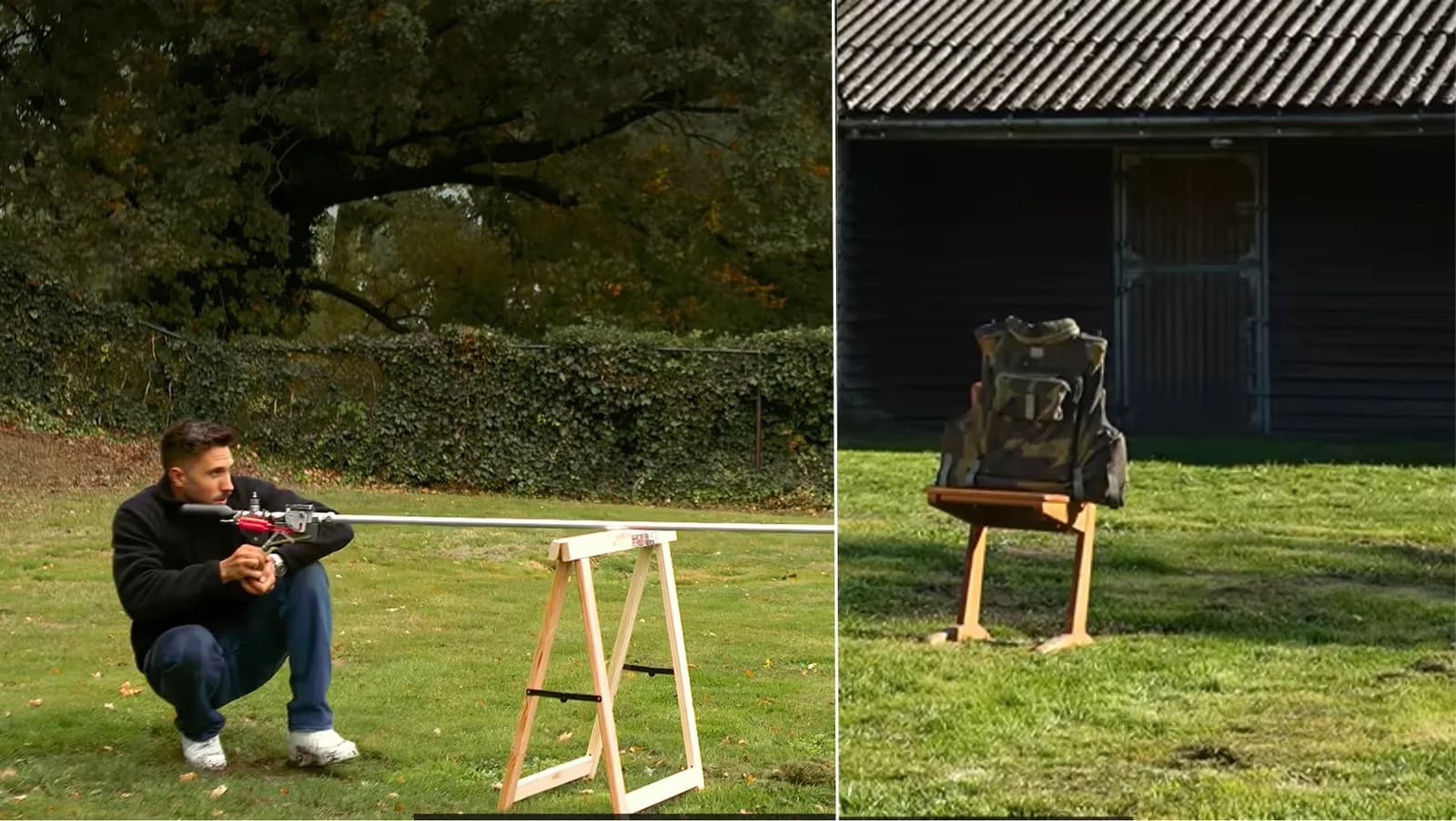
A YouTuber from the United Kingdom, Mike Shake, has upgraded his basic blowgun by pairing it with a self-built cannon that stores compressed air at roughly 4,500 PSI—about 1,285 times the pressure of a human breath.
By connecting the cannon to a 2-meter barrel with an 18-millimeter bore, he transformed the simple blowgun into a launcher capable of firing hardened steel projectiles beyond the speed of sound. While the setup reached supersonic velocities, the immense forces also caused the plastic cones behind the darts to shatter under pressure, limiting the launcher’s effectiveness.
3D-printed sabot darts to reduce drag
To solve the problem, the YouTuber turned to 3D-printed sabots made from a blend of resin and carbon fiber-reinforced nylon. In military ammunition, a sabot is a lightweight sleeve that allows a smaller projectile to be fired from a larger barrel. It seals the barrel to maximize pressure behind the projectile before stripping away immediately after leaving the muzzle, minimizing aerodynamic drag.
Shake adapted the same concept using low-cost, 3D-printed components instead of the metal sabots typically used in armor-piercing munitions. His custom design created a tight seal inside the barrel, efficiently transferring the compressed air’s energy to the projectile before separating cleanly in flight, allowing the steel dart to continue toward its target with reduced drag.
Getting the sabot dimensions right proved to be one of the biggest engineering challenges. The sleeve had to fit tightly enough to seal the compressed air behind the projectile without becoming lodged inside the barrel.
Beyond modifying the dart sleeves, the YouTuber also experimented with multiple types of ammunition, including hardened steel darts, broadhead-style boggin points, and even ordinary 4-millimeter nails, all with a similar slender profile.
The larger 18-mm bore also played a key role in boosting performance. A wider barrel allows a greater volume of compressed air to accelerate the projectile, much like a larger sail captures more wind. Combined with pressures reaching 3,850 PSI during testing, the setup generated enough force to propel the lightest darts to 385 meters per second, exceeding the speed of sound.
Supersonic darts pierce armor
Because the launcher exceeded the United Kingdom’s regulations for air-powered weapons, Shake tested it in the Netherlands, where the experiments could be conducted legally.
The results demonstrated how much energy the compressed-air launcher could deliver. A small steel nail embedded itself into a Level IV ballistic armor plate, the highest-rated personal body armor designed to stop armor-piercing rifle rounds. At full operating pressure, the launcher also drove nails through a car door, a ballistic dummy head, and the steel housing of a computer monitor.
Even at a distance of 100 meters, one projectile maintained a velocity of approximately 315 meters per second while carrying about 615 joules of kinetic energy. According to Shake, that was enough to keep the slender nail on a stable trajectory over long distances.
Despite operating at extremely high pressures, the barrel itself showed no signs of wear and tear even after repeated firings. The 3D-printed sabots separated cleanly after exiting the muzzle, allowing the projectiles to continue toward the target without damaging the launcher.
Moreover, the blowgun’s performance altered based on the weight of the projectile. Lightweight steel darts produced energy comparable to a 0.22-caliber rifle round, while the heavier nails approached the muzzle energy of 0.40 S&W and 0.45 ACP handgun cartridges. Unlike many pneumatic launchers, however, the targets were moved by the impact of the projectile itself rather than by escaping compressed air, highlighting the efficiency of the sabot design.
The finished launcher was described by Shake as the “most powerful and dangerous device he has ever built for his YouTube channel.” An experiment that began by exploring the physics of a simple blowgun ultimately evolved into a high-pressure launcher capable of firing armor-piercing darts at supersonic speeds.
Source: https://interestingengineering.com/innovation/youtuber-turns-blowgun-into-supersonic-launcher
Get the latest news delivered to your inbox.
Related articles