10 massive battery storage projects around the world redefining power grids
Storing electricity at the scale of several gigawatt-hours is becoming a reality for power grids...
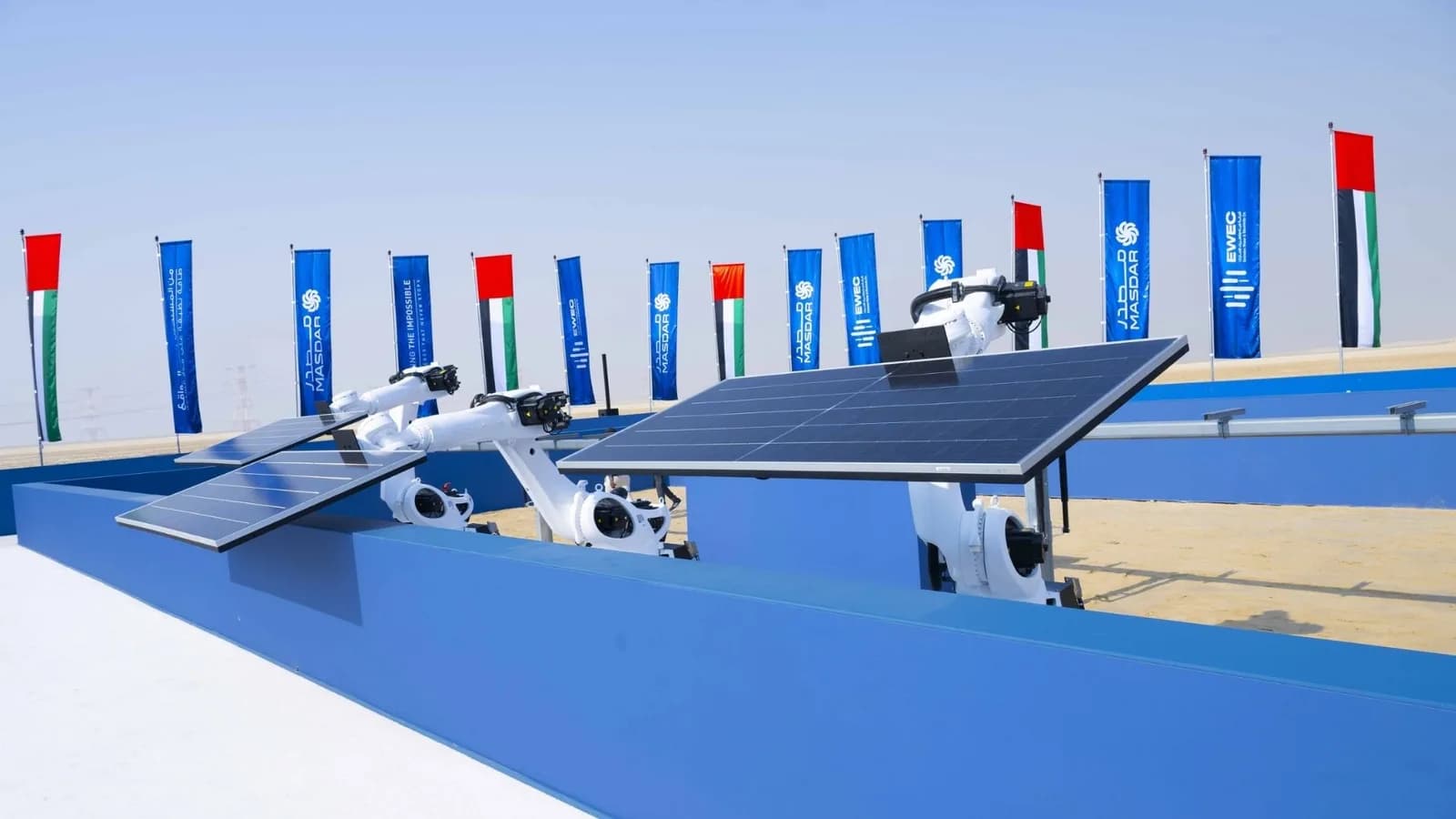
Storing electricity at the scale of several gigawatt-hours is becoming a reality for power grids around the world.
From a solar-powered development in Abu Dhabi to battery installations across Saudi Arabia, these projects are designed to store electricity and supply it when it is needed.
The following list includes individual facilities, multi-site programs, and phased developments, with capacities reflecting their published scope.
Some are already operating, others remain under development, and Moss Landing illustrates why historical capacity must be distinguished from what a facility can deliver today.
1. Masdar–EWEC round-the-clock project, UAE -19 GWh
Abu Dhabi’s Masdar–EWEC development combines a 5.2-gigawatt solar plant with 19 gigawatt-hours of battery storage. The project is designed to deliver 1 gigawatt of renewable electricity around the clock, extending solar power delivery beyond daylight hours.
Masdar laid the foundation for the project in October 2025, with operations targeted for 2027. Its design includes grid-forming technology, black-start capability, and forecasting and dispatch systems to coordinate electricity generation, storage, and delivery.
2. SEC–BYD battery storage program, Saudi Arabia – 12.5 GWh
BYD announced a 12.5-gigawatt-hour energy storage contract with Saudi Electricity Company in February 2025.
The agreement covers multiple grid-scale projects and brings BYD’s combined Saudi cooperation with the utility to 15.1 gigawatt-hours, including an earlier 2.6-gigawatt-hour delivery.
MEED identifies the program as five facilities with a combined power rating of 2.5 gigawatts, built with Alfanar as the engineering, procurement, and construction contractor.
Equipment supplier NR Electric reported that SEC’s five-region, 2.5-gigawatt storage project completed its grid-connected charging and discharging tests on May 27, 2026, marking commissioning.
3. Oasis de Atacama, Chile – 14.1 GWh (overall platform)
Grenergy’s Oasis de Atacama is a phased solar and battery storage development in Chile. Although earlier plans set its storage capacity at about 11 gigawatt-hours, the company’s September 2026 announcement raised the overall platform a capacity to 14.1 gigawatt-hours.
That figure reflects the wider development, with individual phases coming online separately.
Grenergy confirmed in September 2026 that Gabriela, the fourth phase, was operational with 272 megawatts of solar generation and 1,100 megawatt-hours of battery storage.
4. Najran, Khamis Mushait, and Madaya storage program, Saudi Arabia – 7.8 GWh
Saudi Arabia’s 7.8-gigawatt-hour storage deployment spans three sites at Najran, Khamis Mushait, and Madaya. Sungrow supplied more than 1,500 PowerTitan 2.0 systems and announced grid connection completion in December 2025.
The equipment integrates batteries, power conversion systems, medium-voltage transformers, and switching equipment into preassembled units.
Sungrow says factory testing and preassembly reduced on-site installation work, while a local service team supported installation, commissioning, and grid connection.
5. Envision Jingyi Chagan Hada, China – 4 GWh
The Envision Jingyi Chagan Hada Energy Storage Power Station in Inner Mongolia has a reported capacity of 4 gigawatt-hours. It connected to the grid in late December 2025, forming part of Envision’s wider 12.8-gigawatt-hour regional storage cluster.
According to the Sustainable Markets Initiative’s project showcase, the station passed the grid’s three-charge, three-discharge verification in a single attempt.
Its control system combines forecasting, dispatch, and electricity-market trading, coordinating how stored energy is managed and sold.
6. Edwards & Sanborn, USA – 3.287 GWh
California’s Edwards & Sanborn project combines solar generation with 3.287 gigawatt-hours of battery storage. Developer Terra-Gen and contractor Mortenson announced substantial completion of the Kern County development in January 2024.
The installation spans more than 4,600 acres, with part of the project on Edwards Air Force Base.
Mortenson identifies LG Chem, Samsung, and BYD as battery suppliers, while the project serves customers including California utilities, the city of San Jose, and Starbucks.
7. Moss Landing, USA – 3 GWh (historical installed capacity)
Vistra’s Moss Landing Energy Storage Facility reached 750 megawatts and 3,000 megawatt-hours of installed capacity after its third expansion entered commercial operation in June 2023.
That expansion added 350 megawatts and 1,400 megawatt-hours, establishing the California site as a major early example of multi-gigawatt-hour battery storage.
Its historical capacity requires qualification following the January 2025 fire at the 300-megawatt facility.
EPA confirms that the affected building has had no active battery storage operations since that incident, while Vistra subsequently decided not to return the separate 100-megawatt facility to service.
8. Collie Battery, Australia – 2.24 GWh
Neoen’s Collie Battery in Western Australia has a combined capacity of 560 megawatts and 2,240 megawatt-hours. The development comprises a 219-megawatt first stage and a 341-megawatt second stage; the company’s October 2025 update said both are operational.
The service addresses electricity reliability risks associated with coal-plant retirements, growing rooftop solar generation, and demand on Western Australia’s South-West Interconnected System.
9. Bisha BESS, Saudi Arabia – 2 GWh
The Bisha battery storage facility in Saudi Arabia’s Aseer province is rated at 500 megawatts and 2,000 megawatt-hours.
Contractor Alfanar describes the delivered installation as a four-hour system that stores electricity during low-demand periods for redistribution when demand rises.
Bisha has also demonstrated a capability needed after a major grid outage: black start, or restoring power without relying on an already energized network.
NR Electric reported a successful black-start test in February 2026 using its integrated power conversion, power management, and energy management systems.
10. Huadian Xinjiang Kashgar, China – 2 GWh (first phase)
The first phase of Huadian’s Kashgar energy storage project in Xinjiang has a capacity of 500 megawatts and 2,000 megawatt-hours.
A Huadian Xinjiang account published by the China Energy Storage Alliance confirms that the first storage block entered grid-connected operation in July 2025.
The installation uses 100 lithium iron phosphate storage units and combines grid-forming and conventional storage configurations, each accounting for half its capacity.
State Grid Kashgar said the project supports renewable electricity use and grid stability in a region where photovoltaic generation represents a substantial share of installed power capacity.
Conclusion
These projects show how battery storage is expanding from individual installations to multi-site programs measured in gigawatt-hours.
Their engineering challenges extend beyond capacity to grid integration, reliable operation, and safety. As more facilities enter service, how consistently they store and deliver electricity will matter as much as their size.
Source: https://interestingengineering.com/energy/10-massive-battery-storage-projects-around-world
Related articles