45 humanoid robots process up to 1,200 parcels an hour in postal logistics trial
China Post has deployed 45 humanoid robots at its Hangzhou Postal District Center to handle...
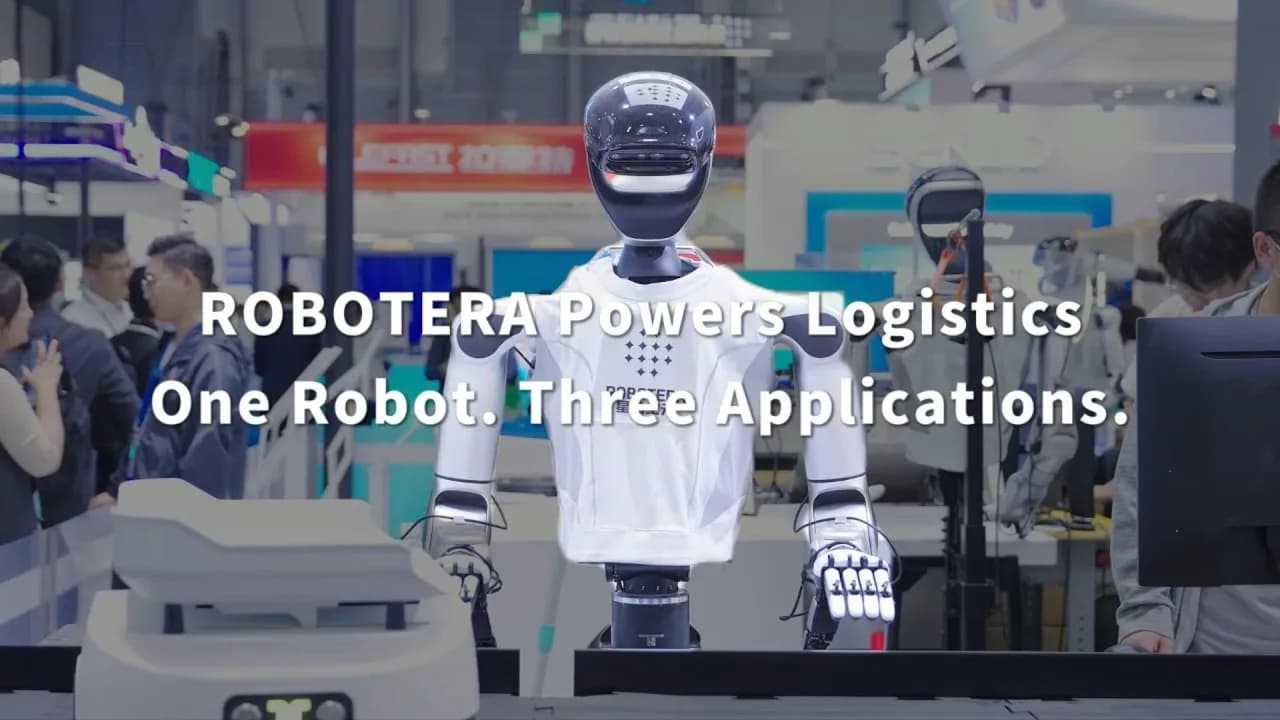
China Post has deployed 45 humanoid robots at its Hangzhou Postal District Center to handle parcels. The deployment is part of a large-scale testing program launched in April to assess embodied AI robots for postal logistics.
The machines, developed by ROBOTERA, are designed to automate several stages of parcel induction, including sorting and handling irregularly shaped packages. The project highlights China’s efforts to introduce humanoid robots into real-world logistics operations and evaluate their ability to work across demanding industrial environments.
Robots automate sorting
ROBOTERA’s 45 humanoid robots at China Post’s Hangzhou Postal District Center are being tested for parcel induction and handling operations. The deployment represents one of China’s largest trials of humanoid robots in postal logistics, with the machines taking on tasks traditionally performed by human workers in parcel-processing facilities.
The testing program began in April 2026 and is focused on evaluating how embodied AI-powered humanoids can handle the varied and repetitive tasks involved in processing incoming parcels. Rather than being limited to a single operation, the robots are designed to carry out multiple stages of parcel induction, from picking up packages and adjusting their orientation to identifying irregularly shaped items and placing parcels onto induction platforms.
One of the key capabilities being evaluated is the robots‘ ability to recognize and handle parcels with different shapes and physical characteristics. Packages entering postal facilities can vary considerably in size, form, and orientation, making automated handling more complicated than moving standardized objects along a conveyor system. The robots must therefore identify individual parcels, determine how to handle them, and position them appropriately for subsequent processing.
The machines can also identify irregularly shaped parcels and reject them from the normal induction process. This is an important function in automated logistics operations, where incorrectly positioned or unusually shaped packages can disrupt downstream sorting processes. The ability to recognize such items and separate them from regular parcels could help reduce handling errors and operational interruptions.
Another aspect of the deployment is the robots’ ability to manage operational exceptions. This suggests that the trial is evaluating more than straightforward pick-and-place movements, with the machines also expected to respond to situations that arise during parcel handling. Such capabilities are important for introducing embodied AI systems into working logistics environments, where packages and operating conditions are not always uniform.
Advancing parcel handling
ROBOTERA said the fleet’s parcel induction efficiency has improved considerably through multiple rounds of iterative optimization. During the initial testing phase, the robots processed approximately 500–600 parcels per hour. This figure subsequently increased to around 1,200 parcels per hour during specific testing periods.
The company also reported that operational accuracy had exceeded 90 percent. Improvements have been recorded in motion smoothness, recognition accuracy, and handling precision, indicating progress in both the robots’ perception and physical manipulation capabilities.
The performance figures indicate how the technology has developed since the beginning of the trial. However, the reported throughput represents performance during specific testing periods and should not necessarily be interpreted as a sustained, round-the-clock processing rate across the entire 45-robot fleet.
The deployment is part of a broader effort by China Post’s Hangzhou branch to introduce more automated equipment into its postal operations. The organization plans to expand the adoption of intelligent sorting and security inspection systems across additional operational scenarios.
For ROBOTERA, the project provides an opportunity to evaluate humanoid robots in a demanding industrial environment involving repetitive handling tasks, variable package shapes, and operational exceptions. Unlike controlled demonstrations, postal logistics facilities require robots to perform physical tasks repeatedly while maintaining consistent recognition and handling accuracy.
Source: https://interestingengineering.com/ai-robotics/chinese-humanoid-robots-postal-trial
Get the latest news delivered to your inbox.
Related articles