Ranked: Years of Salary to Buy a Home in 50 European Cities
Europe is home to some of the most expensive housing markets worldwide. Locals may need to work for decades to afford a flat.
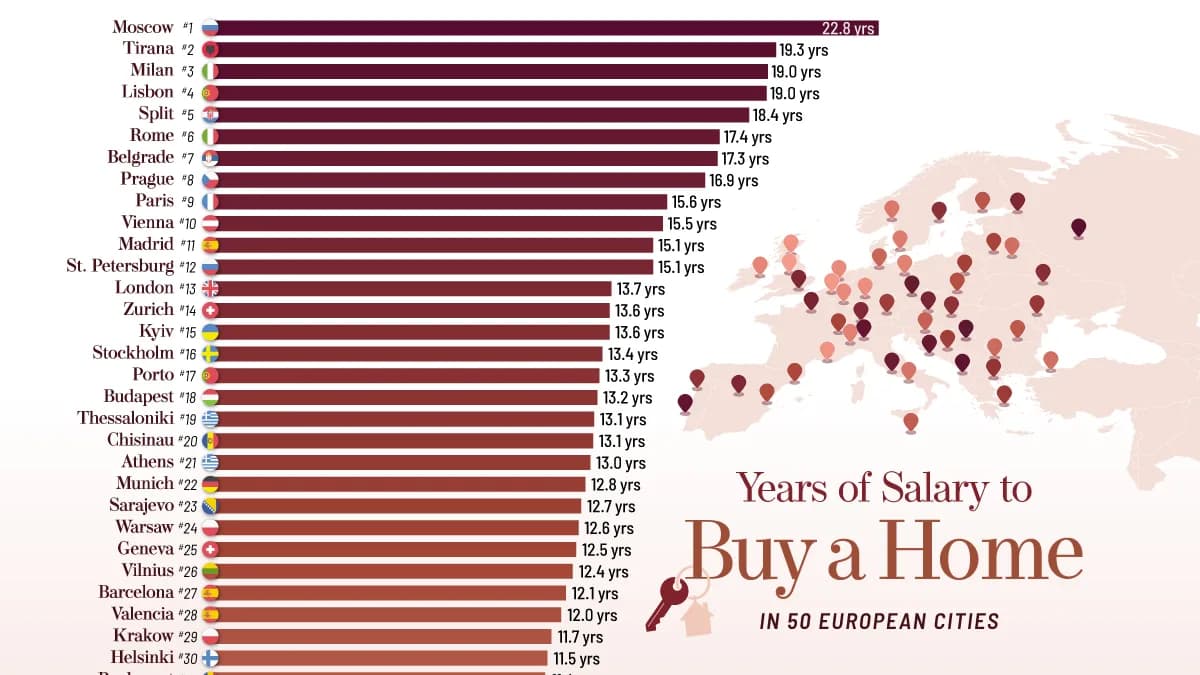
How Far Does a Salary Go Toward Buying a Home in Europe?
Key Takeaways
Buying a city-center apartment in Moscow costs the equivalent of nearly 23 years of average take-home pay, compared with just five in Manchester.
Lisbon and Milan require approximately 19 years of salary, more than twice as many as Amsterdam and Berlin.
Within countries, higher salaries often fail to offset higher housing prices: London’s price-to-income ratio is about 2.7 times Manchester’s.
Expensive real estate doesn’t necessarily make a city less affordable than others. For prospective homebuyers, local earnings can matter just as much as property prices.
This visualization ranks 50 major European cities by the number of years of average take-home pay needed to buy a 50-square-meter city-center apartment, using November 2026 property price and salary estimates from Numbeo.
These crowdsourced estimates assume that an entire annual take-home salary, based on 12 monthly paychecks, goes toward the purchase. They exclude living expenses, financing costs, and transaction taxes and fees, measuring housing affordability relative to income rather than a realistic saving timeline.
Where Buying a Home Requires the Most Income
Moscow tops the ranking at 22.8 years, followed by the Albanian capital of Tirana at 19.3 years. Milan and Lisbon also rank ahead of famously expensive housing markets such as London (13.7 years) and Zurich (13.6 years).
At the other end of the ranking, Brussels joins Manchester among the most affordable cities, with a central apartment costing the equivalent of six years of average salary.
The table below ranks all 50 European cities by the number of years of average take-home pay needed to buy a city-center apartment.
RankCityYears of Salary
1 Moscow, Russia22.8
2 Tirana, Albania19.3
3 Milan, Italy19.0
4 Lisbon, Portugal19.0
5 Split, Croatia18.4
6 Rome, Italy17.4
7 Belgrade, Serbia17.3
8 Prague, Czechia16.9
9 Paris, France15.6
10 Vienna, Austria15.5
11 Madrid, Spain15.1
12 Saint Petersburg, Russia15.1
13 London, UK13.7
14 Zurich, Switzerland13.6
15 Kyiv, Ukraine13.6
16 Stockholm, Sweden13.4
17 Porto, Portugal13.3
18 Budapest, Hungary13.2
19 Thessaloniki, Greece13.1
20 Chisinau, Moldova13.1
21 Athens, Greece13.0
22 Munich, Germany12.8
23 Sarajevo, Bosnia-Herzegovina12.7
24 Warsaw, Poland12.6
25 Geneva, Switzerland12.5
26 Vilnius, Lithuania12.4
27 Barcelona, Spain12.1
28 Valencia, Spain12.0
29 Krakow, Poland11.7
30 Helsinki, Finland11.5
31 Bucharest, Romania11.4
32 Valletta, Malta11.2
33 Zagreb, Croatia11.2
34 Hamburg, Germany11.1
35 Sofia, Bulgaria10.6
36 Minsk, Belarus10.4
37 Istanbul, Turkiye10.4
38 Naples, Italy10.3
39 Oslo, Norway10.1
40 Copenhagen, Denmark10.1
41 Berlin, Germany9.9
42 Turin, Italy9.7
43 Dublin, Ireland9.7
44 Amsterdam, Netherlands9.6
45 Luxembourg, Luxembourg8.5
46 Frankfurt, Germany7.9
47 Marseille, France7.3
48 Edinburgh, UK6.9
49 Brussels, Belgium6.0
50 Manchester, UK5.0
Tirana and Zurich illustrate why property prices alone can be misleading when comparing housing affordability.
A 50-square-meter city-center apartment in Tirana costs approximately €190,000, compared with roughly €1.2 million in Zurich. However, average monthly take-home pay in Zurich (€7,361) is about nine times that of Tirana (€818).
Despite having a purchase price more than six times as high, a central apartment in Zurich is considerably more affordable relative to local earnings.
Lisbon’s Housing Pressure Goes Beyond Tourism
In Lisbon, a city-center apartment costs an estimated €351,000, while average monthly take-home pay is approximately €1,541. That mismatch illustrates the financial challenge facing local homebuyers.
Tourism and short-term rentals have added to housing demand, particularly in the historic center. Airbnb listings in Lisbon increased from roughly 18,300 in September 2019 to 21,200 in December 2024, with research linking their concentration to higher local housing prices.
Supply constraints compound the pressure. Across Portugal, lengthy permitting procedures and regulatory uncertainty slow construction, while vacant and underused properties do not readily return to the market. Improving affordability therefore involves both building more homes and making better use of existing housing.
The Affordability Divide Within Countries
Large differences in housing affordability also emerge without crossing a border. City-center apartment prices per square meter are approximately 3.7 times as high in London as in Manchester, while average take-home salaries are only about 35% higher.
Italy shows a similar imbalance. Central apartment prices in Milan are more than twice those in nearby Turin, but average net salaries are only around 13% higher. Buying an apartment in Milan requires roughly 10 additional years of equivalent local earnings.
Paris (15.6 years) and Marseille (7.3 years), France’s two largest cities, follow the same pattern. In each of these comparisons, the higher salaries available in major economic hubs fall well short of offsetting their housing price premiums.
Learn More on the Voronoi App
For another perspective on housing affordability in Europe, check out EU Households Spend on Average 20% of Disposable Income on Housing on Voronoi.
Source: https://www.visualcapitalist.com/ranked-years-of-salary-to-buy-a-home-in-50-european-cities/
Get the latest news delivered to your inbox.
Related articles