Ranked: Best Countries to Work In vs. Retire In
New Zealand tops the work-life balance rankings, while Norway leads for retirement. See which countries offer the best of both worlds.
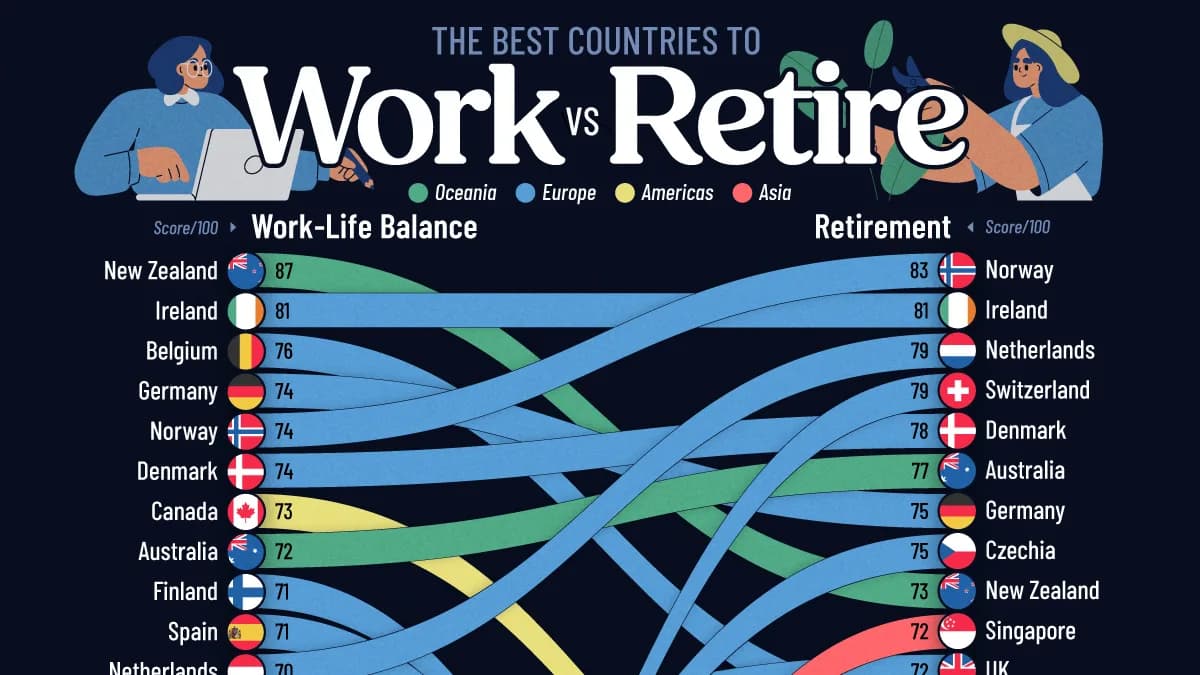
Where Is It Best to Work and Where Is It Best to Retire?
Key Takeaways
The U.S. ranks 59th out of 60 countries for work-life balance but makes the top 20 for retirement in our comparison.
Canada ranks seventh for work-life balance but drops to 17th for retirement, behind Czechia and Singapore.
Ireland and Norway are the only two countries to rank among the top five for both work-life balance and retirement.
Does a better working life translate into a better retirement?
This graphic compares the best countries for work-life balance and retirement using data from Remote’s 2025 Global Life-Work Balance Index and Natixis’ 2026 Global Retirement Index. Together, the studies examine factors ranging from paid vacation and working hours to financial security and health in retirement.
The analysis is limited to countries covered by both studies, featuring the top 25 in each index within this group, along with the U.S. for comparison. Scores reflect separate methodologies and are not directly comparable.
Northern Europe’s Advantage in Work and Retirement
New Zealand leads the global work-life balance rankings for the third consecutive year, supported by the second-highest minimum wage among the 60 countries studied and an average workweek of 33 hours. However, it ranks lower for retirement security.
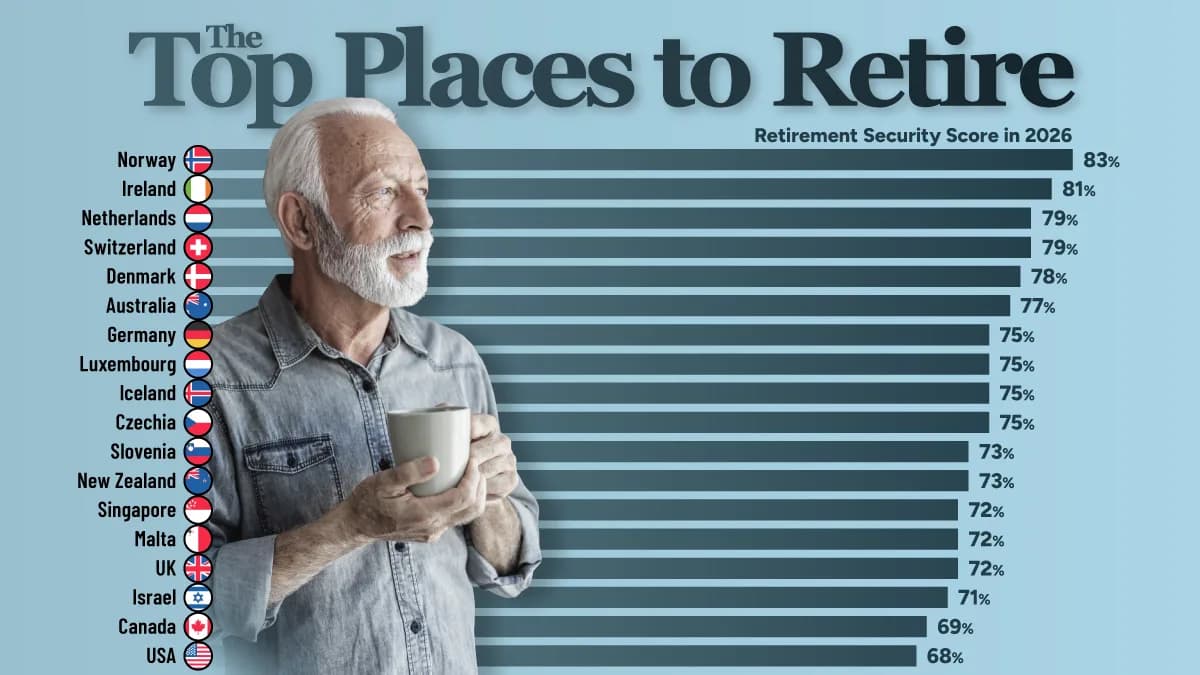
Northern Europe dominates the retirement rankings, with Norway, Ireland, the Netherlands, and Denmark all placing in the top five. Australia is the highest-ranked country outside Europe in our comparison.
CountryWork-Life Balance Score (0-100)Retirement Index Score (0-100)
New Zealand8773
Ireland8181
Belgium7671
Germany7475
Norway7483
Denmark7478
Canada7369
Australia7277
Finland7154
Spain7156
Netherlands7079
Portugal7064
UK7072
Austria6870
France6864
Poland6670
Sweden6569
Hungary6459
Greece6452
Czechia6375
Italy6166
Japan6167
Switzerland5979
Brazil5942
Chile5952
Singapore5872
South Korea5469
Israel5071
U.S.3468
Even the world’s happiest country faces challenges in retirement. Finland ranks ninth for work-life balance but 35th in the full retirement index, weighed down by weakening economic conditions and high unemployment.
Ireland, by contrast, ranks second in both indices. Workers benefit from four weeks of statutory paid vacation, a €14.15 hourly minimum wage, and high levels of public safety.
Ireland also ranks first for retirement finances for the third consecutive year, supported by relatively favorable government debt levels and a younger population. As aging populations put pressure on pension systems, Ireland is comparatively well positioned to support future generations of retirees.
The Work-Life Balance Gap Between the U.S. and Canada
In just two years, the U.S. has fallen from 53rd to 59th in Remote’s work-life balance index. Canada, meanwhile, is the only country in the Americas to rank among the global top 10, supported by universal healthcare and stronger sick pay protections.
In 2025, the average American worker logged 1,800 hours, compared with 1,687 in Canada and 1,332 in Germany. The gap with Germany is equivalent to nearly 12 additional 40-hour workweeks a year.
Paid vacation policies offer another contrast. Across the European Union, workers are legally entitled to at least four weeks of paid annual vacation. In the U.S., federal law does not guarantee paid vacation, although many employers offer it voluntarily.
Where Pensions Replace the Most Income
The Netherlands ranks among the top three countries for retirement in our comparison, partly reflecting the strength of its pension system.
Mandatory pension schemes in the Netherlands are projected to replace 96% of an average-wage worker’s after-tax earnings following a full career, compared with 51% in the U.S. and 45% in Canada.
Under the OECD’s full-career model, the projected U.S. replacement rate rises to 101% when voluntary pension contributions are included. This illustrates how Social Security and private retirement savings, combined with lower taxes in retirement, can allow some workers to match or even exceed their previous take-home pay.
The distinction highlights how much retirement security in America can depend on access to employer-sponsored plans and the ability to save consistently over several decades.
Learn More on the Voronoi App
To learn more about this topic, check out this graphic on the cost of retiring comfortably around the world.
Source: https://www.visualcapitalist.com/ranked-the-best-countries-to-work-vs-retire/
Get the latest news delivered to your inbox.
Related articles