Miniature robots turn artificial skin into smart surface that moves objects
Researchers at Saarland University have built a prototype smart surface in which nine film-based miniature...
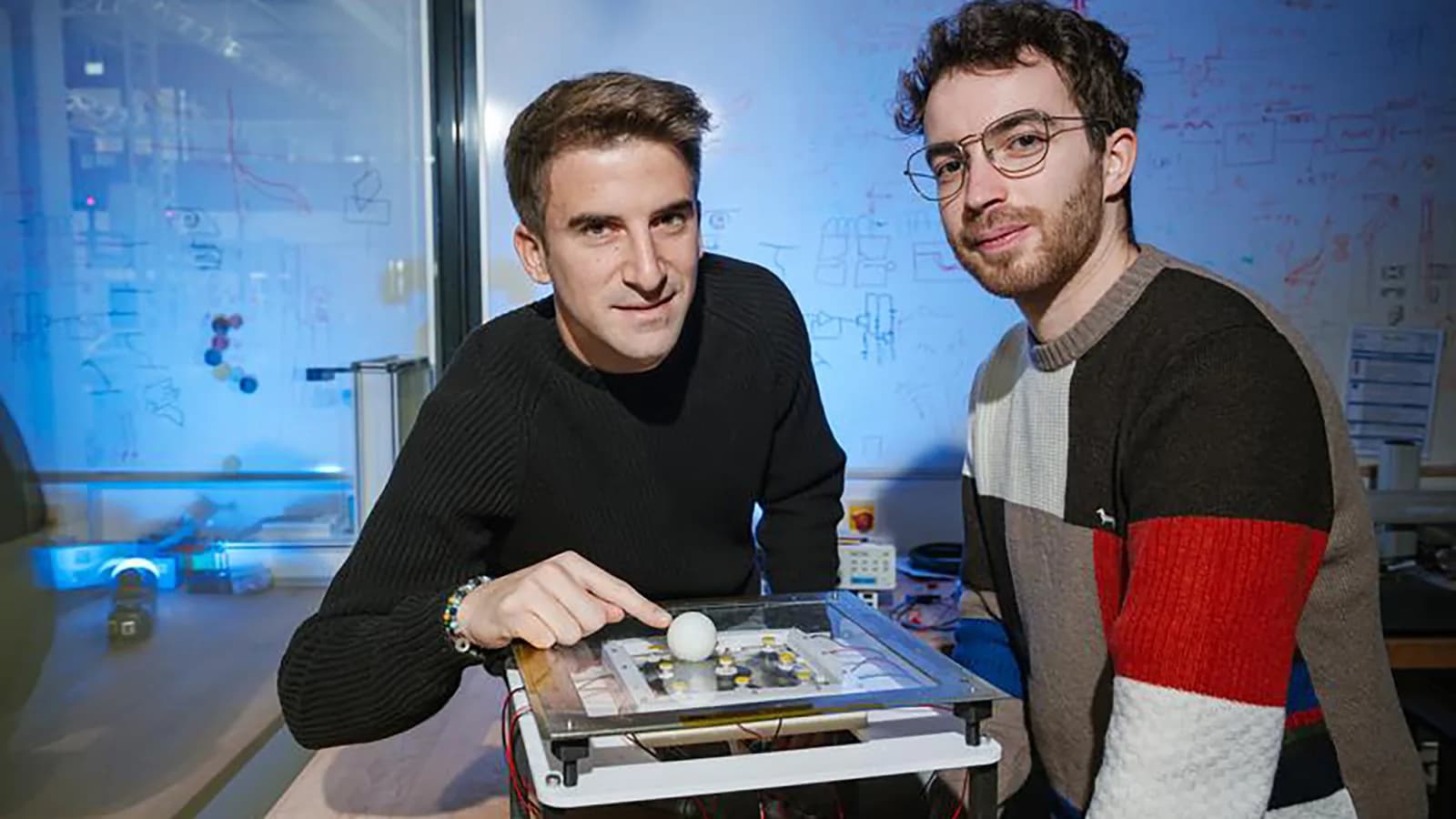
Researchers at Saarland University have built a prototype smart surface in which nine film-based miniature robots, hidden beneath a silicone skin, work as a team to roll a table tennis ball across it, according to a university release.
Each robot is an actuator, a part that produces movement, made from an electroactive polymer, a stretchable film that changes shape under voltage. The group, led by Professor Gianluca Rizzello, said the system runs on electricity alone and needs no hydraulic or pneumatic equipment and no cameras or external sensors.
The robots sense the ball’s weight stretching the skin above them. The actuator nearest the ball rises, and its neighbors detect the resulting tension. Stronger or gentler pulses let the team roll the ball one way or another, or stop it. Rizzello, professor of adaptive polymer-based systems at Saarland University, said the system is “a prototype of an entirely new type of intelligent surface.”
How these films sense and move
The elastomer film, a stretchable polymer, has a conductive layer printed on each side, according to the university’s release. A voltage makes those layers attract each other, which compresses the film and pushes it outward, increasing its surface area.
As the film deforms, its capacitance, a measure of how much electric charge it holds, changes. Each shape matches a specific capacitance reading, so the film also works as its own shape sensor and continuously reports its form, the release said.
Neighboring actuators can detect changes in the silicone membrane that connects them, doctoral researcher Saverio Addario said. The team used algorithms and machine-learning methods to analyze capacitance and position data from the actuators. It then built a model that generates commands for the prototype’s control unit, according to the release.
The films are dielectric elastomers, a class of materials whose actuators are often called artificial muscles. The release says research groups at Saarland University, including Rizzello’s, have spent years developing and refining these materials.
What comes next
The release says the technology could lead to lightweight, flexible conveyor belts for industrial use and to responsive textiles and interactive displays. Pressing against a user’s skin, a surface could form a temporary push button or volume control, which is haptic, or touch-based, feedback.
The release adds that vibrating the film at high frequencies lets the surface work as a loudspeaker. Other labs are also working on robot skin, including an optical skin on a robotic arm at the Hong Kong University of Science and Technology and an electronic skin on a robotic hand at the University of Turku.
The demonstration used nine actuators and one ball. The release gives no figures for force, speed, power use or durability, and it describes the conveyor, textile, display and haptic uses as possible rather than tested. It does not say whether the sound function was measured on this prototype.
Rizzello’s team is now working to refine how the actuators cooperate. The results were published in Advanced Functional Materials, according to the university’s Nov. 25 release.
Source: https://interestingengineering.com/science/artificial-skin-film-robots-team
Get the latest news delivered to your inbox.
Related articles