‘Atomic number zero’: Scientists take a major step toward creating pure neutron matter
A collaborative effort between researchers at the RIKEN Nishina Center for Accelerator-Based Science in Japan...
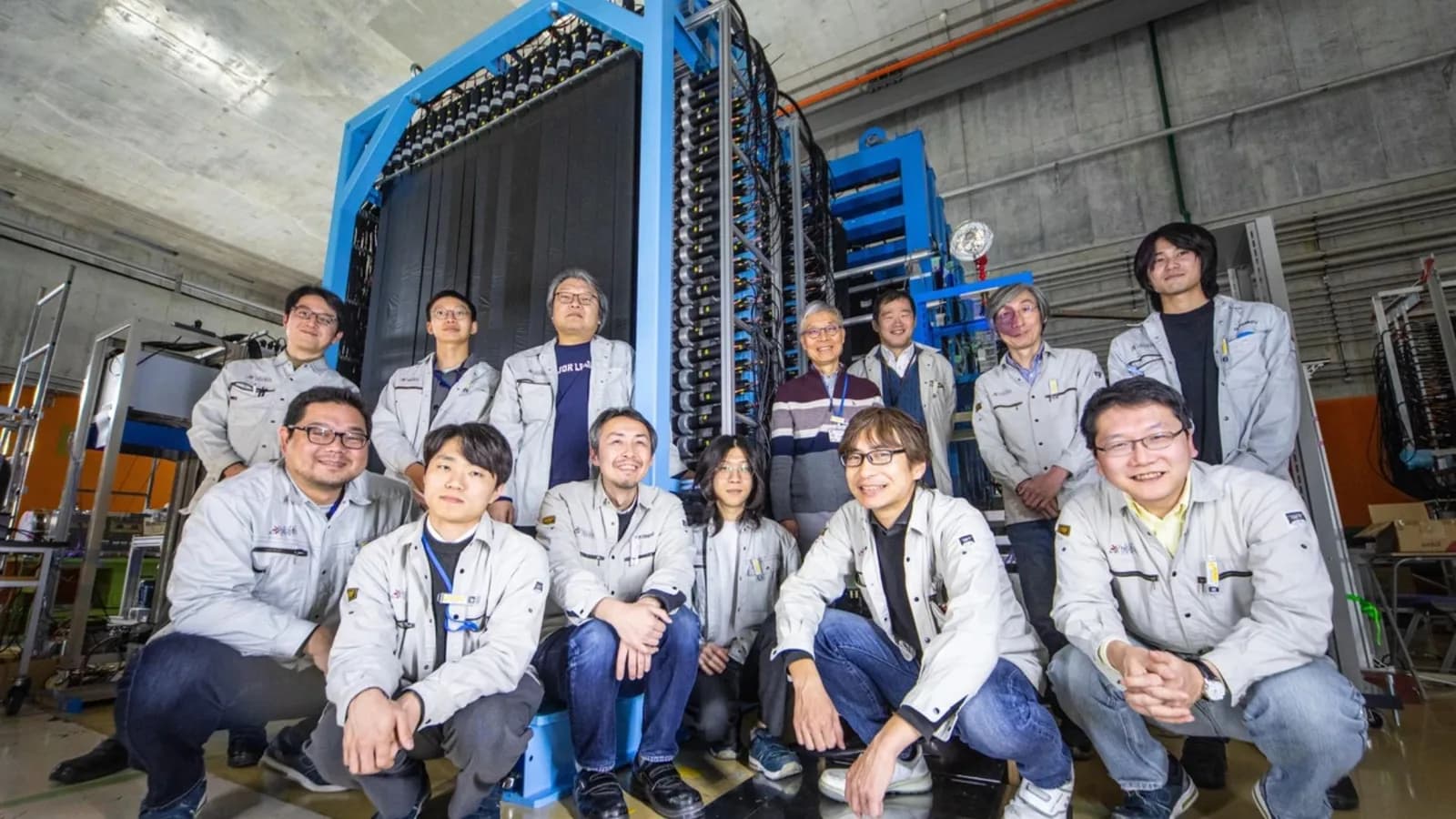
A collaborative effort between researchers at the RIKEN Nishina Center for Accelerator-Based Science in Japan and the Institute for Basic Science (IBS) in South Korea is working to build exotic nuclei containing only neutrons. This groundbreaking work, known as ‘atomic number zero,’ has long been thought to be impossible by nuclear physicists.
At the core of all matter are atoms, and at the core of the atom is its nucleus. Atomic nuclei contain nucleons, which are protons and neutrons. Positively charged protons determine the atomic number of the atom, while neutrally charged neutrons help in keeping the same-charge-bearing protons together.
Interestingly, though, neutrons are unstable on their own. When left free, they undergo beta decay and transform into a proton. Yet, they remain important in the course of the formation of the universe, where they helped produce helium after the Big Bang as well as elements heavier than iron.
Why look for pure neutron matter?
Neutron stars are mostly composed of neutrons and are extremely dense objects, holding millions of tons of mass in spaces as small as a sugar cube. Nuclear physicists have not yet solved the puzzle of why neutron stars do not collapse into black holes. To examine this, they need to make a nuclei composed entirely of neutrons.
Physicists believe that critical to solving this puzzle is the understanding of the three-neutron force, which emerges when three neutrons interact at once. Using heavy-ion beams accelerated at speeds nearly half the speed of light and directed at helium or hydrogen targets, researchers at RIKEN generated multineutron systems between 2016 and 2022.
Conventional detectors work using electromagnetic interactions between particles. Since neutrally charged neutrons do not participate in these interactions, it is difficult to detect them. To determine whether the multineutron system formed, researchers had to reconstruct the missing mass from the reaction products.
RIKEN experiments used the NEBULA neutron detector for this work. When neutron-rich nuclei collide with hydrogen nuclei, the trajectories and signals of recoil protons are used to determine the energies and positions of the neutrons. However, since neutron-proton interactions are rare, the efficiency of the detector remains as low as 0.1 percent.
How Korean collaboration helped
RIKEN’s previous collaboration with the French research group worked to double the depth of the detector to 18.88 inches (48 cm). However, this could only help increase the efficiency to a little above one percent.
The team got in touch with researchers at Institute for Basic Science (IBS) in South Korea who were building the ROAN accelerator and had finished constructing their neutron detector, dubbed LAMPS-NDA, boasting a depth of 31.5 inches (80 cm). After multiple meetings, the detector was moved to RIKEN and integrated into the existing detector system in May 2026.
With the new detector on board, the detection efficiency at RIKEN for the four-neutron system nearly doubled to 3.5 percent.
“Our goal is to create, for the first time on Earth, matter composed almost entirely of neutrons, similar to the material found inside neutron stars,” said Tomohiro Uesaka, Group Director of Nuclear Dynamics Research Group at RIKEN in a press release.
“With detection efficiencies at this level, we have good reasons to expect meaningful results. Better detection efficiency also greatly increases our motivation for the experiment.”
Get the latest news delivered to your inbox.
Related articles