Chinese team boosts underwater drone sonar by over 10 dB with tungsten-silicone lens
Researchers at Shanghai Jiao Tong University have developed a soft tungsten-silicone ‘contact lens’ which allows...
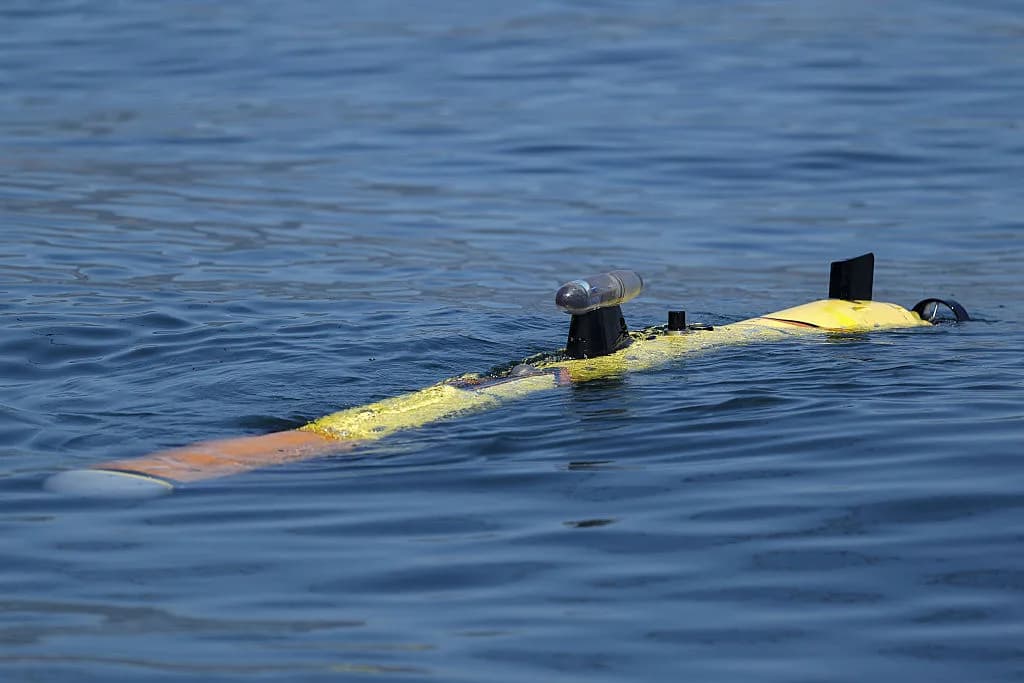
Researchers at Shanghai Jiao Tong University have developed a soft tungsten-silicone ‘contact lens’ which allows underwater drones to produce much sharper sonar images without any increase in power consumption and without the need for any complex signal processing.
The passive acoustic lens , developed by Professor Yu Zhang’s group, compensates for the distortions that the curved protective domes of underwater vehicles introduce, ensuring that the sonar beam remains well focused after it has passed through the dome.
“Every time an autonomous drone dives to explore the ocean floor, the very armor designed to protect it simultaneously blinds its sonar,” the researcherssaid in a statement, describing a long-standing engineering challenge for autonomous underwater vehicles.
Solving decades-old sonar problem
Underwater drones normally have their sonar systems contained within smooth, curved domes which serve to reduce drag and protect the delicate electronics. The downside, of course, is that the domes also bend and scatter the outgoing sound, which has a negative effect on sonar performance and makes it harder to pick up objects at a distance.
Engineers have traditionally tackled the problem with large phased array systems or complex software algorithms. Signal processing can only improve the quality of the received signal and cannot recover the acoustic energy that’s been lost through wave distortion. Larger electronic systems also draw more power, thereby reducing the operational time of battery-powered unmanned underwater vehicles (UUVs).
To overcome these limitations, Zhang’s team designed a passive acoustic lens that physically reshapes sonar waves before they leave the vehicle.
Using a technique known as time reversal, the researchers first worked out how the protective dome would distort outgoing sound. They then created a corrective lens by embedding microscale tungsten particles in a flexible silicone to create a material with acoustic properties very similar to water.
By varying the tungsten concentration throughout the material, they were able to precisely control the speed of sound in different parts of the lens. The structure is in the form of concentric rings, which is very much like the way a prescription lens has varying thickness. This allows certain parts of the sound wave to be delayed just enough to cancel out the distortion caused by the curved dome.
Stronger sonar without draining batteries
Lab and field testing demonstrated that the passive lens had a significant effect in sharpening the sonar beam.
They claim it took a diffuse 65-degree acoustic beam and compressed it down to a very focused 16- to 30-degree beam. It also increased the main sonar signal by over 10dB across the 20 to 45kHz band. Background reverberation was reduced by over 10dB as well, improving echo detection without any additional power or computational processing.
As the correction is built right into an inexpensive molded material, the approach could make high-performance sonar practical for smaller, cheaper underwater drones which simply can’t afford to have the bulky electronics or high-power phased arrays.
The silicone tungsten composite was also found to be stable during testing in saltwater and over a range of temperatures, indicating it would be suitable for use in a marine environment.
The next stage of the project will be long-term ocean deployments, looking at resistance to marine biofouling. The researchers also plan to look at the use of 3D-printing to make seamless gradient acoustic lenses. That same wave-shaping approach could ultimately be applied to medical ultrasound and non-destructive testing systems for industrial infrastructure.
The findings were published in the International Journal ofExtremeManufacturing.
Source: https://interestingengineering.com/innovation/china-underwater-drone-sonar-tungsten-lens
Get the latest news delivered to your inbox.
Related articles