Google DeepMind uses Gemini 4 agent teams to speed up quantum algorithms, with results verified in Lean
Teams of Gemini 4 agents found quantum circuits that cut the computing cost of a fusion-energy calculation by 11.8 times and improved a Cytochrome P450 enzyme simulation by 2.5 times, with every result formally proved in the Lean theorem prover.
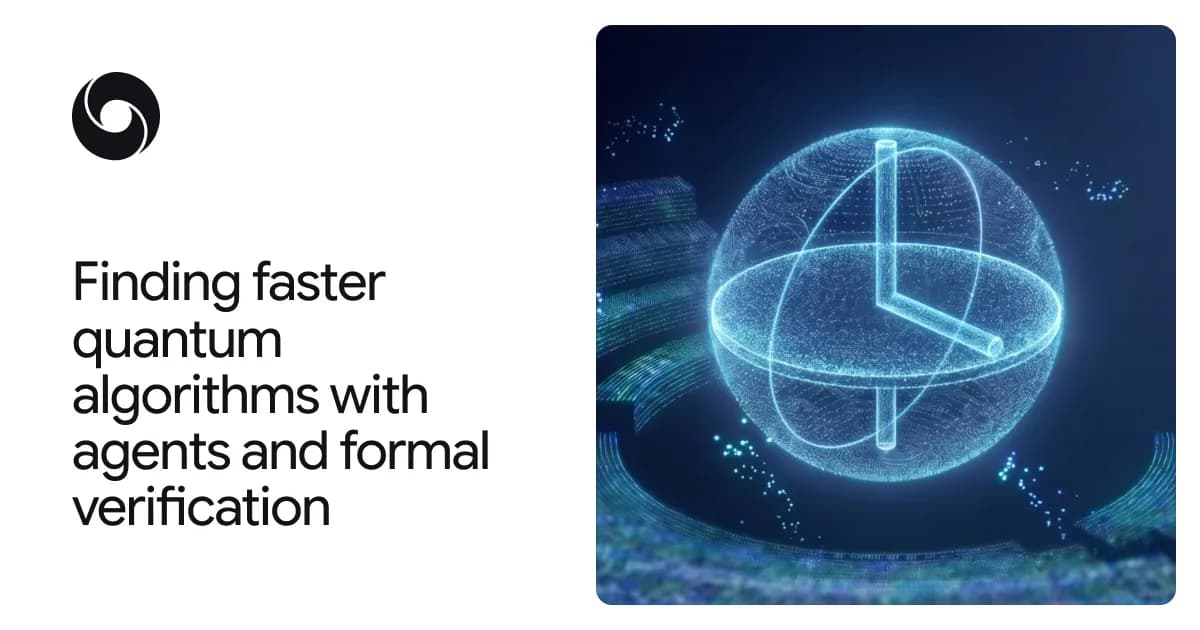
Google DeepMind and Google Quantum AI on November 23 published research in which teams of Gemini 4 agents improved well-known quantum algorithms and produced more efficient quantum circuits. Every result was formally proved in the Lean theorem prover, and the team is open-sourcing its Lean library, problem specifications and verified solutions on GitHub.
Why formal proofs
Resource-intensive quantum circuits cannot be tested on classical computers or today's small quantum processors, so their correctness has to be proved mathematically. DeepMind said separate, independent agent teams searched for improvements on each problem; ideas entered a shared notebook only after being verified in Lean, and every four hours agents from each team met at a "virtual conference" to trade and debate ideas.
Key results
- Fusion energy: for a circuit that calculates an important property of inertial confinement fusion, the agents cut the computing cost, a metric combining qubits and operations, by 11.8x and lowered required memory from 5,650 to 4,338 error-corrected qubits.
- Chemistry and drug design: quantum simulation of a common light-sensitive molecule became 8x cheaper, and for Cytochrome P450, an enzyme that breaks down most human medicines, the agents found a 2.5x improvement and reduced memory from 481 to 333 qubits.
- Core building blocks: a 2.57x speedup for a specific implementation of Grover's search algorithm and a 290x speedup for arcsin, a routine used by many quantum algorithms to load numbers into quantum states.
Caveats
DeepMind acknowledged that running these algorithms in scientific simulations would still demand more resources than the first error-corrected quantum computers are likely to provide, but called the improvements significant. The researchers said proof-checked AI search compresses work that once took years of manual design, letting scientists focus on choosing problems and interpreting results.
Sources: Google DeepMind
Get the latest news delivered to your inbox.
Related articles