Mapped: Where the Death Penalty Is Still Legal in the U.S.
Explore the U.S. death penalty divide in 2026, including which states allow executions and where capital punishment is banned.
Which U.S. States Still Have the Death Penalty?
Key Takeaways:
The death penalty remains legal in 27 U.S. states, while 23 have abolished it.
Four states retain capital punishment but have paused executions, including California.
California has the country’s largest death row population, with 572 people awaiting execution.
While most Western democracies have abolished capital punishment, the United States remains divided over its use, with laws varying significantly from state to state.
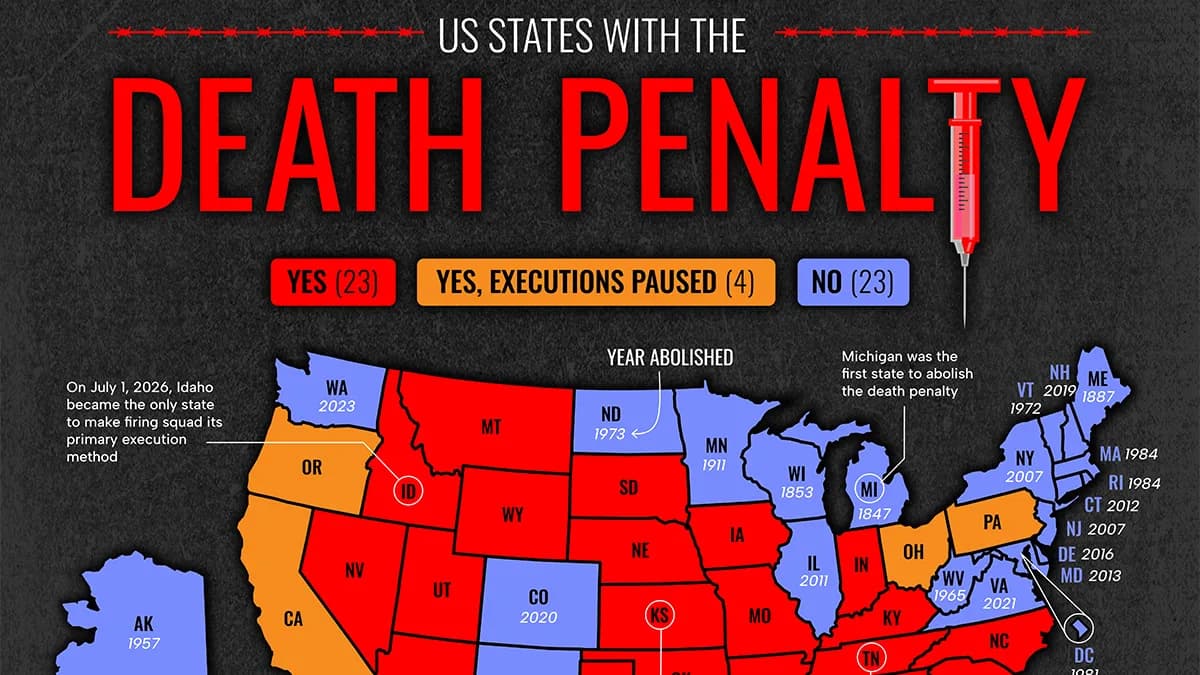
This visualization, created by Julie R. Peasley, maps the legal status of the death penalty across the country, using data from the NAACP Legal Defense Fund’s Death Row USA: Summer 2026 Report.
Which U.S. States Still Have the Death Penalty?
Of the 50 states, 23 retain the death penalty without a statewide pause on executions, four have paused executions without abolishing capital punishment, and 23 have abolished it.
The following table shows each state’s legal status and death row population as of July 1, 2026.
StateDeath Penalty?People on Death Row
(as of July 1, 2026)Year Abolished
AlabamaYes158-
AlaskaNo-1957
ArizonaYes111-
ArkansasYes24-
CaliforniaYes, Executions Paused572-
ColoradoNo-2020
ConnecticutNo-2012
DelawareNo-2016
FloridaYes249-
GeorgiaYes36-
HawaiiNo-1957
IdahoYes8-
IllinoisNo-2011
IndianaYes5-
IowaNo-1965
KansasYes9-
KentuckyYes24-
LouisianaYes57-
MaineNo-1887
MarylandNo-2013
MassachusettsNo-1984
MichiganNo-1847
MinnesotaNo-1911
MississippiYes35-
MissouriYes9-
MontanaYes2-
NebraskaYes12-
NevadaYes57-
New HampshireNo12019
New JerseyNo-2007
New MexicoNo-2009
New YorkNo-2007
North CarolinaYes124-
North DakotaNo-1973
OhioYes, Executions Paused109-
OklahomaYes26-
OregonYes, Executions Paused0-
PennsylvaniaYes, Executions Paused103-
Rhode IslandNo-1984
South CarolinaYes25-
South DakotaYes1-
TennesseeYes42-
TexasYes164-
UtahYes5-
VermontNo-1972
VirginiaNo-2021
WashingtonNo-2023
Washington D.C.No-1981
West VirginiaNo-1965
WisconsinNo-1853
WyomingYes0-
California has the largest death row population (572), more than twice Florida’s 249, despite its moratorium on executions. Texas (164), Alabama (158), and North Carolina (124) round out the top five. Together, these states account for 1,267 people awaiting execution.
Why Does the Death Penalty Persist in the U.S.?
Supporters argue that capital punishment delivers justice for victims’ families and deters particularly serious crimes, although evidence of its deterrent effect remains inconclusive.
The U.S. allows individual states to determine whether to retain capital punishment, subject to federal constitutional limits. In 1976, the Supreme Court upheld revised death penalty laws that included additional procedural safeguards.
According to Northeastern University, historical racial inequalities and political resistance to abolition have also contributed to its persistence.
America’s Regional Divide on Capital Punishment
The Death Penalty Information Center highlights a pronounced regional divide: capital punishment remains especially prevalent across the Republican-leaning South, while much of the Democratic-leaning Northeast has abolished it.
However, the divide is not strictly partisan. Democratic-leaning California retains the death penalty despite suspending executions, while Republican-leaning states such as North Dakota and West Virginia have abolished it.
These differences reflect broader debates over criminal justice and public safety, including approaches to violent crime and firearm deaths across states.
Why Legal Status Doesn’t Tell the Whole Story
Although capital punishment remains legal in 27 states, its actual use is far more limited. According to State Court Report, just 14 states have carried out executions since 2019.
National support for the death penalty has also declined from historical highs, although a majority of Americans continue to favor it. The gap between states that authorize capital punishment and those that actively use it illustrates how differently the policy operates across the country.
Learn More on the Voronoi App
For a global perspective, see The Death Penalty is Still Legal in 87 Countries, which explores how capital punishment laws differ around the world.
Get the latest news delivered to your inbox.
Related articles