
How Cambodia’s law on ‘freedom parks’ curtailed people’s right to protest
"It has not only been used to confine peaceful gatherings and demonstrations to Freedom Park, but increasingly, the very use of Freedom Park has been restricted and denied."
Only one freedom park has been identified in the country
Originally published on Global Voices
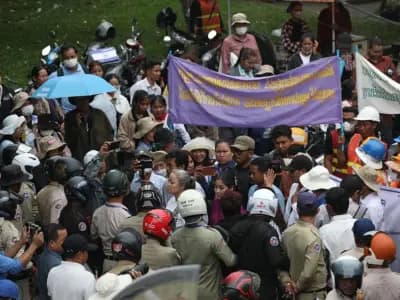
Participants hold banners while security officers block them from marching in Phnom Penh during the May 1 Labor Day. Photo from Licadho. CC BY-NC 4.0
This post is part of Global Voices’ September 2026 Spotlight series, “Protest in Democracy.” With this Spotlight, we seek to explore the many forms of protest, the tactics states use to delegitimize and suppress them, and the complex relationship between protest and democracy. You can support this coverage by donating here.
Cambodia’s Law on Peaceful Demonstration was supposed to ensure the right of citizens to organize and participate in public assemblies by designating freedom parks in every province. But since its passage in 2009, only one park has been identified, and authorities often impose prohibitions on the use of this space for protests.
As early as 2009, several human rights groups flagged some of the restrictive provisions of the law.
The notification letter of the organizers of the planned demonstration will have to include a number of elements, including the number of participants involved in the demonstration. This requirement is absurd, since it is impossible to predict, ahead of a protest, how many people will join. If the estimates of the organizers appear to be inaccurate, under a strict interpretation of the law, the protest could be considered illegal.
Amnesty International also pointed out that the law is silent on “spontaneous” protests.
A related concern is the lack of recognition and protection in the [law] for spontaneous assemblies. Spontaneous assemblies are those that occur without prior organization, usually in response to a specific event. Because they are unplanned, prior notification is not possible.
In 2011, the Cambodian Center for Human Rights (CCHR) warned about the potential designation of freedom parks that are inaccessible to the public.
Another concern with freedom parks is that they could be located where few citizens can see or hear those peacefully assembling or demonstrating, which defeats the object of demonstrations or protests, namely to voice concerns and express views, often in order to influence government leaders, local authorities and the general public.
The Phnom Penh freedom park became crucial for opposition groups to stage protests in 2013 and 2014. A new freedom park was named in 2017, but this was far from the city center and surrounded by warehouses and industrial buildings.
“Moving Freedom Park to a location far from their [protesters’] target audience, resulting in a loss in the expressive value of assemblies, would therefore clearly impede the exercise of fundamental rights,” said the U.N.’s Office of the High Commissioner for Human Rights country representative in Cambodia in an interview with VOA Khmer news outlet.
CCHR has documented numerous instances when the government explicitly prevented groups from holding protests in the Phnom Penh Freedom Park.
For example, protesters from eviction-hit communities were blocked in January 2015.
Barricades were placed in September 2020 ostensibly to maintain security and public order during the pandemic. UN Special rapporteurs issued a statement expressing concern over the security measures that undermined the use of the freedom park.
This year, authorities denied permission for the use of the park to celebrate International Women’s Day and advised groups to mark the day by organizing activities in their respective offices. The city also warned that organizers could face legal action if they proceeded to hold the event and “disrupted security, public order or social stability.”
The same prohibitions were made during the May 1 Labor Day, and authorities only allowed ten people to walk and submit petitions to government agencies.
CCHR cited the experience of groups in coordinating their plans with authorities.
Authorities will call a meeting with CSO representatives, in which a small number of CSO staff will be greatly outnumbered by Government officials, many of whom are high-ranking. Similarly, when the authorities call CSO representatives to hear their decision and explanation, the representatives are often not given sufficient time to speak or engage in discussion about the decision.
It also summed up how the law has been weaponized to undermine protests.
It has not only been used to confine peaceful gatherings and demonstrations to Freedom Park, but increasingly, the very use of Freedom Park has been restricted and denied.
Restrictions on peaceful gatherings therefore risk limiting the democratic space in which Cambodians can exercise their agency and participate meaningfully in public and political life, reducing democracy to the act of voting alone.
Human rights groups are calling for the review of the law since more protests and assemblies are expected to be organized ahead of the 2027 Commune/Sangkat Council elections and the 2028 National Assembly elections.
Written by Mong Palatino
Related articles

Trump orders US government to call AI ‘Super Intelligence’
The US executive branch is no longer acknowledging the existence of "artificial intelligence.

Will Chinese AI companies slow down? A top House Democrat wants answers
As President Donald Trump prepares to meet tech and AI CEOs in Washington, Rep. Ro Khanna (D-CA) is calling for a treaty between the US and China to keep AI from wreaking havoc on the world.

Movement from behind your gadget
The growth of online activism has given different colors in the movement agendas. There is a debate on how effective it is, and how it could complement each other.
Young Japanese find new outlets for peace activism amid rising tensions in the Pacific
GV observed Japanese peace activism shifting from an ideological, often confrontational and hierarchical approach among the older generation to a more individualised, accessible, pop-style approach…

The vibes are bad for Flock in Washington
Flock is in the hot seat in Washington, even if its CEO declined to actually face senators at a hearing about its "AI Surveillance Network" on Wednesday.

Data centers are black boxes, but California wants to change that
California Gov. Gavin Newsom signed a slate of bills on Monday that could finally give communities better data - and more say - on how data centers impact their electricity bills and water supply.