In win against impunity, Indonesian court orders the reform of Military Justice Law
"Justice for civilian victims of military abuses shouldn’t be blocked by an unfair military court system."
The court ruled that soldiers who committed criminal offenses should be tried by civilian courts
Originally published on Global Voices
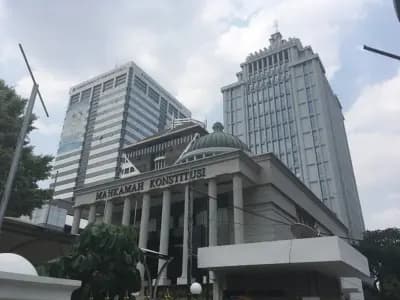
Constitutional Court of Indonesia in Jakarta. Photo by Christophe95. Wikipedia. CC BY-SA 4.0
This post is part of Global Voices’ November 2026 Spotlight series, “Justice as infrastructure.” In this Spotlight, Global Voices is partnering with The Hague Institute for Innovation of Law (HiiL) to highlight the ways justice functions as critical infrastructure for any society. You can support this coverage by donating here.
Indonesia’s Constitutional Court ruled that the 1997 Military Justice Law would be invalid unless amended within two years. The decision was hailed by human rights groups because it means soldiers who commit crimes can be tried in civilian courts.
Article 9 of the Military Justice Law requires active-duty personnel of the Indonesian National Armed Forces to be held accountable exclusively under the military justice system, even when they commit ordinary criminal offenses and human rights violations.
The law was a legacy of the New Order era when the country was under the strongman rule of Suharto, who relied on the military establishment to hold power from 1966 until his resignation in 1998.
The October 15 court ruling was celebrated by human rights groups that have long advocated for the overhaul of the law. They have documented how military courts have failed to investigate and prosecute grave abuses committed by soldiers. They have also expressed concern that military judges are active-duty soldiers, and that judicial investigations and prosecutions often take place within the military chain of command and behind closed doors, with no public oversight.
One of the petitioners asking officials to revoke the law was Eva Meliani Pasaribu, the daughter of Tribrata TV journalist Rico Sempurna Pasaribu, who was killed in June 2024 after reporting about a gambling operation allegedly involving a high-level military official. The military conducted a closed-door investigation and dismissed the allegation for lack of evidence.
Ibnu Syamsu Hidayat, the legal counsel for the petition, addressed the court during the hearing and explained how the law erodes civilian supremacy within a democratic system of governance.
“The dominance of military court jurisdiction over the general judiciary is considered inconsistent with the principles of a constitutional democracy, which mandates that civilian authority must take precedence over military power.”
Hidayat added that the law’s broad provisions have been interpreted to include other criminal offenses committed by soldiers.
“It allows them not only to try military personnel or those equated with them for military crimes and disciplinary violations, but also to adjudicate other criminal cases such as corruption, traffic offenses, domestic violence, narcotics, psychotropics, and child protection cases.”
During the hearing, numerous high-level military officers spoke up in defense of the law. The director general of Defense Forces at the Ministry of Defense, Marshal H. Haris Haryanto, argued that the actions of soldiers, including criminal violations, “can also affect the solidarity and readiness of the military institution.” He added, “Military courts are designed to understand these characteristics so they can deliver decisions that satisfy a sense of justice while also taking into account the interests of national defense.”
The commander of the National Armed Forces, General Agus Subiyanto, said the petition questioning the effectiveness, independence, and accountability of the military justice system “is not based on a comprehensive understanding of the characteristics of military law.”
He emphasized that military judges have the independence of judicial power guaranteed by the constitution and are under the technical judicial supervision of the Supreme Court, adding, “In a military organization, discipline is the primary foundation of national strength. Therefore, the commander’s authority to ensure due process for his subordinates is an inherent legal obligation to maintain operational readiness and the institution’s honor.”
Legal experts who participated in the hearing disagreed, arguing that the law needs reform in order to comply with current human rights standards. Al Araf told the court that the law was drafted under the framework of an “authoritarian political regime” that ignored the principles of rule of law.
“During the New Order era, the legal products enacted in the form of statutes tended to be repressive and merely served as instruments of control for those in power,” he said. “The state enacted laws not within the framework of the rule of law, but solely to fulfill the needs of the rule by law.”
Zainal Arifin Mochtar, another legal expert at the hearing, said the law has to be updated to conform with democratic principles.
“Many issues have emerged, ranging from dual jurisdictions, a lack of synchronization with the spirit of reform, the absence of detailed regulations regarding connectivity, to the issue of independence and accountability of military justice, which is often discussed as a form of legal exceptionalism,” he said.
The move has been widely celebrated by human rights defenders. The Indonesian human rights group KontraS welcomed the court decision, noting that one of its employees has been subjected to an acid attack perpetrated by a group of soldiers. Under the new ruling, soldiers could be tried in public courts in such cases.
“This ruling closes a legal loophole that has long been perceived as protecting individual soldiers from accountable law enforcement, while also marking a new chapter in upholding the rule of law and fulfilling the mandate of security sector reform in Indonesia,” read their statement.
The reform is the result of decades of work and activism, as explained by Human Rights Watch (HRW).
“Justice for civilian victims of military abuses shouldn’t be blocked by an unfair military court system,” read their statement. “Amending the law on military justice will support efforts begun decades ago to ensure the Indonesian military is a professional, credible institution whose soldiers are held accountable when they commit serious abuses.”
Free Press Unlimited said the court ruling is a victory against impunity.
“The Constitutional Court’s eagerly awaited ruling is a true victory for justice and a critical step for Indonesia in its fight against impunity,” read their statement on the ruling. “We urge lawmakers to act promptly and adhere to this landmark ruling as soon as possible. Only then can Indonesia finally turn a corner and ensure that cases involving military personnel will be dealt with by civilian courts, as it should be.”
Both Indonesian and international civil society groups are urging lawmakers to start the reform process by consulting the public and various stakeholders. Activists argue that public vigilance has to be sustained, especially since Indonesia’s current president, Prabowo Subianto, is a former general dismissed from the military for committing human rights violations. Since coming to power in 2024, he has expanded the military’s role in civilian governance.
Written by Mong Palatino
Get the latest news delivered to your inbox.
Related articles