Lockheed Martin plans first-ever robotic welding demo aboard ISS for moon bases
Lockheed Martin is preparing to demonstrate robotic welding aboard the International Space Station (ISS). The...
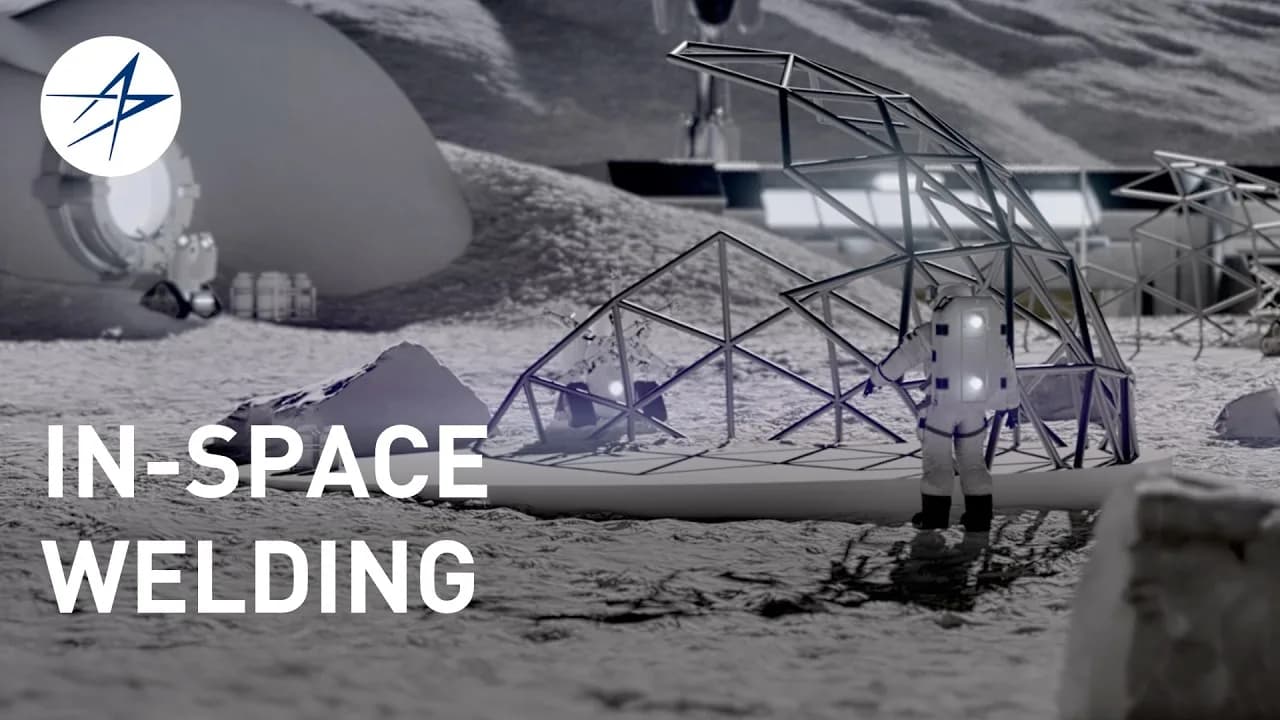
Lockheed Martin is preparing to demonstrate robotic welding aboard the International Space Station (ISS). The technology could eventually allow large structures to be built and repaired directly in orbit or on the Moon.
Called JOINS (Joining Demonstrations In-Space), the project will expose welding equipment to the harsh conditions of space, including microgravity, vacuum, and extreme temperature changes. Lockheed Martin describes it as the first American and first-ever robotic welding demonstration in exposed space.
The project addresses a challenge for future exploration: some infrastructure may be too large or complex to launch as a single structure. Instead of transporting fully assembled equipment from Earth, robotic systems could eventually build structures where they are needed.
Potential applications include shelters that protect rovers during the Moon’s long nights, lunar communications structures, and frameworks for large space telescopes.
Why building structures in space matters
Rocket payload capacity and launch costs limit the size and weight of equipment that can be sent into orbit. Building structures in space could help overcome those constraints while reducing the amount of assembly hardware that must be launched from Earth.
JOINS will investigate how metal components can be joined with limited power, how heat moves through materials in a vacuum, and how robotic tools behave during extreme temperature changes. These factors will help engineers determine whether welded connections can withstand the mechanical and thermal stresses faced by structures operating in space.
“Every kilogram saved, every joint welded enabling high stiffness and precision, translates to cheaper missions and more capable architectures,” said Bobby Biggs, JOINS program manager at Lockheed Martin.
If successful, the technology could allow robotic systems to assemble, integrate, and repair large structures, reducing the need for astronauts to carry out every task manually.
Two welding methods to be tested
The JOINS payload will use Voyager Technologies’ Bishop Airlock aboard the ISS as a staging area and test environment. The airlock will expose the equipment to the space environment so engineers can evaluate its performance beyond the station’s pressurized areas.
The demonstration will test two techniques on aluminum and stainless-steel samples: laser beam welding and friction stir welding.
Laser beam welding uses a concentrated, high-energy beam to join metal. It is suited to thin or intricate joints where heat input must be controlled.
Friction stir welding uses mechanical friction to generate heat and join metal without melting the base material. It could produce strong, crack-resistant seams while limiting thermal distortion.
Onboard inspection systems, including cameras, will monitor the welds. Data will be sent to mission control in Houston, while the physical test samples are expected to return to Earth months later for further inspection and testing.
Lockheed Martin is carrying out JOINS through a $9.1 million funded Space Act Agreement with NASA under the agency’s Tipping Point program, with additional company investment.
The demonstration will also inform STRATOS, a NASA collaboration focused on robotic assembly technologies. Both efforts are part of the broader push toward in-space servicing, assembly, and manufacturing, which could eventually make it possible to construct and maintain larger infrastructure beyond Earth.
Source: https://interestingengineering.com/space/lockheed-martin-nasa-iss-moon-orbit
Get the latest news delivered to your inbox.
Related articles