Mapped: The New Time Differences Across North America
Vancouver will be an hour ahead of Seattle this winter as much of western Canada stops changing its clocks.
How North America’s Clocks Changed For This Winter
Key Takeaways
Most Americans will turn their clocks back one hour on November 1, while Hawaii and most of Arizona will see no change.
Vancouver will be one hour ahead of Seattle this winter as British Columbia keeps its clocks unchanged.
Winnipeg will share Toronto’s time after November 1, instead of being one hour behind.
A trip across the U.S.–Canada border could come with a new time difference this winter, even between cities whose clocks usually match.
On November 1, 2026, most of the U.S. and eastern Canada will turn their clocks back one hour, while much of western and central Canada will keep the same time.
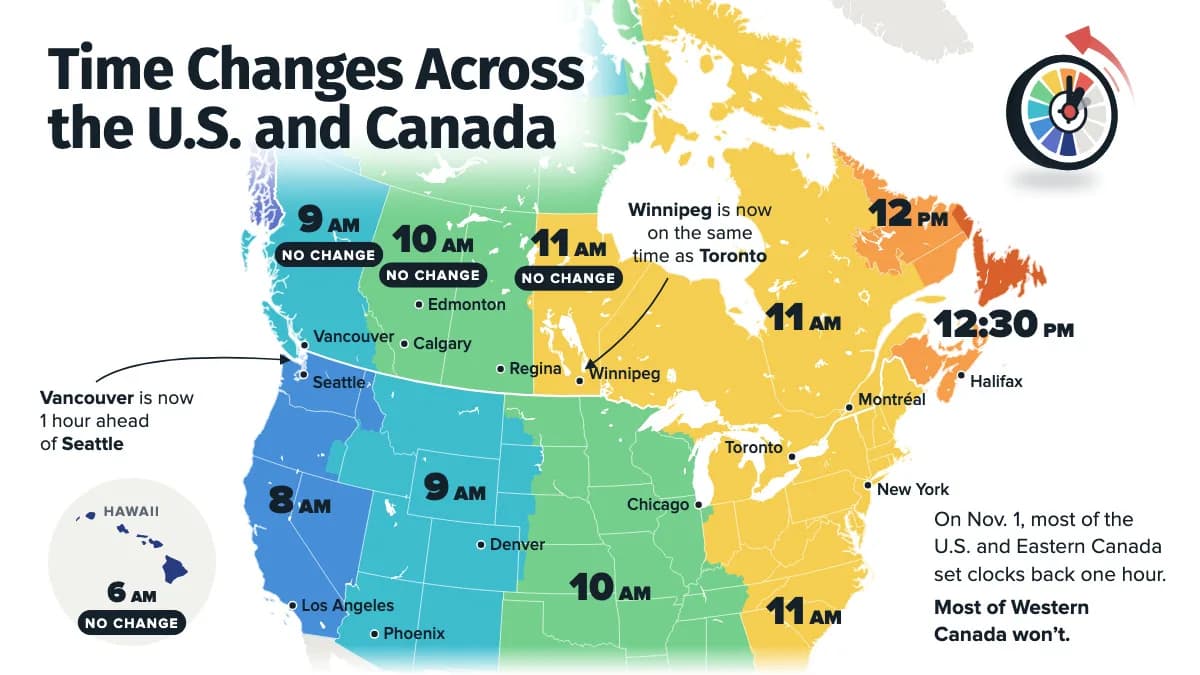
This map shows winter time differences across the two countries using the IANA Time Zone Database and provincial and territorial government announcements. Every clock shows the same moment, when it is 4 p.m. in London.
Vancouver and Seattle Will Be an Hour Apart
Vancouver and Seattle share the same time through October 31, 2026. The next day, Seattle will turn its clocks back while Vancouver stays put. When it is 8 a.m. in Seattle, it will be 9 a.m. in Vancouver.
British Columbia ended seasonal clock changes for most of the province after its spring adjustment in March 2026. Most of B.C. will keep its summer time through winter, preserving an extra hour of daylight in the late afternoon compared with a return to standard time.
Drag the divider to compare the two maps before and after the November 1 clock change:
Both maps show local times when it is 4 p.m. in London.
Calgary and Edmonton will remain on Regina’s time at 10 a.m., while Denver moves back to 9 a.m. Alberta’s move to permanent time keeps its clocks aligned with Saskatchewan throughout the year. The Northwest Territories is also ending seasonal changes, coordinating with Alberta to preserve shared time for business and health services.
The table below compares local times before and after November 1, using 4 p.m. in London as a common reference point. Time-zone names reflect November 1.
Time Zone (Nov. 1)CityOct. 31, 2026Nov. 1, 2026
Hawaii Standard Time Honolulu6 a.m.6 a.m.
Alaska Standard Time Anchorage8 a.m.7 a.m.
Pacific Standard Time Los Angeles / Seattle9 a.m.8 a.m.
Pacific Time (B.C.) Vancouver9 a.m.9 a.m.
Mountain Standard Time Phoenix9 a.m.9 a.m.
Mountain Standard Time Denver10 a.m.9 a.m.
Alberta Time Calgary / Edmonton10 a.m.10 a.m.
Central Standard Time Regina10 a.m.10 a.m.
Central Standard Time Chicago / Dallas11 a.m.10 a.m.
Manitoba Standard Time Winnipeg11 a.m.11 a.m.
Eastern Standard Time Toronto / Montréal; New York12 p.m.11 a.m.
Atlantic Standard Time Halifax1 p.m.12 p.m.
Newfoundland Standard Time St. John’s1:30 p.m.12:30 p.m.
Manitoba is keeping daylight saving time permanently, while Toronto will turn its clocks back. As a result, Winnipeg will share Toronto’s time this winter and be one hour ahead of Chicago. Both Winnipeg and Toronto will show 11 a.m. at the moment illustrated on the map.
Hawaii and most of Arizona already keep the same time throughout the year. The U.S. daylight saving rules exempt both from seasonal clock changes, although the Navajo Nation observes them.
Why U.S. States Still Turn Their Clocks Back
Unlike Canadian provinces, U.S. states cannot adopt permanent daylight saving time without federal authorization. They can stop changing their clocks by keeping standard time, the winter setting, year-round, as Hawaii and most of Arizona already do.
More than 20 U.S. states have passed laws or resolutions supporting permanent daylight saving time. But without a change to federal law, most Americans will continue adjusting their clocks twice a year.
Only 12% of U.S. adults supported changing the clocks twice a year in an October 2025 poll. When asked which time they would prefer year-round, 56% chose daylight saving time, which would mean brighter winter evenings but darker mornings.
Learn More on the Voronoi App
If you enjoyed today’s post, check out America seems ready to call time on daylight saving on Voronoi.
Source: https://www.visualcapitalist.com/mapped-time-changes-us-canada-2026/
Get the latest news delivered to your inbox.
Related articles