
New solar-powered trash bin lid breaks down chemicals that cause garbage odors
A solar-powered device designed to control garbage odors has shown promising results in tests with...
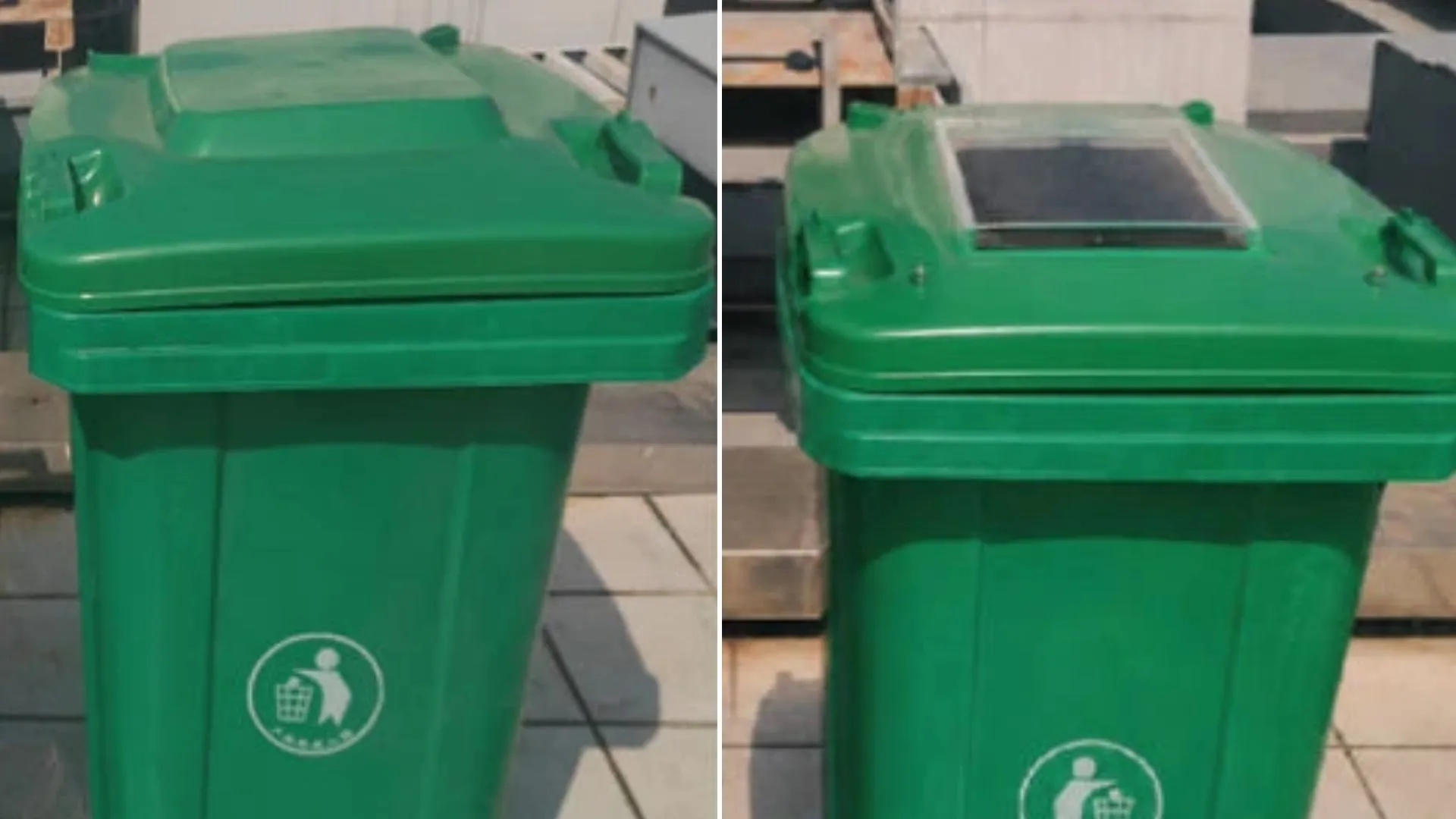
A solar-powered device designed to control garbage odors has shown promising results in tests with real food waste. Researchers developed a removable lid insert that fits standard wheeled trash bins and uses sunlight to break down odor-causing chemicals.
The device targets acetic acid, a major contributor to the sharp smell produced as food waste decomposes. In outdoor testing, the system continued breaking down the compound for more than 40 days under natural sunlight.
The approach could offer a practical way to manage odors from household waste placed outside homes, especially in warm and humid conditions where food can decay quickly.
Sunlight helps tackle rotting waste odors
Food left inside household garbage bins can release volatile organic compounds as it breaks down. Acetic acid, which is also found in vinegar, is among the compounds responsible for the strong smell associated with decomposing waste.
Activated carbon filters can capture some of these compounds when placed beneath a trash-bin lid. However, their effectiveness can decline in hot and humid conditions.
The researchers instead looked at sunlight as an energy source for odor control. Their goal was to treat odor-causing chemicals inside the bin before they spread into the surrounding air.
“Our motivation was therefore very practical. We wanted to address the odor at its source, inside the bin itself, instead of letting it escape into the street,” said Jinlong Wang, a corresponding author of the study.
Lithium gives the catalyst a boost
The team selected manganese oxide, or MnO2, as the base material for the catalyst. When activated by sunlight, the material can capture volatile organic acids and help break apart the chemical bonds in acetic acid.
Researchers then ionically bonded lithium to the manganese oxide. This modification improved the material’s ability to break down acetic acid compared with untreated MnO2 and activated carbon under simulated sunlight in laboratory experiments.
The modified catalyst also maintained its performance in humid conditions. This was important because outdoor trash bins can be exposed to moisture while containing wet food waste.
The findings suggested the material could work under the environmental conditions expected during everyday garbage storage.
A lens concentrates sunlight inside the bin
For the outdoor experiment, the researchers built a transparent insert that allowed gases to pass through while directing sunlight toward the catalyst. A lens inside the removable module concentrated incoming light onto the catalytic layer.
The insert was designed to attach to the lid of a standard wheeled trash bin. This allowed the researchers to test the system using actual food waste rather than relying only on laboratory simulations.
During the test, the catalyst continuously broke down acetic acid released as fruit, bread, and wine decomposed. It remained effective for more than 40 days under natural sunlight, suggesting the material could maintain performance over an extended period.
“Conventional catalytic odor abatement relies on electrical heating to activate the catalyst, but we use light instead,” Wang added.
The researchers say the results could eventually support a more sustainable approach to controlling odors in waste management by using sunlight instead of electrical heating.
The study was published in ACS Environmental Science & Technology.
Related articles

New center bids to supercharge nuclear isotope production for deep-space missions
Canada is moving to expand its role in supplying nuclear isotopes that could power spacecraft...
Schneider tests quantum chip that improves home energy forecasting by up to 41%
Australian government-backed Silicon Quantum Computing (SQC), whose investors include telecom giant Telstra and Commonwealth Bank,...
Digital twin tech from US, Korea could predict toxic ammonia leaks on new ships
The US, South Korea and Germany have recently joined forces in order to develop a...

Mapped: The World’s Digital Leaders in 2026
Which economies are the most digitally connected? See how 159 economies rank in the ITU’s 2026 ICT Development Index.

Breaking up (with Elon Musk) is hard to do
In a throwback to MySpace-style internet drama, Shivon Zilis announced that she and the father of four of her children, Elon Musk, had broken up on X.

OpenAI’s Dot agent is enterprise software that can also order your dinner
It's a tale as old as last week: OpenAI's new agent platform, called Dots, is full of cute little guys who can do your bidding.