Powerful lasers could slash energy needed to ignite fuel in nuclear fusion reactors
A UK-based fusion firm and one of the world’s leading laser facilities have teamed up...
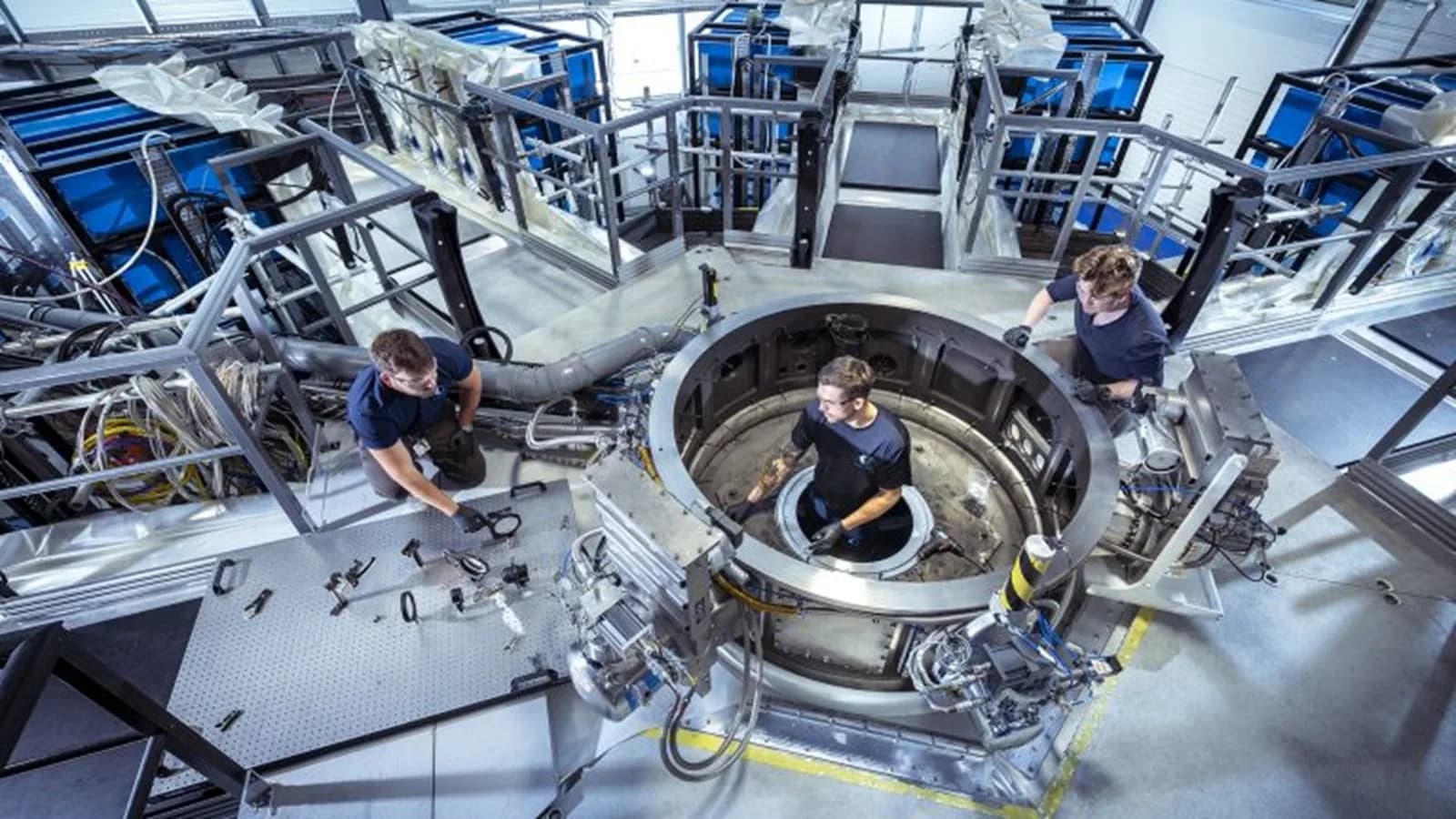
A UK-based fusion firm and one of the world’s leading laser facilities have teamed up to make nuclear fusion cheaper and more efficient by improving how powerful lasers ignite compressed fuel.
First Light Fusion, an Oxfordshire company and the UK’s only inertial confinement fusion developer, announced its effort with the Science and Technology Facilities Council’s (STFC) Central Laser Facility (CLF) on November 12. The partnership will reportedly focus on fast ignition, a process that uses short, intense laser pulses to rapidly heat dense fusion fuel and trigger a fusion reaction.
The research is part of the company’s Fusion via Low-power Assembly and Rapid Extraction (FLARE), which separates fuel compression and ignition into two stages. The first has been successfully tested at First Light Fusion’s M3 facility.
Jonathan Skidmore, PhD, the company’s chief scientist, said the first stage used a simple pulsed-power driver to compress fuel to high density. “The next phase is to rapidly heat that dense fuel,” he continued.
A new fusion method
Conventional approaches use lasers to both compress and heat fusion fuel. The FLARE concept, however, splits these processes into two separate steps. A simple pulsed power system first compresses deuterium-tritium (D-T) fuel to extremely high densities. Then, a powerful laser pulse rapidly heats the compressed fuel to initiate fusion.
Skidmore highlighted the benefits of the partnership. “The CLF has world-leading expertise in laser and plasma physics to accelerate this step,” the scientist shared. “Bringing these two phases together gives us a clear route towards integrated FLARE experiments.”
First Light and CLF will study how a short, intense laser pulse can most effectively deliver energy into the compressed fuel. Credit: First Light Fusion
According to First Light Fusion, the collaboration will study how laser-generated electrons travel through the fuel and how efficiently they transfer their energy. The goal is to show how research laboratories and private firms in the UK can combine their expertise to speed progress toward commercial fusion energy.
The researchers will also explore engineered target structures and magnetic fields to guide the electrons toward the ignition region. Their goal is to reduce the laser energy needed to trigger fusion while maintaining high energy gains.
Cheaper fusion power
FLARE aims to design the fuel target, compression, and ignition systems together. Its cylindrical design provides access to a larger area of compressed fuel, which could offer greater flexibility in developing the ignition system.
First Light Fusion has spent 15 years researching ways to advance fusion energy. Its work has covered target design, pulsed power technology, machine learning, and simulations. Meanwhile, CLF brings expertise in high-power lasers, plasma physics, and the behavior of energetic electrons.
The new collaboration will develop the rapid heating stage of FLARE. Credit: First Light Fusion
The partners will also consider engineering requirements, costs, and the ability to expand the technology for commercial use. High fusion gain could allow future power plants to generate electricity with fewer fusion cycles. It also places less demanding requirements on the driver, chamber, and fuel delivery system.
John Collier, PhD, director of STFC’s Central Laser Facility, said the effort will use CLF’s expertise in fast ignition modeling and experiments to tackle a specific technical challenge. “By working together, we can identify the most robust approaches and target the experiments that will deliver the greatest value,” he concluded in a press release.
Get the latest news delivered to your inbox.
Related articles