Ranked: 15 Popular Smartphones by Radiation Levels
Compare smartphone radiation levels across 15 popular models, ranked by maximum head SAR, from the iPhone 17 to Samsung devices.
Which Popular Smartphones Have the Highest Radiation Levels?
Key Takeaways
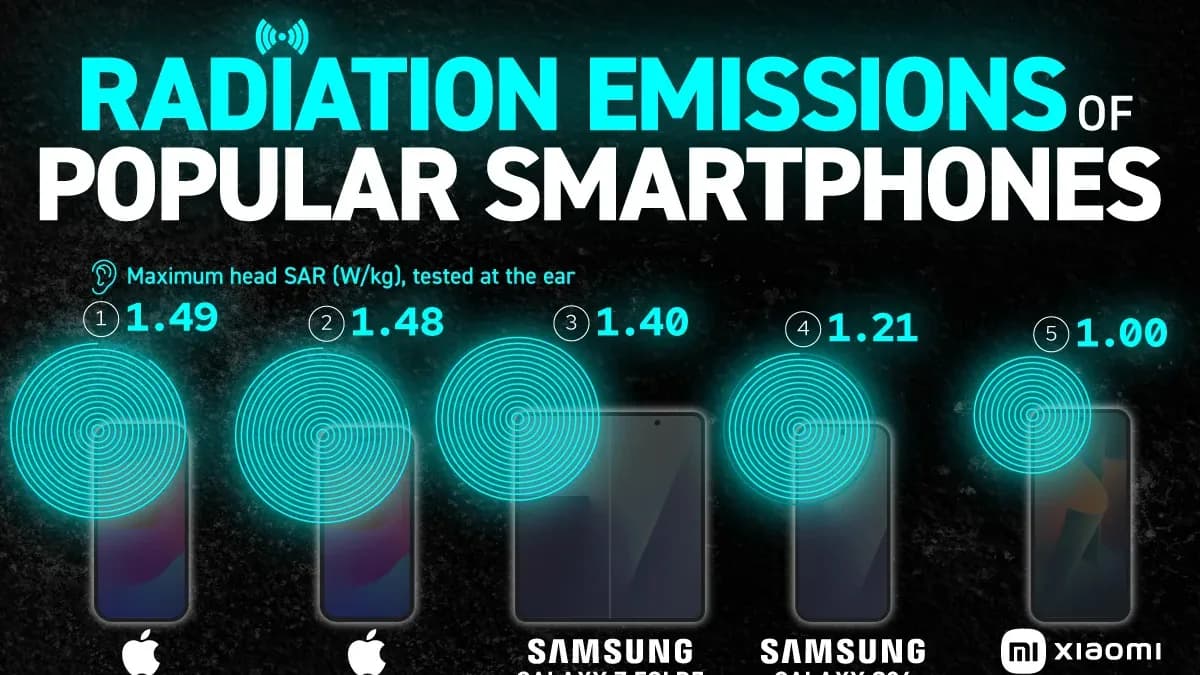
The iPhone 17 has the highest maximum head SAR among the 15 smartphones compared, at 1.49 W/kg, narrowly ahead of the iPhone 16e at 1.48 W/kg.
Samsung’s Galaxy Z Fold7 records approximately 3.7 times the maximum head SAR of its Galaxy A16 5G, showing how much measurements can vary within the same brand.
SAR measures radiofrequency energy absorption under laboratory conditions, not everyday exposure or health risk.
Every smartphone uses radiofrequency waves to communicate with cellular networks, but the amount of energy absorbed during standardized testing can vary significantly between devices.
Using data from Germany’s Federal Office for Radiation Protection (BfS), this visualization ranks 15 popular smartphones by their maximum head Specific Absorption Rate (SAR), measured in watts per kilogram (W/kg).
These measurements offer a standardized way to compare phones, but higher SAR readings do not necessarily indicate greater health risks. Smartphone radiofrequency waves are non-ionizing, unlike higher-energy radiation such as X-rays, and health authorities have not established that exposure from mobile phones within applicable safety limits causes adverse health effects.
Ranking Smartphone Radiation Levels
SAR measurements can differ depending on whether a phone is tested at the ear or near the body. The table below compares both measurements for 15 popular smartphones, ranked by their maximum head SAR values.
RankManufacturerModelHead
(W/kg, at the ear)Body
(W/kg, 0.5cm)
1AppleiPhone 171.491.49
2AppleiPhone 16e1.481.49
3SamsungGalaxy Z Fold71.401.24
4SamsungGalaxy S261.211.10
5XiaomiPoco X7 Pro1.001.00
6XiaomiXiaomi 171.000.99
7GooglePixel 90.991.40
8GooglePixel 100.991.39
9MotorolaEdge 600.951.22
10MotorolaMoto G85 5G0.911.36
11MotorolaRazr 600.841.39
12SamsungGalaxy Z Flip 70.691.21
13SamsungGalaxy A56 5G0.611.05
14SamsungGalaxy A26 5G0.410.96
15SamsungGalaxy A16 5G0.380.94
Apple occupies the top two positions, with the iPhone 17 and iPhone 16e separated by just 0.01 W/kg.
Samsung’s Galaxy Z Fold7 follows at 1.40 W/kg, ahead of the Galaxy S26 at 1.21 W/kg. At the other end of the ranking, the Galaxy A16 5G records 0.38 W/kg, the lowest reading among the 15 devices.
Head and Body Measurements Tell Different Stories
A smartphone’s position in the ranking can change depending on whether SAR is measured at the head or near the body.
Motorola’s Razr 60 ranks 11th for head SAR at 0.84 W/kg, but its body SAR of 1.39 W/kg is tied for the fourth-highest reading among the 15 devices.
Google’s Pixel 9 shows a similar pattern, with a body SAR of 1.40 W/kg compared with a head SAR of 0.99 W/kg. Apple’s iPhone 17, meanwhile, measures 1.49 W/kg in both tests.
These measurements come from different standardized testing configurations and do not represent typical daily exposure.
Why Radiation Levels Vary Across Smartphone Brands
SAR readings do not necessarily follow a consistent pattern based on brand, price, or smartphone generation.
Google’s Pixel 9 and Pixel 10 both record a maximum head SAR of 0.99 W/kg. Xiaomi’s Poco X7 Pro and Xiaomi 17 also share the same reading, at 1.00 W/kg.
Motorola’s three featured devices fall within a relatively narrow range, from 0.84 W/kg for the Razr 60 to 0.95 W/kg for the Edge 60.
Factors such as antenna design, operating frequencies, and testing conditions can influence SAR measurements. Because these readings are specific to individual devices, they cannot be used to characterize an entire smartphone brand.
Smartphones also differ in the materials and components used in their construction. Our visualization of the critical metals inside a smartphone looks at the resources used to manufacture modern mobile devices.
Does Higher Smartphone Radiation Mean Greater Health Risk?
Not necessarily. SAR measures the maximum rate at which radiofrequency energy is absorbed by tissue during standardized testing. It does not measure a person’s cumulative exposure throughout a typical day.
The amount of radiofrequency energy a phone transmits varies with signal strength and other network conditions. Keeping the phone away from your head, such as by using speakerphone or headphones, can also reduce exposure.
Unlike ionizing radiation, radiofrequency waves do not have enough energy to directly ionize atoms or damage DNA in the way that X-rays can.
According to the U.S. Food and Drug Administration, the weight of scientific evidence has not linked cellphone radiofrequency radiation with health problems. Research and safety monitoring continue.
Ultimately, these rankings compare maximum SAR measurements under laboratory conditions, not which smartphones are safer or more dangerous to use.
Learn More on the Voronoi App
If you enjoyed this visualization, check out The Percentage of Internet Users by Country on the Voronoi app.
Source: https://www.visualcapitalist.com/smartphone-radiation-emissions-ranked/
Get the latest news delivered to your inbox.
Related articles