Ranked: Countries With the Most Islands
Explore the countries with the most islands, led by Sweden, Norway, and Finland, and see how counting rules shape the rankings.
Which Countries Have the Most Islands?
Key Takeaways
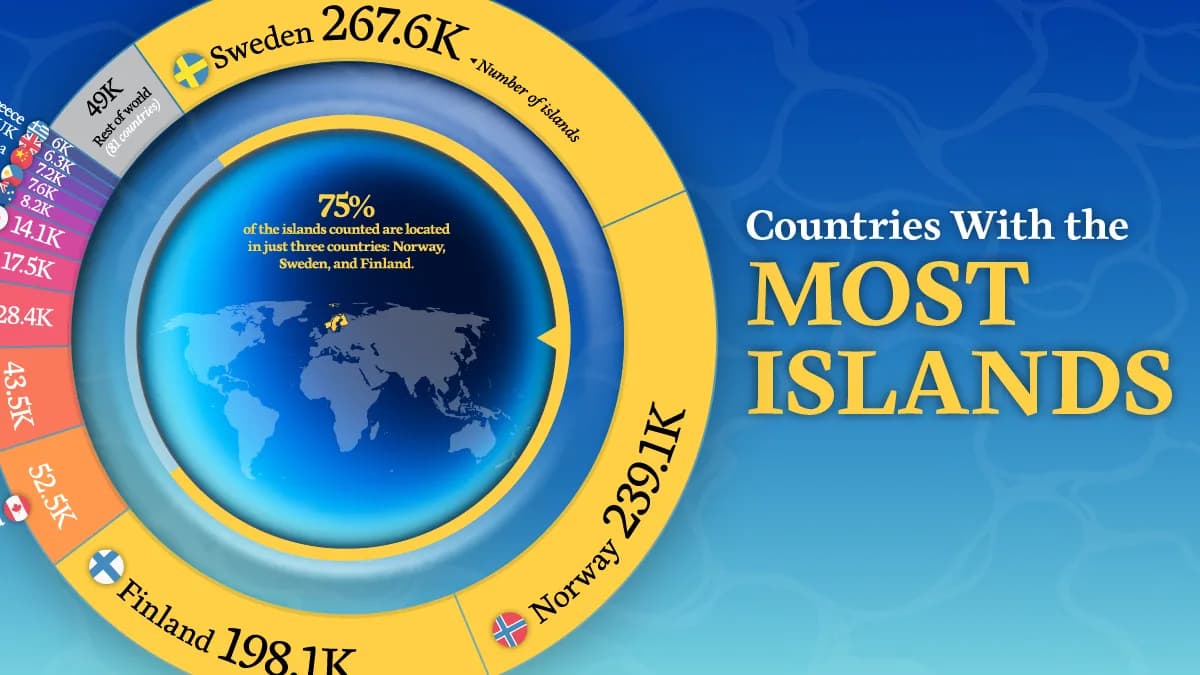
Sweden, Norway, and Finland account for nearly 75% of the islands counted in this dataset, with a combined 704,773 islands.
Island counts are not directly comparable because countries use different definitions, minimum sizes, and rules for including inland islands.
Islands cover just 5% of Earth’s land area but host an estimated 20% of its bird, reptile, and plant species.
Indonesia and the Philippines are famous for their sprawling tropical archipelagos, but neither tops the list of countries with the most islands.
Instead, Northern Europe dominates the ranking, thanks in part to its intricate coastlines, extensive lake systems, and countless small rocky islands.
This infographic ranks countries by their reported number of islands, using data from national statistical and mapping agencies compiled in Wikipedia’s list of countries by number of islands.
In total, the dataset covers 945,247 islands, although differing national definitions mean this is not a standardized worldwide census.
Three Nordic Countries Account for Nearly 75% of Islands
Sweden ranks first with 267,570 islands, followed by Norway with 239,057 and Finland with 198,146. Together, they account for 704,773 islands, or 74.6% of the total recorded in this ranking.
CountryNumber of islandsShare of all Islands
Sweden267,57028.31%
Norway239,05725.29%
Finland198,14620.96%
Canada52,4555.55%
Chile43,4714.60%
United States28,4493.01%
Indonesia17,5081.85%
Japan14,1251.49%
Australia8,2220.87%
Philippines7,6410.81%
China7,2260.76%
United Kingdom6,3460.67%
Greece6,0000.63%
Cuba4,1950.44%
Laos4,0000.42%
North Korea3,5790.38%
South Korea3,3580.36%
Vietnam3,0000.32%
Estonia2,3550.25%
Iceland2,0000.21%
France1,9000.20%
Thailand1,4300.15%
India1,3820.15%
Mexico1,3560.14%
Russia1,3380.14%
Saudi Arabia1,2850.14%
Croatia1,2460.13%
Brazil1,2000.13%
Maldives1,1920.13%
Egypt1,0480.11%
Solomon Islands9920.10%
Malaysia8780.09%
Italy8080.09%
Bahamas7000.07%
Bangladesh7000.07%
Venezuela6500.07%
Micronesia6070.06%
New Zealand6000.06%
Papua New Guinea6000.06%
Ireland5000.05%
Türkiye5000.05%
Belize4500.05%
Iran4270.05%
Denmark4060.04%
Guyana3650.04%
Fiji3300.03%
Madagascar2500.03%
Algeria2400.03%
Peru2330.02%
Poland2030.02%
Palau2000.02%
Spain1790.02%
Tonga1690.02%
Taiwan1680.02%
Argentina1520.02%
Somalia1400.01%
Costa Rica1200.01%
Bulgaria1170.01%
Seychelles1150.01%
Honduras1020.01%
Portugal1020.01%
Sri Lanka1000.01%
Guinea-Bissau880.01%
Uganda840.01%
Vanuatu830.01%
Colombia740.01%
Cambodia710.01%
Singapore640.01%
Haiti590.01%
Antigua and Barbuda540.01%
Mauritius500.01%
Senegal35
Serbia35
Marshall Islands34
Netherlands34
Brunei33
Kiribati33
Saint Vincent and the Grenadines32
North Macedonia30
Malta21
Sudan20
Sierra Leone19
Azerbaijan16
Cape Verde15
Albania14
Lebanon12
Pakistan12
Samoa12
Tuvalu9
Equatorial Guinea8
Syria5
Barbados4
Dominica3
Nauru1
Total:945,247100%
Scandinavia’s extraordinary island counts are partly the result of its glacial history. During the last Ice Age, glaciers carved and reshaped the landscape, leaving behind countless rocky outcrops, shallow coastal waters, and lake systems as the ice retreated.
Sweden’s Stockholm Archipelago, for example, stretches into the Baltic Sea and contains roughly 30,000 islands, islets, and skerries.
Nearby, Finland’s Archipelago Sea contains tens of thousands of islands, while Norway’s Øygarden Islands, west of Bergen, form a coastal landscape of rocky islands separated by narrow channels.
Canada and Chile Lead Outside Northern Europe
Canada ranks fourth with 52,455 islands, followed by Chile at 43,471 and the United States at 28,449.
Canada’s reported total refers to coastal islands, excluding the country’s extensive freshwater island geography.
One of its largest island concentrations is the Canadian Arctic Archipelago, which comprises more than 36,000 islands, including Baffin Island, one of the world’s largest.
Farther south, the Alexander Archipelago in southeastern Alaska comprises roughly 1,100 named islands, including Prince of Wales Island and Admiralty Island.
The region is known for its rugged coastline, temperate rainforests, and diverse marine ecosystems.
Meanwhile, Georgian Bay, part of Lake Huron in Ontario, is home to more than 30,000 freshwater islands. This illustrates how Canada’s total island count could be substantially higher under a definition that includes inland islands.
Farther down the ranking, Indonesia has 17,508 islands, followed by Japan with 14,125 and the Philippines with 7,641.
Why Island Counts Aren’t Directly Comparable
One reason Sweden and Norway rank so highly is that even extremely small islands can qualify. Sweden’s mapping approach recognizes islands as small as 9 square meters, while Norway counts islands around 10 square meters or larger. Both include inland islands.
Japan’s 14,125 figure, meanwhile, is based on naturally formed landmasses with a circumference of at least 100 meters, excluding artificial islands. The count also excludes islands in lakes and rivers, illustrating how different mapping criteria can shape a country’s position in the ranking.
Croatia offers another example: its total of 1,246 combines 79 islands, 525 islets, and 642 rocks or rocks awash, according to research published in Geoadria.
Why Are Islands Important?
Despite covering just 5% of Earth’s land area, islands are home to an estimated 20% of the world’s bird, reptile, and plant species.
Their geographic isolation allows unique species to evolve, often producing plants and animals found nowhere else. A 2024 study published in Nature found that 21% of the world’s vascular plant species are endemic to islands.
Beyond biodiversity, islands provide important nesting grounds for seabirds and serve as resting points along migration routes.
They are also home to more than 600 million people, supporting distinct cultures and livelihoods closely tied to local ecosystems.
Learn More on the Voronoi App
To learn more about this topic, check out this graphic on the countries with the most freshwater.
Get the latest news delivered to your inbox.
Related articles