Ranked: Countries With the Most Languages
From Papua New Guinea to the U.S., discover which countries have the most living languages and the surprising differences between them.
This story was prepared automatically by software.
Which Countries Speak the Most Languages?
Key Takeaways
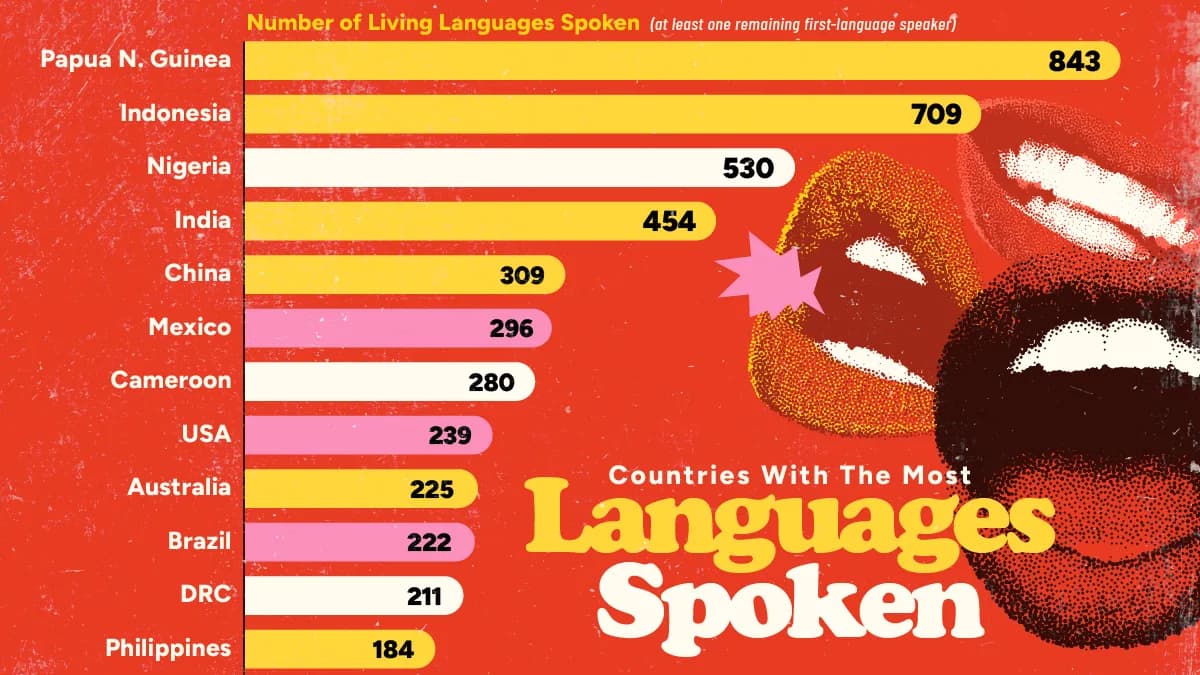
Papua New Guinea leads globally with 843 living languages, more than India and China combined.
Indonesia and Nigeria rank second and third, ahead of far more populous countries.
The U.S. ranks eighth with 239 living languages, reflecting its Indigenous linguistic heritage and established language communities.
Some of the world’s greatest linguistic diversity is found in tropical regions, where geography, climate, and thousands of years of settlement have helped distinct languages develop and survive.
Using data from SIL International via Our World in Data, this graphic ranks countries by their number of living languages in 2025. The figures include languages with at least one remaining first-language speaker.
The Countries With the Most Spoken Languages
The table below ranks the 25 countries with the most living languages in 2025.
RankCountryNumber of Living Languages (2025)
1 Papua New Guinea843
2 Indonesia709
3 Nigeria530
4 India454
5 China309
6 Mexico296
7 Cameroon280
8 U.S.239
9 Australia225
10 Brazil222
11 DR Congo211
12 Philippines184
13 Malaysia133
14 Chad129
15 Tanzania127
16 Myanmar125
17 Nepal123
18 Russia119
19 Vietnam111
20 Vanuatu107
21 Canada101
22 Peru95
23 Ethiopia92
24 Colombia89
25 Cote d'Ivoire88
Indonesia ranks second with 709 living languages, followed by Nigeria with 530. Together with Papua New Guinea, these three countries account for more than 2,000 living languages.
Geographic size is no guarantee of linguistic diversity. Russia and Canada, the world’s two largest countries by land area, have 119 and 101 living languages, respectively. Vanuatu, a small Pacific island nation, has more living languages than Canada, with 107.
How Climate Shapes Language Diversity
Research suggests that tropical climates help explain why many of the most language-rich countries lie near the equator. Where food and natural resources are available year-round, smaller communities can sustain themselves locally, allowing distinct languages to persist over generations.
Geography and migration have also shaped linguistic diversity. Mountains, forests, and islands have historically separated communities, allowing distinct languages to develop. In the U.S., Indigenous heritage and established migrant communities contribute to its linguistic diversity.
Yet this diversity is under threat. Research estimates that around 1,500 languages could disappear by 2100, putting generations of cultural knowledge, oral traditions, and local history at risk.
Learn More on the Voronoi App
To learn more about this topic, check out this graphic on the world’s most spoken languages by total speakers.
Related articles