Ranked: The 10 Largest Populations of Each Major Religion
India holds nearly 95% of the world's Hindus and Asia leads Islam, while Christianity spans five continents. See the top 10 countries for each major religion.
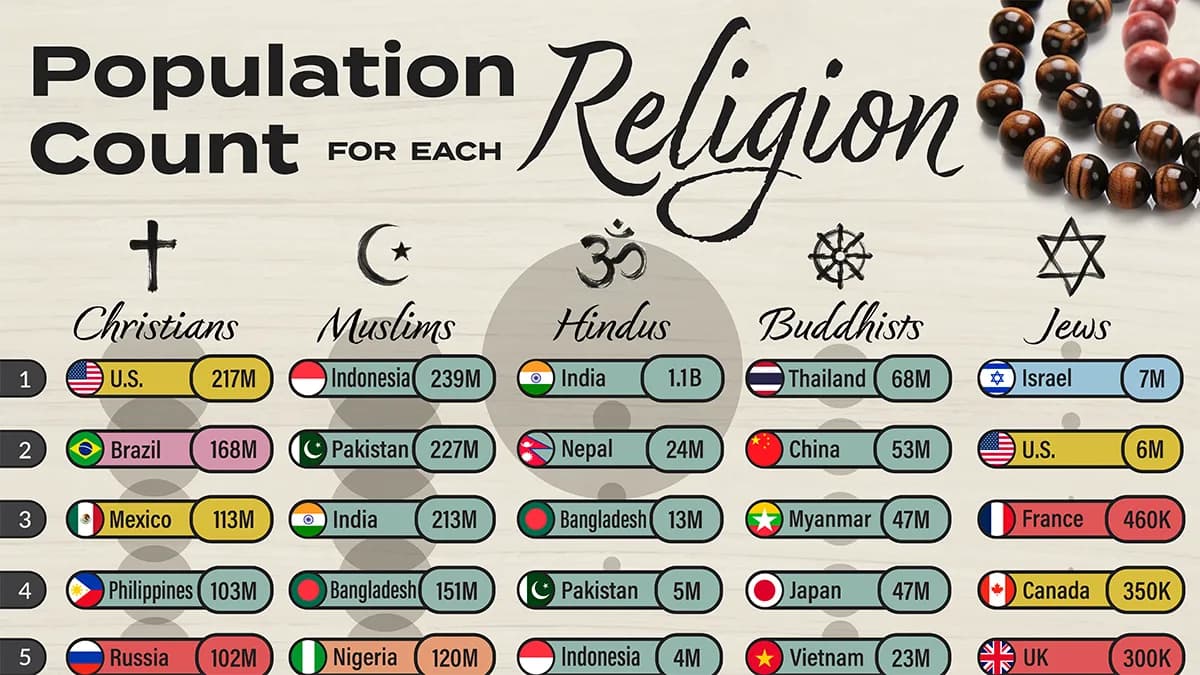
Where the World’s Major Religious Populations Live
Key Takeaways
The world’s four largest Muslim populations are in South and Southeast Asia, accounting for 41% of all Muslims.
India is home to nearly 95% of the world’s Hindus, while Israel and the United States together account for 85% of the world’s Jews.
Christianity is the most geographically dispersed of the five religions, with less than half of its followers living in its 10 highest-ranking countries.
Nearly three-quarters of humanity identifies with one of five major religions. Yet some of the largest religious populations are found in countries far from a faith’s birthplace or where its followers are a minority.
This graphic ranks the 10 countries with the largest populations of Christians, Muslims, Hindus, Buddhists, and Jews in 2020, using estimates from the Pew Research Center covering people of all ages.
Asia Leads Islam While Africa Reshapes Christianity
Although Islam is often associated with the Middle East, its largest populations are in Indonesia (239 million), Pakistan (227 million), India (213 million), and Bangladesh (151 million).
Together, these four countries are home to 830 million Muslims, roughly 40% more than the entire Middle East and North Africa combined (585 million). Meanwhile, Saudi Arabia, the birthplace of Islam, ranks 17th globally with 29 million Muslims.
The table below ranks the 10 countries with the largest Christian and Muslim populations in 2020 (in millions):
RankChristiansMuslims
CountryMillionsCountryMillions
1 U.S.217.3 Indonesia239.0
2 Brazil168.3 Pakistan226.9
3 Mexico113.1 India213.1
4 Philippines102.5 Bangladesh151.4
5 Russia102.4 Nigeria120.0
6 Nigeria92.8 Egypt104.0
7 DR Congo92.4 Iran87.5
8 Ethiopia73.2 Turkey83.6
9 South Africa51.6 Sudan46.3
10 Italy48.2 Algeria43.3
The following table shows the equivalent rankings for Hinduism, Buddhism, and Judaism:
RankHindusBuddhistsJews
CountryMillionsCountryMillionsCountryMillions
1 India1,113.2 Thailand67.6 Israel6.78
2 Nepal23.5 China53.4 U.S.5.73
3 Bangladesh13.1 Myanmar47.2 France0.46
4 Pakistan5.0 Japan47.0 Canada0.35
5 Indonesia4.4 Vietnam22.6 UK0.30
6 Sri Lanka3.3 Cambodia16.2 Argentina0.17
7 U.S.3.0 Sri Lanka15.7 Russia0.12
8 Malaysia2.1 South Korea9.9 Germany0.12
9 UK1.1 India9.5 Australia0.11
10 UAE1.1 Malaysia6.4 Brazil0.09
Rapid population growth is also shifting the geographic distribution of Christianity and Islam toward sub-Saharan Africa. Between 2010 and 2020, the region’s Christian population grew 31% to 697 million, surpassing Europe’s 505 million as religious disaffiliation reduced Christian populations across Europe and North America.
Four African nations rank among the top 10 for Christianity: Nigeria, the Democratic Republic of the Congo, Ethiopia, and South Africa. Their combined Christian population of 310 million is more than double that of the two European entries, Russia and Italy.
Over the same decade, sub-Saharan Africa’s Muslim population grew 34% to 369 million. Nigeria ranks fifth globally for Muslims (120 million) and sixth for Christians (93 million), making it the only country in the top 10 for both faiths.
Hinduism and Judaism Are Highly Concentrated
India’s 1.1 billion Hindus outnumber those in second-ranked Nepal by a factor of 47. Fewer than 9 million Hindus live outside the top 10 countries.
Judaism is similarly concentrated across two nations. Israel (6.8 million) and the United States (5.7 million) are home to the vast majority of the world’s 14.8 million Jews. Third-ranked France has just 460,000, less than one-twelfth of the U.S. total.
The table below compares each religion’s global population, highest-ranking country, and geographic concentration in 2020:
MetricChristiansMuslimsHindusBuddhistsJews
Global Population (Millions)2,268.92,022.61,177.9324.214.8
Largest Country U.S. Indonesia India Thailand Israel
Top Country Share (%)9.611.894.520.945.9
Top 10 Share (%)46.865.099.391.296.3
Buddhism is concentrated within a single region rather than a single country. All 10 of its largest populations are in Asia, accounting for 91% of the world’s Buddhists. Thailand leads with 68 million, ahead of China (53 million), despite having a much smaller overall population.
Christianity sits at the opposite extreme. The United States leads with 217 million Christians, followed by Brazil with 168 million. Yet even the U.S. accounts for less than a tenth of the global Christian population.
Relatively low rates of international migration help keep Hinduism concentrated in South Asia. Only 13 million Hindus live outside their country of birth, accounting for 5% of international migrants compared with 15% of the world’s population.
Where Major Religions Rank High as Minorities
Many of the countries featured in these rankings are home to large religious minorities, offering a different perspective from mapping the largest religion in each country.
India has the world’s third-largest Muslim population even though Muslims make up just 15% of its residents. Meanwhile, Hindus are a minority in eight of the 10 countries with the largest Hindu populations.
Beyond South and Southeast Asia, immigration has helped three countries enter the Hindu top 10: the U.S. (3.0 million), the UK (1.1 million), and the UAE (1.1 million). In the U.S., 2.6 million Hindus are foreign-born, arriving mainly for work and family reunification. In the UAE, roughly 1.1 million Hindu migrants, mostly temporary workers, account for nearly all of the country’s Hindus and 12% of its total population.
Buddhists are a minority in six of their top 10 countries, including second-ranked China, where only 3.7% of residents formally identify as Buddhist. Pew notes that surveys asking about formal religious affiliation in East Asia may overlook many people who follow Buddhist or folk traditions without formally identifying with a religion.
Israel, where 77% of residents are Jewish, is the only country with a Jewish majority. In every other top-10 country, Jews make up less than 2% of the population. This includes the U.S. (1.7%), where Pew counts 5.7 million people who identify with Judaism as a religion, compared with 7.5 million under its broader cultural definition.
Across all five religions, only two countries appear in three of the top-10 rankings: India (Hindus, Muslims, and Buddhists) and the United States (Christians, Jews, and Hindus).
Learn More on the Voronoi App
If you enjoyed today’s post, check out Religious Diversity Around the World on Voronoi.
Source: https://www.visualcapitalist.com/ranked-top-10-countries-population-each-major-religion/
Get the latest news delivered to your inbox.
Related articles